
Couples Chemistry Quiz
How the Scales are Structured
Who Usually Takes This Test?
See How You Compare
Below is a preview of how scores are typically distributed across each scale.
Example Questions From the Test
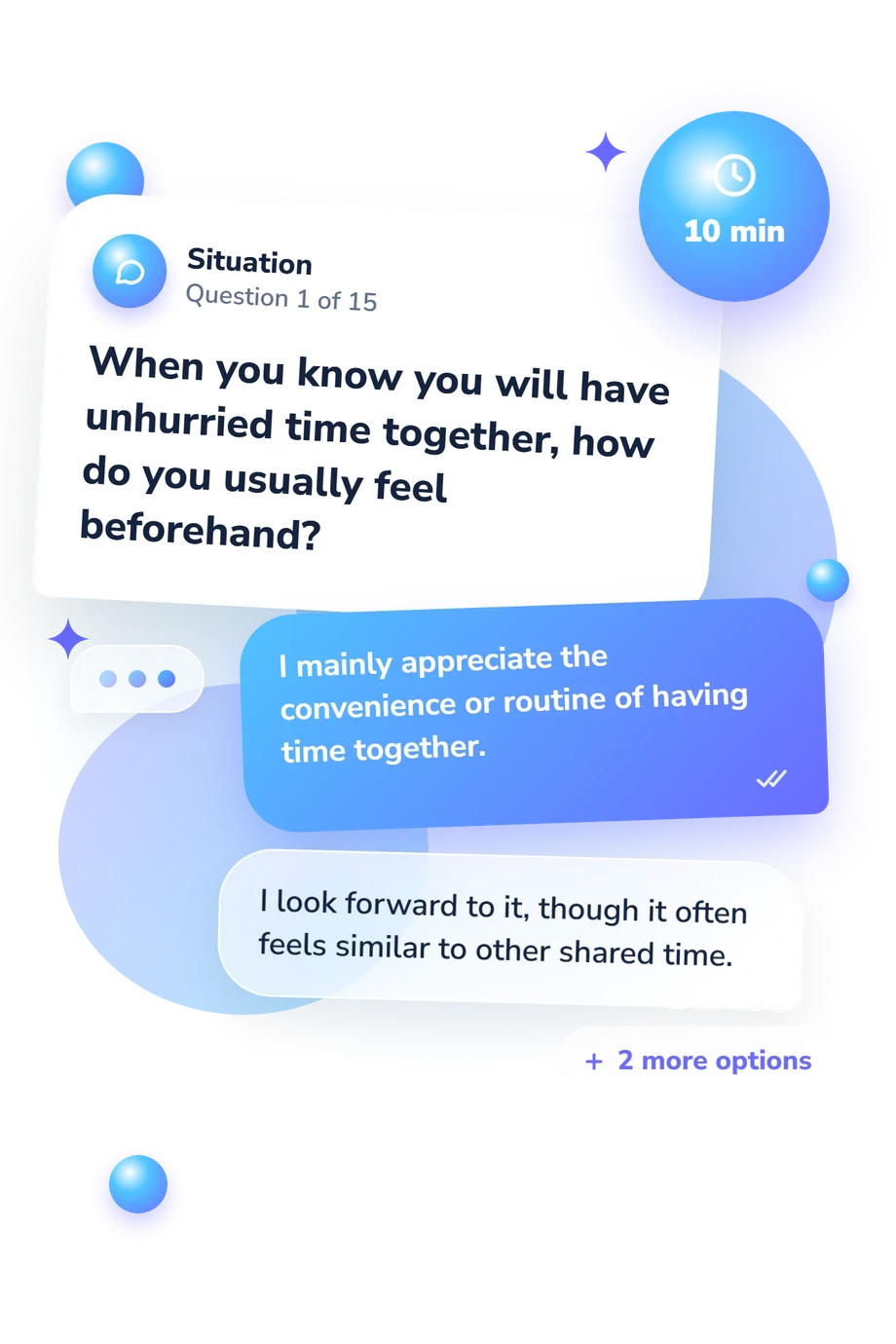
- I mainly appreciate the convenience or routine of having time together.
- I look forward to it, though it often feels similar to other shared time.
- I feel a noticeable sense of anticipation on many occasions.
- I often feel excited and drawn toward the particular energy we create together.
- We quickly invent something fun, affectionate, or slightly adventurous to do together.
- We usually choose a shared activity that both of us enjoy.
- We spend some of the evening together and some on separate interests.
- We generally continue with our individual routines and enjoy the extra space.
- We usually share what happened and feel emotionally understood by each other.
- We talk about the main issue, though deeper feelings may stay unspoken.
- We exchange practical updates and then unwind in our own ways.
- We generally prefer to process difficult days separately and reconnect later.
Couples Chemistry Quiz - Description and methodology of the test
Partners deciding whether this relationship chemistry quiz fits their conversation can first notice ease, friction, playfulness, and everyday teamwork in their relationship. The couples chemistry quiz helps them consider whether to take a closer look without treating the result as a verdict. It turns the question of whether there is chemistry between us into discussion points about current patterns.
What This Assessment Explores
Chemistry here means a pattern of felt energy, emotional access, and coordination, not a verdict about love or durability. Items cover shared time, affection, humor, vulnerable conversations, mood awareness, decisions, responsibilities, and differing needs for closeness or independence. This questionnaire describes a current relationship pattern, not fixed traits; it is a couples chemistry test for observing how partners interact.
These are the three result dimensions:
- Attraction and Playfulness (0-15) reflects affectionate energy, anticipation, humor, flirtation, and shared novelty; Quiet spark (0-5), Intermittent spark (6-10), and Lively spark (11-15) are its displayed bands.
- Emotional Connection (0-15) reflects emotional understanding, curiosity, and openness; Separate inner worlds (0-5), Growing attunement (6-10), and Strong attunement (11-15) describe its bands.
- Partnership Rhythm (0-15) reflects fit in pacing, decisions, responsibilities, and preferences; Independent rhythms (0-5), Flexible rhythm (6-10), and Natural rhythm (11-15) describe its bands.
Methodology and Scientific Basis
Each item presents a relationship situation with four response options. The choices describe different degrees or forms of anticipation, openness, playfulness, responsiveness, or coordination. The questionnaire does not specify how each response contributes to the three scale totals, so its three displayed scales should be interpreted descriptively rather than reverse-engineered into a scoring formula.
Prototype analysis treats the construct as multidimensional rather than attraction alone. The questionnaire has conceptual parallels with Harel and Koslowsky's Relational Behavior Interactions Scale, Malouff and colleagues' Four-Factor Romantic Relationship Scales, and Laurenceau, Barrett, and Pietromonaco's interpersonal process model of intimacy. Those instruments and models do not standardize or validate the questionnaire; they simply offer conceptual comparisons for its domains.
Interpretation follows the displayed definitions: a higher result indicates more of the named tendency in the situations covered, not a better relationship. Chemistry can shift, so this result from an is there chemistry between us quiz captures a moment. Self-report also makes current context and self-awareness relevant, so these reflective, non-diagnostic descriptions are not population norms or predictions about longevity.
- Liepmann, A., Tu, E., & Muise, A. (2025). A Content Analysis of Lay Definitions of Romantic Chemistry. Archives of Sexual Behavior, 54(3), 943-956. 10.1007/s10508-025-03105-6
- Harel, T., & Koslowsky, M. (2024). Development and validation of the relational behavior interactions scale for couples. Scientific Reports, 14(1), Article 8086. 10.1038/s41598-024-58901-2
- Malouff, J. M., Coulter, K., Receveur, H., Martin, K., James, P., Gilbert, S. J., Schutte, N., Hall, L. E., & Elkowitz, J. M. (2012). Development and Initial Validation of the Four-Factor Romantic Relationship Scales. Current Psychology, 31(4), 349-364. 10.1007/s12144-012-9156-z
- Laurenceau, J.-P., Barrett, L. F., & Pietromonaco, P. R. (1998). Intimacy as an interpersonal process: The importance of self-disclosure, partner disclosure, and perceived partner responsiveness in interpersonal exchanges. Journal of Personality and Social Psychology, 74(5), 1238-1251. 10.1037/0022-3514.74.5.1238
Updated: