
College Algebra Quiz
How the Scales are Structured
Who Usually Takes This Test?
See How You Compare
Below is a preview of how scores are typically distributed across each scale.
Example Questions From the Test
- Real part 1 with imaginary coefficient negative one
- Real part 5 with imaginary coefficient negative one
- Real part 5 with imaginary coefficient positive one
- Real part 3 with imaginary coefficient negative two
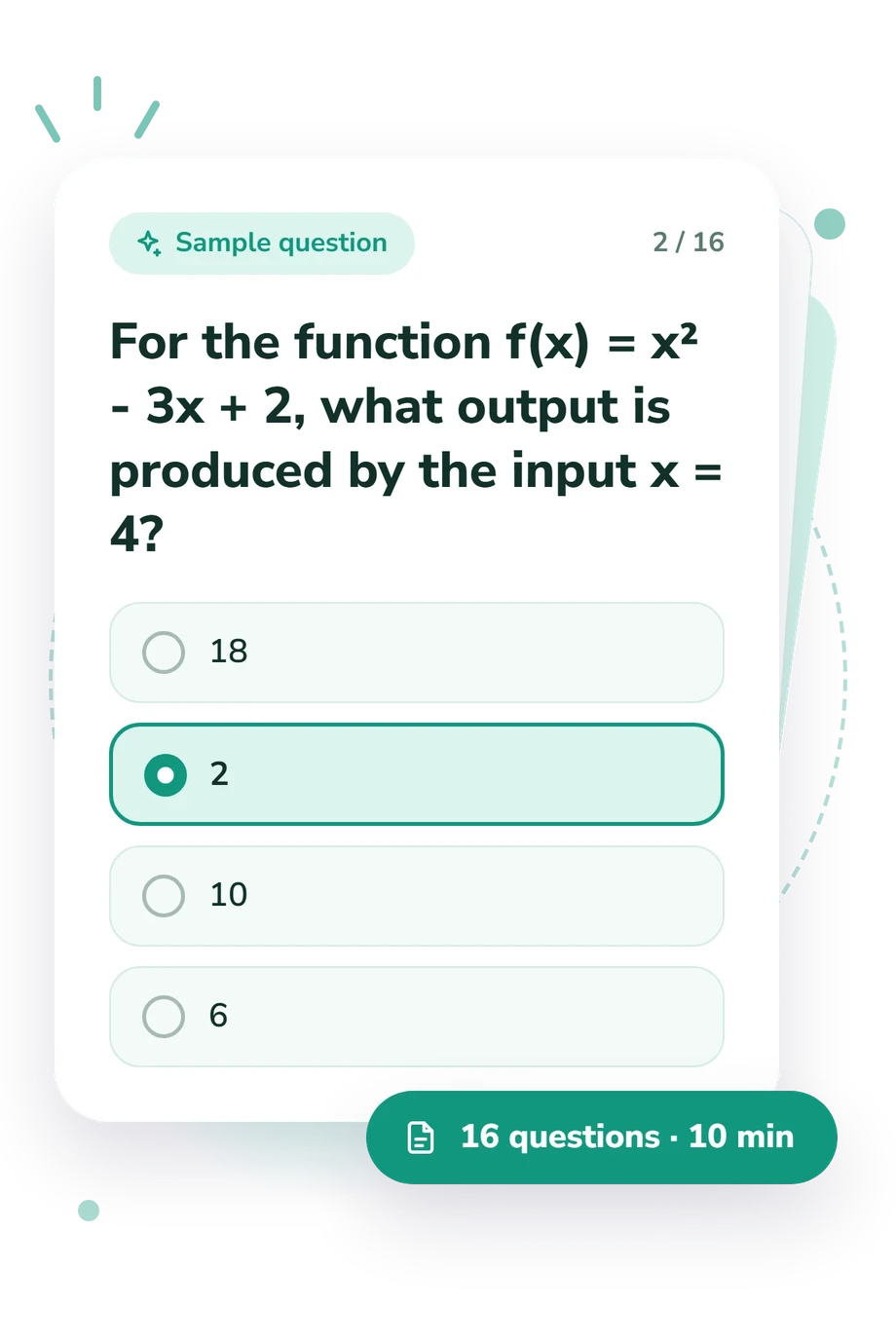
- 18
- 2
- 10
- 6
- x to the fifth power divided by y to the fourth power
- x to the sixth power divided by y to the fourth power
- x to the sixth power multiplied by y to the fourth power
- x to the sixth power divided by y to the second power
College Algebra Quiz - Description and methodology of the test
Students checking readiness for further coursework can use this college algebra quiz to identify skills that deserve attention. It suits learners reviewing core material, instructors wanting an informal snapshot, and anyone planning focused practice. The result offers a starting point for study and can complement a college algebra study guide by indicating whether to revisit foundations or move toward applications.
What This Assessment Explores
This college algebra practice quiz examines how well learners use central algebra ideas in calculations and interpretations. It is intended for people reviewing coursework or deciding what to practise next.
The sampled dimensions are:
- Symbolic reasoning shows how accurately you handle complex numbers, exponents, radicals, logarithms, and polynomial remainders.
- Functions and graphs indicate whether you can evaluate, compose, transform, and identify domain restrictions.
- Equations, inequalities, systems, and models reveal how well you solve relationships and translate practical situations into algebra.
Results appear on College Algebra Knowledge (0-16): Foundations to reinforce (0-6) points to review of notation, equation solving, and function operations; Developing knowledge (7-12) suggests targeted practice with multi-step applications; Strong knowledge (13-16) indicates solid command of the sampled concepts. The result is a snapshot of these topics, not a complete profile of college algebra ability.
Methodology and Scientific Basis
Each item presents four answer choices and asks for the option that best completes a calculation, interpretation, or model. The format combines direct operations with multi-step reasoning.
As a college algebra assessment, this questionnaire reports performance on the quiz itself. The displayed score is not a formal placement result, and no separate weighting rule should be inferred beyond the reported scale. The score summarizes performance on the 16 items and samples symbolic manipulation, functions, equations, inequalities, systems, and models.
APCR-CC (Peralta et al., 2020) is the closest published comparison: its algebra and precalculus readiness constructs are conceptually consistent with the domains sampled here. This questionnaire is not presented as an adaptation of APCR-CC. Lial et al. and Abramson support the represented content through textbook treatments, not validation of this online version.
No standardization, norm group, reliability estimate, or placement validity is established for this questionnaire. Results may vary with recent study, test-taking conditions, and the particular skills selected. The bands work best as study signals: lower performance supports foundational review, middle performance points to targeted multi-step practice, and higher performance supports continued progression. A single score cannot capture every form of algebraic reasoning.
- Yadira Peralta, Nidhi Kohli, April Strom, Irene Duranczyk, Vilma Mesa, and Laura Watkins. "A Psychometric Analysis of the Algebra and Precalculus Concept Readiness Assessment for Community Colleges." Journal of Psychoeducational Assessment, vol. 38, no. 3, 2020, pp. 321-336. 10.1177/0734282919846019
- Margaret L. Lial, John Hornsby, David I. Schneider, and Callie J. Daniels. College Algebra. 13th ed., Pearson, 2021.
- Jay Abramson. College Algebra 2e. OpenStax, Rice University, 2021.
Updated: