
Close Up Food Quiz
How the Scales are Structured
Who Usually Takes This Test?
See How You Compare
Below is a preview of how scores are typically distributed across each scale.
Example Questions From the Test
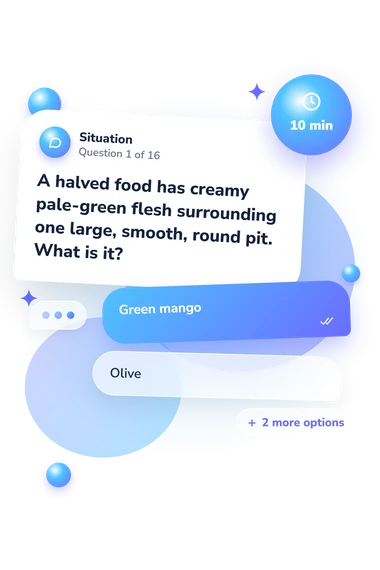
- Green mango
- Olive
- Green plum
- Avocado
- Broccoli
- Asparagus
- Artichoke
- Green cabbage
- Green grape
- Kiwi
- Gooseberry
- Honeydew melon
Close Up Food Quiz - Description and methodology of the test
People who enjoy noticing ingredients, cooking details, and small visual differences can use the Close Up Food Quiz to examine how they recognize foods from partial views. It functions as a food recognition test for curious learners, home cooks, and anyone practising careful observation. The result provides a focused snapshot of visual food knowledge, showing how familiar structures and preparation clues guide identification.
What This Assessment Explores
The questions ask you to identify ingredients from close or partial views rather than a complete presentation. Pits, seeds, membranes, rings, grains, layers, colour, and texture become evidence that must be connected with a likely food. This makes the activity a visual food identification test focused on perceptual detail and everyday food knowledge.
The result uses one overall scale, Close-Up Food Knowledge (0-16), summarizing performance across varied ingredients. Emerging Observer (0-6) indicates reliance on broad shapes, labels, or context; Developing Detective (7-12) indicates growing use of texture, structure, and cooking clues; Sharp Food Spotter (13-16) indicates consistent identification from small visual and structural details.
The item themes show what the score draws on:
- Fruits and vegetables require attention to pits, seeds, membranes, rings, buds, and cloves.
- Grains, spices, kernels, fish, and cheese are identified through shape, colour, layering, fat lines, or elasticity.
- Pastries and sweet foods use lamination, snap, interior texture, and surface structure.
Methodology and Scientific Basis
Each question presents a visual or descriptive clue with four answer options. To choose close-up food quiz answers, you weigh structure, colour, texture, preparation, or internal arrangement; the clues point to specific features rather than a complete dish. Performance is combined into one displayed total; no category scores are shown.
The closest evidence concerns visual recognition. Gauthier and Fiestan (2023) linked recognition of prepared foods with visual ability beyond broader factors. Smithson, Lin, and Gauthier (2026) examined food-specific recognition through proximity judgments, while Shutts, Condry, Santos, and Spelke (2009) discussed how food knowledge develops and where it has limits. This questionnaire is conceptually consistent with that work, but it was not adapted from or validated by those studies.
Interpret the total as a snapshot of performance on this item set. Population norms, reliability, and clinical validation are not established for this questionnaire; its bands are descriptive categories rather than clinical thresholds. Familiarity with ingredients, cultural exposure, vocabulary, attention, and context can influence answers, so the result reflects recognition and circumstances of completion.
- Gauthier, Isabel, and Giselle Fiestan. "Food neophobia predicts visual ability in the recognition of prepared food, beyond domain-general factors." Food Quality and Preference 103 (2023): 104702. 10.1016/j.foodqual.2022.104702
- Smithson, Conor J. R., Yiming Lin, and Isabel Gauthier. "Using scene proximity judgments to study food-specific recognition ability." Psychonomic Bulletin & Review 33, no. 3 (2026): 59. 10.3758/s13423-025-02845-9
- Shutts, Kristin, Kirsten F. Condry, Laurie R. Santos, and Elizabeth S. Spelke. "Core knowledge and its limits: the domain of food." Cognition 112, no. 1 (2009): 120-140. 10.1016/j.cognition.2009.03.005
Updated: