
Childhood Autism Rating Scale (CARS) Test
How the Scales are Structured
Who Usually Takes This Test?
See How You Compare
Below is a preview of how scores are typically distributed across each scale.
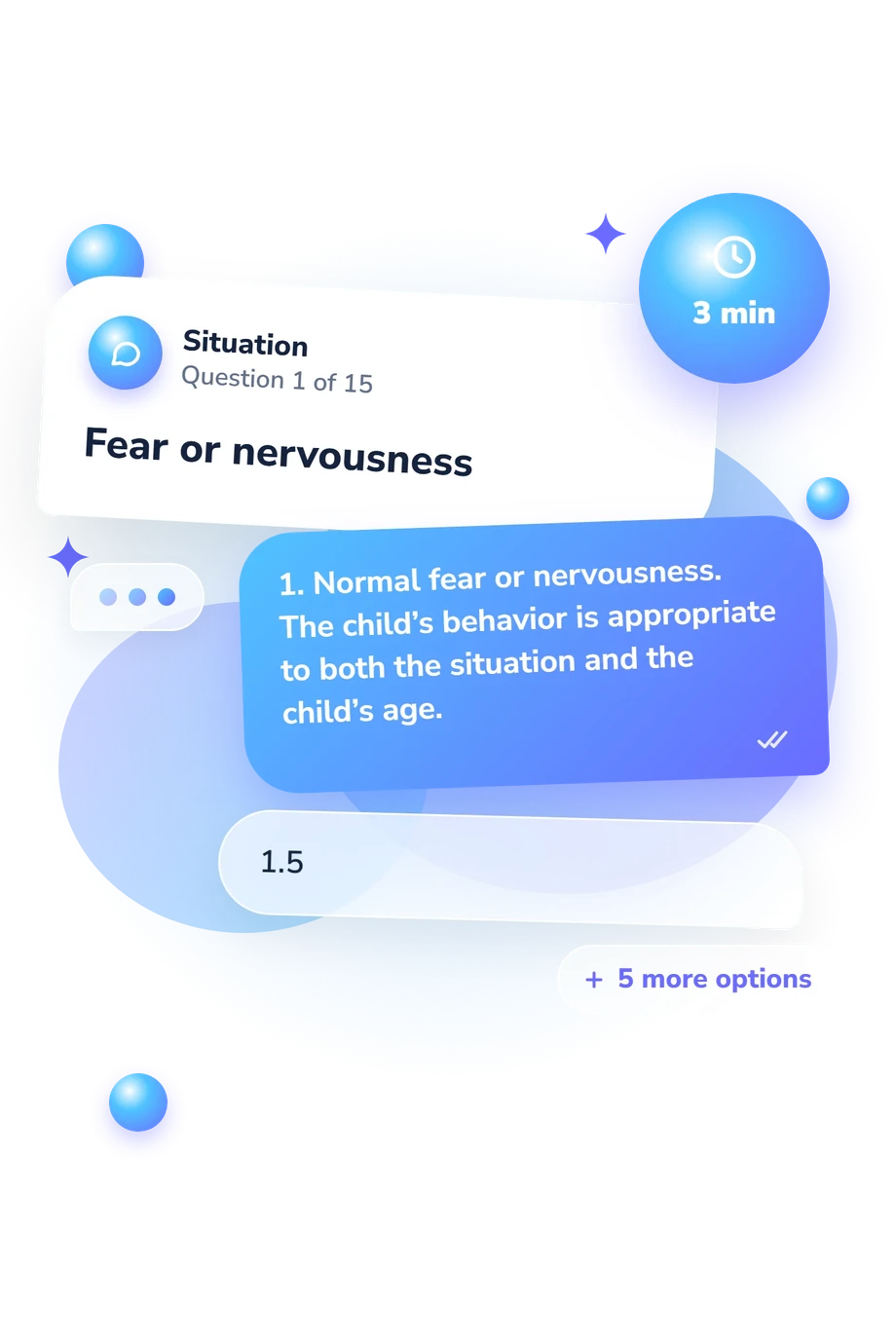
Example Questions From the Test
- No evidence of difficulty relating to people. The child’s behavior is appropriate for age. Some shyness, fussiness, or anxiety may be seen when the child is asked to do something, but it is not atypical.
- 5
- Mildly abnormal relationships. The child may avoid the adult’s eye contact, avoid the adult, or become distressed if interaction is imposed; may be excessively shy, may not respond to the adult in the usual way, or may be more dependent on the adult than children of the same age (may be “clingy”).
- 5
- Moderately abnormal relationships. The child shows aloofness (at times seems unaware of the adult). Sometimes strong and persistent efforts are needed to get the child’s attention. The child initiates contact to a minimal degree.
- 5
- Severely abnormal relationships. The child is completely aloof or unaware of what the adult is doing. He or she almost never responds to or initiates contact with an adult. Only very persistent attempts may gain any response and get the child’s attention.
- Imitation is age-appropriate. The child can imitate sounds, words, and movements that match their level of skill development.
- 5
- Mild impairment in imitation. Most of the time, the child imitates simple behaviors such as clapping or individual speech sounds; occasionally imitates only after some prompting from an adult or after a delay.
- 5
- Moderate impairment in imitation. The child imitates only some of the time, or requires a considerable degree of persistence and assistance from an adult; often imitates only after a delay.
- 5
- Severe impairment in imitation. The child almost never imitates sounds, words, or movements, even with help or support.
- Emotional response is age-appropriate and appropriate to the situation. The child shows the appropriate type and degree of emotional response, reflected in changes in facial expression, posture, or behavior.
- 5
- Emotional response is mildly abnormal. The child unexpectedly shows an emotional response that is inappropriate in type or intensity. At times, the child’s reactions are unrelated to objects or events occurring around them.
- 5
- Emotional response is moderately abnormal. The child shows definite signs of an emotional response that is inappropriate in type or degree. Reactions may be delayed or excessive and unrelated to the situation; the child may grimace, laugh, or show rigidity without showing any emotion toward objects or events.
- 5
- Emotional response is severely abnormal. Responses rarely fit the situation; if the child is in a particular mood, it is very difficult to change that mood. Conversely, the child may show a wide range of emotions when nothing is happening.
Childhood Autism Rating Scale (CARS) Test - Description and methodology of the test
Parents, caregivers, and professionals who are organizing observations of a child’s behavior can use this CARS autism assessment to look across several areas rather than focusing on one isolated sign. The Childhood Autism Rating Scale (CARS) Test offers a structured profile of autistic features, from social relating and communication to sensory responses, activity, and adaptation to change. Its result can help clarify which patterns deserve closer discussion.
What This Assessment Measures
The CARS combines ratings of social relating, imitation, emotional response, body use, play, flexibility, sensory reactions, communication, activity, intellectual functioning, and overall impression. It is an autism assessment for children that brings observations together, rather than isolating one behavior.
The displayed Childhood Autism Rating Scale (CARS) Total Score is 15-60. It indicates the range and intensity of autistic features represented by the ratings, with results labeled No autism indicated (15-29), Mild-moderate traits (30-36), or Severe traits (37-60).
These themes show what the profile brings together:
- Emotional response shows whether reactions fit the situation.
- Fear or nervousness indicates the proportionality of fear responses.
- Activity level reflects the child’s energy or passivity.
- Level and consistency of intellectual response describes functioning across areas.
- General impression summarizes the overall view of autistic features.
Methodology and Scientific Basis
Each domain offers four graded descriptions, from behavior judged age-appropriate to behavior described as severely atypical. The respondent selects the statement that best matches the child’s observed presentation, rather than answering yes or no. Ratings run from 1 to 4, with half-point choices between levels, and the 15 ratings are summed into the total score.
The Childhood Autism Rating Scale questionnaire follows the structure of the published Childhood Autism Rating Scale (CARS), created by Eric Schopler, Robert J. Reichler, and Barbara Rochen Renner. Its domains and graded rating logic are presented here in an online respondent format.
The published CARS is a standardized rating scale, but this online format does not by itself create new norms. Magyar and Pandolfi examined the published CARS factor structure, while Russell and colleagues examined its reliability, validity, and diagnostic accuracy in their sample. These findings concern the published instrument; they do not establish separate norms or identical psychometric performance for this online administration.
Because ratings depend on observer perspective, memory, and current context, the score is best used to organize concerns and guide broader assessment; it is not a diagnosis on its own.
- Schopler, E., Reichler, R. J., & Renner, B. R. (1988). The Childhood Autism Rating Scale (CARS). Los Angeles, CA: Western Psychological Services.
- Schopler, E., Reichler, R. J., DeVellis, R. F., & Daly, K. (1980). Toward objective classification of childhood autism: Childhood Autism Rating Scale (CARS). Journal of Autism and Developmental Disorders, 10(1), 91-103. 10.1007/BF02408436
- Magyar, C. I., & Pandolfi, V. (2007). Factor structure evaluation of the childhood autism rating scale. Journal of Autism and Developmental Disorders, 37(9), 1787-1794. 10.1007/s10803-006-0313-9
- Russell, P. S. S., Daniel, A., Russell, S., Mammen, P., Abel, J. S., Raj, L. E., Shankar, S. R., & Thomas, N. (2010). Diagnostic accuracy, reliability and validity of Childhood Autism Rating Scale in India. World Journal of Pediatrics, 6(2), 141-147. 10.1007/s12519-010-0029-y
Updated: