












Bipolar Disorder Test

Understand whether your mood patterns may fall on the bipolar spectrum in about 4 minutes. Take this Bipolar Disorder Test — a validated 20-item BSDS screen — to spot subtle highs behind depression and guide your next steps in care.
Start Online Test
Questions204 minutes
Hi! My name is Freudly, i am an AI therapist, I will give you an interpretation of the test after you complete it.
08:30
October 2, 2025
October 2, 2025
Material has been updated
20,908 views
3,216 completions
2,040 likes
Verified by Daniel Hall
Psychologist with 25 years of experience
Share
Scale Explorer

How the Scales are Structured

example score
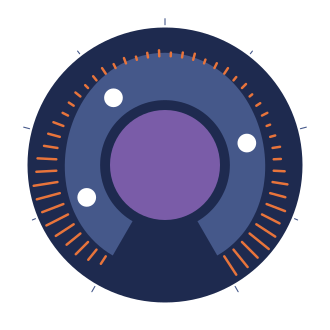
19/25
Bipolar Spectrum Disorders Scale (BSDS)
This scale screens for the likelihood and severity of symptoms consistent with bipolar spectrum disorders based on reported mood and energy patterns.
Low likelihood
Moderate likelihood
High likelihood
010Low likelihood1118Moderate likelihood1925High likelihood
A score of 19 falls in the High likelihood range, indicating a stronger pattern of experiences associated with bipolar spectrum symptoms on this screening scale.
Start Online Test
just completed the test
DATA-BASED USER COHORTS

Who Usually Takes This Test?

Depression with mood swings
41%OF USERS
People currently feeling depressed who also notice periodic bursts of energy, reduced need for sleep, or unusually upbeat or irritable phases want to see if it fits a broader mood pattern.
Unclear diagnosis seekers
34%OF USERS
People who have had shifting symptoms or mixed feedback from clinicians use the test to check for subtler bipolar-spectrum signs that don’t look like classic mania.
Family history concern
25%OF USERS
People with relatives who have bipolar disorder take it to understand their own mood history and whether they may be at risk.
BASED ON AGGREGATED, ANONYMIZED DATA FROM TENS OF THOUSANDS OF FREUDLY USERS.
Benchmarking

See How You Compare

Once you complete the test, your results are compared with real-world data from people in your country.
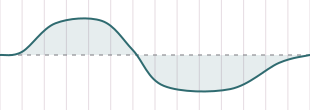
Below is a preview of how scores are typically distributed across each scale.
Bipolar Spectrum Disorders Scale (BSDS)
Average
9.6
Normal range
5.114
min.
0
max.
25
Majority
This curve shows how scores are typically distributed.
Once you complete the test, your result will appear on the scale so you can see how you compare.
Featured On
CLEAR ANSWERS TO COMMON QUESTIONS

Frequently Asked Questions

What does this Bipolar Disorder Test screen for?
It screens for signs of bipolar spectrum conditions — including presentations that may not match classic mania or hypomania. It focuses on patterns of mood elevation, energy changes, reduced need for sleep, and cycling between high and low mood states, particularly when these occur alongside depressive episodes.
Who is this questionnaire intended for?
It is intended for adults who report depression, mood swings, or periods of increased energy or activity. It is particularly useful for people whose depression has not fully responded to treatment, those who have received mixed clinical feedback, and those with a family history of bipolar disorder or mood disorders.
How long does it take and how many items are included?
Completion typically takes about 4 minutes. The questionnaire includes 20 items across two sections: a narrative description of mood patterns and a set of individual symptom statements. Select the response that best reflects your typical patterns across time — not a single day or week.
How is this different from a standard depression or bipolar quiz?
Most depression assessments don't screen for hypomanic history — meaning bipolar II and cyclothymia are easily missed. The BSDS was specifically designed to identify softer bipolar spectrum presentations: the subtle highs, increased energy, and cycling patterns that sit behind what looks like treatment-resistant depression. A standard bipolar quiz rarely captures this level of clinical nuance.
Is this Bipolar Disorder Test a diagnostic tool?
No. This is a screening measure and does not confirm or rule out a diagnosis of bipolar disorder. Elevated scores indicate that bipolar spectrum features may be present and warrant further clinical evaluation — they do not establish a diagnosis. Formal diagnosis requires a comprehensive clinical interview incorporating mood history, symptom duration, and functional impact.
How should the results be used?
Results are a screening indicator to guide next steps — not a final conclusion. Scores of 11 or above suggest moderate-to-high likelihood of bipolar spectrum features and support referral for a fuller diagnostic evaluation. Share your results with a psychiatrist or psychologist who can conduct a structured clinical interview and consider the full mood history.
What should I do if my Bipolar Disorder Test score is elevated?
We recommend discussing your results with a psychiatrist experienced in mood disorders. A test for bipolar disorder like this one is a structured starting point — not a verdict. An elevated score means the pattern is worth investigating carefully, particularly if you've experienced inadequate response to antidepressants or have a family history of bipolar disorder.
WHAT THE TEST MEASURES
About This Assessment

This measure is designed to screen for features of bipolar spectrum conditions that may not fit classic presentations of mania or hypomania. Developed by Ronald Pies, the Bipolar Disorder Test uses the Bipolar Spectrum Diagnostic Scale (BSDS) to identify patterns of mood and energy fluctuation — including past periods of elevated mood or increased activity occurring alongside depressive episodes — that may suggest bipolar-spectrum psychopathology. It includes 20 items and typically takes about 4 minutes to complete.

Why Take a Bipolar Disorder Test

Bipolar disorder is one of the most frequently misdiagnosed mental health conditions. Most people with bipolar II or cyclothymia first present to clinicians during a depressive episode — and without a structured screen for hypomanic history, the bipolar component is easily missed. The result is years of treatment for unipolar depression that doesn't fully work, because the underlying mood disorder has not been correctly identified.

The BSDS was specifically designed to catch these softer, subtler presentations — the periods of unusual energy, reduced need for sleep, accelerated thinking, or elevated productivity that don't look like classic mania but are clinically significant. If you've been treated for depression that hasn't fully responded, experienced pronounced mood swings, or have a family history of bipolar disorder, a structured test for bipolar disorder like this one can be a critical step toward a more accurate clinical picture.

What the Assessment Measures

The BSDS uses a two-part format. First, respondents read a narrative description of mood and energy fluctuation patterns and indicate how well it describes their own experience. Then they rate how closely a series of individual symptom statements match their history. This approach captures both the overall pattern of bipolar spectrum experience and specific symptom markers, including:

  • Periods of elevated or irritable mood — distinct episodes where mood was noticeably higher or more irritable than usual, with or without obvious cause
  • Increased energy and reduced need for sleep — stretches of unusual productivity, racing thoughts, or feeling powered up on less sleep than normal
  • Hypomanic or mixed episodes — periods of elevated mood occurring alongside depressive symptoms, which are characteristic of bipolar II and mixed presentations
  • Cycling patterns — recurring shifts between high and low mood states that follow a recognizable pattern over time
  • Depressive episodes — periods of low mood, reduced energy, and loss of interest, which often dominate the clinical presentation in bipolar spectrum conditions

Total scores range from 0 to 25. Scores of 11–18 suggest moderate likelihood of bipolar spectrum features; scores of 19 and above indicate high likelihood warranting further clinical evaluation.

Who This Assessment Is For

This Bipolar Disorder Test is appropriate for adults who experience depression alongside mood swings, unusual energy episodes, or periods that feel distinctly "off" in the upward direction. It is also relevant for those who have had inadequate response to antidepressants, mixed feedback from clinicians, or a family history of bipolar disorder. Clinicians use it as a structured first-step screen to flag bipolar-spectrum features before a full diagnostic workup.

Clinical Validity and Use in Practice

The BSDS has demonstrated good sensitivity and specificity for bipolar spectrum conditions, including presentations that do not meet criteria for classic bipolar I mania. Results are a screening indicator — they do not confirm or rule out a diagnosis. Elevated scores support the need for further clinical evaluation and may inform treatment planning. All results should be interpreted in the context of a comprehensive clinical interview and relevant collateral information.

Author: Pies, R.
Literature: Pies, R. W., Ghaemi, S. N., & colleagues. Sensitivity and specificity of a new bipolar spectrum diagnostic scale. Journal of Affective Disorders. 2005.
Test Question Form
You Might Also Like
Personality Inventory for DSM-5 Brief Form (PID-5-BF)
In clinical assessment, brief dimensional measures can help identify malada…
Start Test
Ritvo Autism and Asperger Diagnostic Scale (RAADS)
This self-report measure is designed to screen for characteristics associat…
Start Test
Checklist for Autism Spectrum Disorder (CASD)
When there are concerns about autism-related behaviors, the Checklist for A…
Start Test
Popular tests
Narcissistic Personality Inventory (NPI)
This self-report measure is used to assess narcissism as a personality trai…
Start Test
Yale-Brown Obsessive Compulsive Scale (Y-BOCS)
This measure is used to rapidly quantify the current severity of obsessive…
Start Test
CRAFFT Screening Test (CRAFFT 2.1)
This brief screening measure is designed to identify potential alcohol and…
Start Test
Patient Health Questionnaire-9 (PHQ-9)
This measure is commonly used to quickly screen for the presence and severi…
Start Test
Maslach Burnout Inventory (MBI)
This self-report measure is used to assess occupational burnout symptoms in…
Start Test
Adolescent Anxiety Questionnaire
This measure is designed to support a brief appraisal of anxiety symptoms a…
Start Test
Emotional Creativity Inventory (ECI)
This self-report measure assesses individual differences in the originality…
Start Test
Horne–Ostberg Morningness–Eveningness Questionnaire (MEQ)
Circadian preferences influence typical patterns of alertness and sleep tim…
Start Test
Ambivalent Sexism Inventory (ASI)
This measure is designed to assess attitudes toward women, including both o…
Start Test
Internalized Misogyny Scale (IMS)
This measure is designed to assess internalized negative beliefs and stereo…
Start Test
Perceived Stress Scale (PSS-10)
This self-report measure assesses the degree to which individuals appraise…
Start Test
Impulsive Behavior Scale (SUPPS-P)
Impulsivity is a multidimensional construct that is often assessed with bri…
Start Test
Clinical Institute Withdrawal Assessment for Alcohol, Revised (CIWA-Ar)
This rating scale is used to rapidly assess the severity of alcohol withdra…
Start Test
Positive and Negative Affect Schedule (PANAS)
This measure provides a brief self-report assessment of current or typical…
Start Test
Light Triad Scale (LTS)
This self-report measure assesses prosocial personality tendencies and orie…
Start Test
Suicidal Ideation Scale
In clinical settings, the Suicidal Ideation Scale is used to structure an i…
Start Test
Body Dysmorphic Disorder Scale (BDD-D)
This brief self-report measure is designed to screen for and quantify distr…
Start Test
Beck Anxiety Inventory (BAI)
This measure is a brief self-report inventory used to screen for anxiety sy…
Start Test
Differential Test of Perfectionism
This instrument is used to screen for perfectionism-related attitudes and t…
Start Test
Locus of Control Scale
This measure assesses generalized expectancies regarding the degree to whic…
Start Test
New Apathy Scale
This brief self-report measure is used to screen for apathy-related symptom…
Start Test
Perth Alexithymia Questionnaire (PAQ)
This measure assesses individual differences in alexithymia, including diff…
Start Test
Social Intelligence Scale
This brief self-report measure is designed to support rapid screening of in…
Start Test
Fear Test
This measure is designed to evaluate individual differences in fear-related…
Start Test
Neuroticism Level Scale
The measure is intended for brief screening of an individual’s propensity t…
Start Test
Aggressiveness Indicators Screening Questionnaire
This screening tool is designed to quickly identify behavioral indicators a…
Start Test
Comments
Leave a Comment