
Capricorn Quiz
How the Scales are Structured
Who Usually Takes This Test?
See How You Compare
Below is a preview of how scores are typically distributed across each scale.
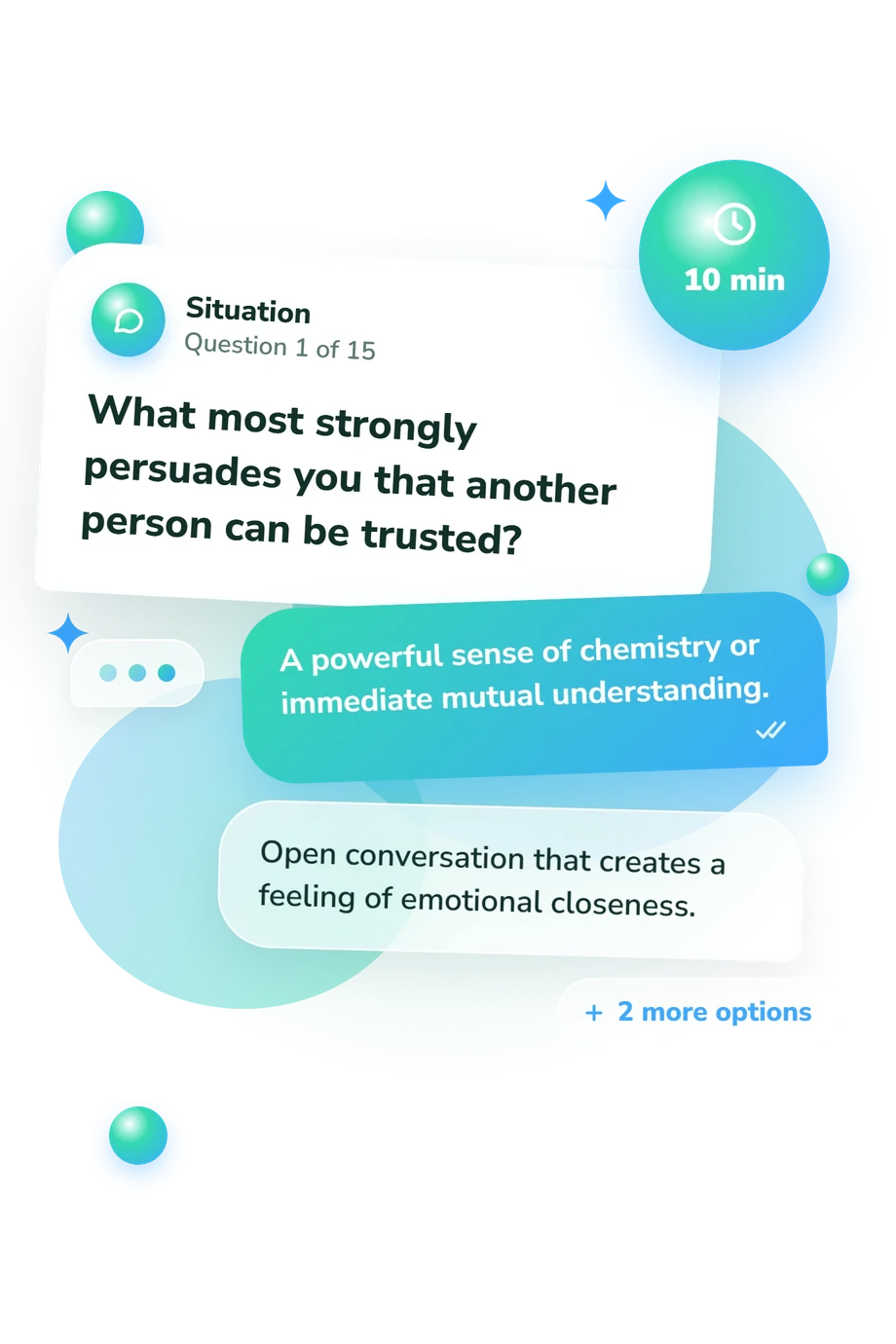
Example Questions From the Test
- A powerful sense of chemistry or immediate mutual understanding.
- Open conversation that creates a feeling of emotional closeness.
- A combination of intuition, shared experiences, and time.
- A consistent pattern of keeping promises and behaving reliably.
- Start the day without a plan and follow whatever catches my attention.
- Choose one main activity and leave the rest of the day open.
- Make a short list but change it freely as the day develops.
- Map out the day so I can fit in the things that matter to me.
- I avoid structuring too much of my life around a distant project.
- I work in energetic stretches whenever motivation appears.
- I set milestones and keep returning to them, even when progress is slow.
- I follow a plan but reassess it if another aim becomes more meaningful.
Capricorn Quiz - Description and methodology of the test
People curious about whether Capricorn themes resemble their everyday style can use the Capricorn Quiz as a structured prompt for self-reflection. It is intended for anyone who wants to examine habits around planning, achievement, trust, and commitment rather than receive a fixed identity label. As a Capricorn personality quiz, it translates familiar situations into a profile that may clarify preferences, strengths, and recurring tensions.
What This Assessment Explores
The questions examine planning, long-range aims, changing circumstances, and the ways people show care and build trust. These dimensions make the Capricorn personality test a profile of tendencies, not a pass-or-fail identity judgment. The three displayed scales are:
- Practical Structure (0-15) reflects a preference for order and preparation: Adaptive Style (0-5) leaves room for change, Flexible Framework (6-10) balances planning with flexibility, and Structure-Centered (11-15) depends on reliable systems.
- Purposeful Ambition (0-15) reflects attraction to sustained goals: Open-Ended Drive (0-5) favors changing direction, Selective Striver (6-10) reassesses while pursuing aims, and Goal-Anchored (11-15) emphasizes milestones and persistence.
- Reserved Loyalty (0-15) reflects gradual trust and dependable care: Openly Connective (0-5) builds closeness expressively, Measured Trust (6-10) balances openness with observation, and Reserved & Steadfast (11-15) shows loyalty through discretion and practical support.
Methodology and Scientific Basis
Each item presents a familiar situation with four response options, moving from more spontaneous or immediate reactions toward more planned, persistent, or selectively expressive responses. Choosing the option that best resembles you produces a pattern across the displayed scales.
Its conceptual frame is closest to the Steyn (2011) astrological-sign study, which examined whether personality differences correspond with astrological categories. This questionnaire is conceptually consistent with that inquiry, not an adaptation of Steyn’s study. Lu et al. (2020) helps distinguish astrological stereotypes from observed social reality, while Wyman and Vyse (2008) reported that double-blind testing did not support natal-chart personality predictions. Ptolemy represents the historical sign-based framework rather than modern validation.
This online questionnaire is best treated as a thematic self-report profile, not a standardized psychometric instrument. The exact points assigned to responses are not stated, so no answer-by-answer scoring rule should be inferred; the bands organize relative alignment with the stated scale definitions. As a Capricorn traits quiz, the assessment can reflect current priorities, mood, and self-perception, making the result a structured snapshot rather than a universal measure.
- Steyn, Renier. (2011). Astrological Signs and Personality Differences. Journal of Psychology in Africa, 21(3), 493-494. 10.1080/14330237.2011.10820488
- Lu, Jackson G., Xin Lucy Liu, Hui Liao, and Lei Wang. (2020). Disentangling stereotypes from social reality: Astrological stereotypes and discrimination in China. Journal of Personality and Social Psychology, 119(6), 1359-1379. 10.1037/pspi0000237
- Wyman, Alyssa Jayne, and Stuart Vyse. (2008). Science Versus the Stars: A Double-Blind Test of the Validity of the NEO Five-Factor Inventory and Computer-Generated Astrological Natal Charts. The Journal of General Psychology, 135(3), 287-300. 10.3200/GENP.135.3.287-300
- Ptolemy. (1940). Tetrabiblos (F. E. Robbins, Trans.). Loeb Classical Library, No. 435. Harvard University Press.
Updated: