
Bug Bite Identification Quiz
How the Scales are Structured
Who Usually Takes This Test?
See How You Compare
Below is a preview of how scores are typically distributed across each scale.
Example Questions From the Test
- The pattern can raise suspicion of bed bugs, but it is not proof and should be combined with exposure and environmental evidence.
- A line of three marks conclusively identifies bed bugs.
- Linear marks rule out fleas, mosquitoes, and non-bite skin irritation.
- The pattern identifies the source more reliably than finding the arthropod.
- Brief tenderness when the area is touched
- A small itchy bump limited to the exposure site
- Mild redness that improves with a cool compress
- Trouble breathing, faintness, or swelling of the tongue or throat
- Burning bumps that may later form small, sterile-looking pustules
- A flat bruise with no initial burning or irritation
- A painless expanding ring that always clears in the center
- A tick-like body remaining attached at the center
Bug Bite Identification Quiz - Description and methodology of the test
People wanting a cautious way to think through an unfamiliar mark can use this assessment to test practical knowledge rather than chase certainty. The bug bite identification quiz is useful for anyone who wants to reason through uncertainty before drawing conclusions from a skin reaction. Someone wondering what bit them can use the questions to compare bug bite symptoms without treating a mark as proof.
What This Assessment Explores
The questionnaire asks readers to connect common marks and exposure clues with proportionate conclusions. It covers mosquito, flea, bed bug, tick, chigger, fire ant, bee, and suspected spider scenarios, plus infection, prevention, first aid, and emergency symptoms. Readers wondering what bug bit them are guided toward insect bite identification from context rather than treating appearance as proof.
Across the items, four practical content areas receive attention:
- Appearance and timing show whether clues are mistaken for proof.
- Exposure and environment show how household, pet, and outdoor details are used.
- Response and prevention show whether removal, repellents, care, and documentation are understood.
- Warning signs show whether urgent developments are recognized.
Bug Bite Identification Knowledge (0-16) is reported as Foundations to Build (0-6), Developing Knowledge (7-12), or Strong Knowledge (13-16). It reflects educational knowledge, not a diagnosis; these bands are not validated medical cutoffs.
Methodology and Scientific Basis
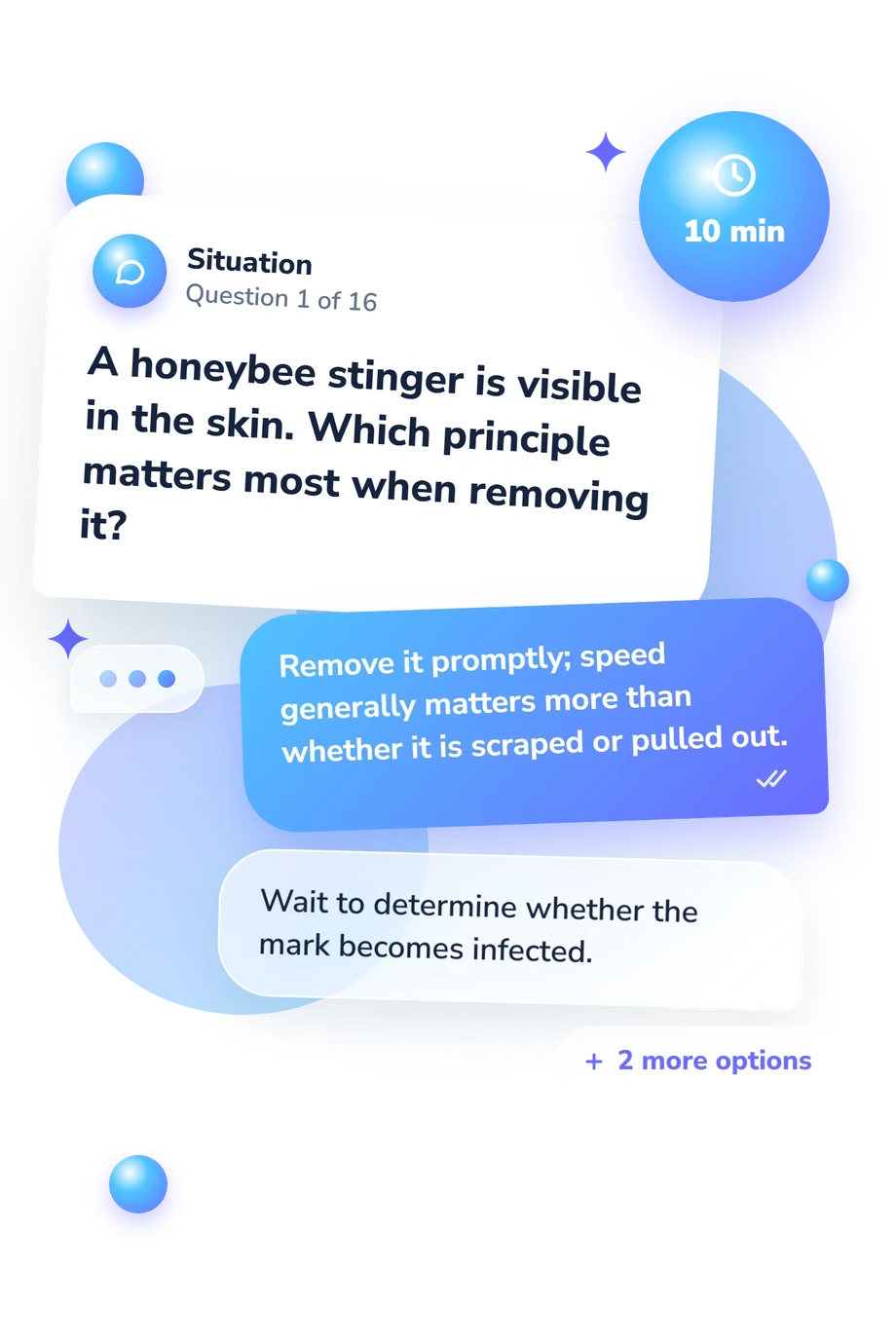
The questionnaire uses 16 multiple-choice items, each presenting a practical scenario with one most defensible response among alternatives. Distractors overstate certainty, rely on appearance alone, confuse similar causes, or recommend unsafe delay. The format is an educational multiple-choice questionnaire rather than a symptom checklist or personality inventory.
The documented output is one educational knowledge result. Its educational status and lack of a validated medical cutoff mean that it can show which concepts a respondent recognizes, but it cannot identify an individual lesion or establish its cause. For someone using this insect bite assessment, the distinction keeps the score focused on learning rather than case-specific certainty.
The question themes are conceptually consistent with published clinical guidance on overlapping skin reactions, safe tick removal, infection clues, emergency symptoms, stinging insects, and effective repellents; they are not an adaptation of a published clinical instrument.
Performance may reflect prior knowledge and attention, while real marks vary between people and can resemble infections or other conditions. Use the result to spot learning gaps, not to treat a score as proof of the cause.
- Herness J, Snyder MJ, Newman RS. Arthropod Bites and Stings. American Family Physician. 2022;106(2):137-147.
- Baker TW, Forester JP, Johnson ML, Stolfi A, Stahl MC. The HIT study: Hymenoptera Identification Test-how accurate are people at identifying stinging insects? Annals of Allergy, Asthma & Immunology. 2014;113(3):267-270. 10.1016/j.anai.2014.05.029
- Fradin MS, Day JF. Comparative Efficacy of Insect Repellents against Mosquito Bites. New England Journal of Medicine. 2002;347(1):13-18. 10.1056/NEJMoa011699
Updated: