
British Dialect Quiz
How the Scales are Structured
Who Usually Takes This Test?
See How You Compare
Below is a preview of how scores are typically distributed across each scale.
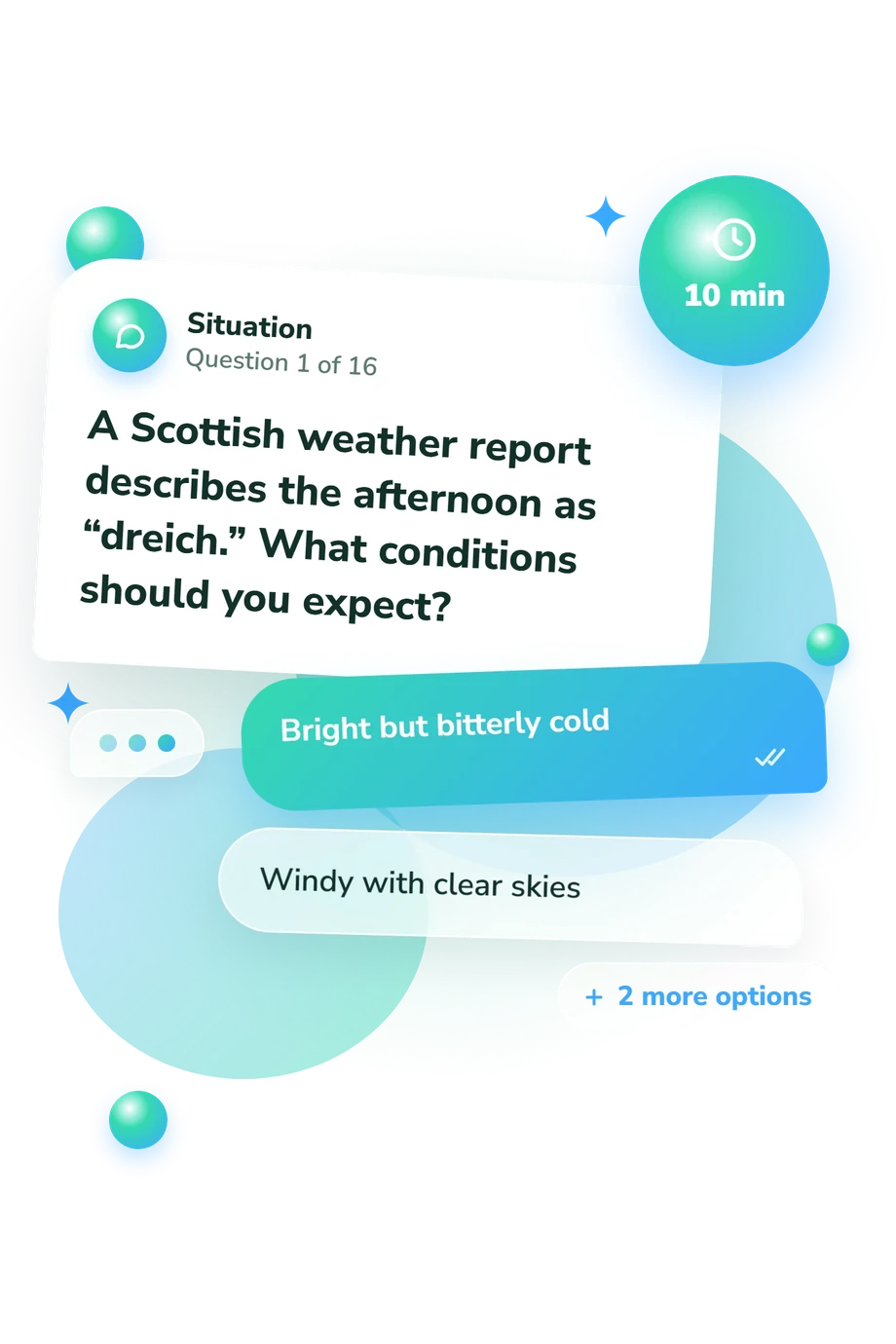
Example Questions From the Test
- Bright but bitterly cold
- Windy with clear skies
- Warm with scattered sunshine
- Gloomy, overcast and possibly damp
- For six hours
- Before six
- At six
- Whenever the work is finished
- Something has gone stale.
- Only basic food is left.
- There is nothing left.
- The cupboard has not been checked.
British Dialect Quiz - Description and methodology of the test
Curious listeners, travellers, language learners, and anyone exploring local speech can use the British Dialect Quiz to test their familiarity with everyday expressions from across Britain. It concentrates on vocabulary and meaning rather than accent, pronunciation, or judgments about how anyone speaks. Its regional dialect quiz format gives learners a practical way to explore how place shapes everyday expressions.
What This Assessment Explores
The questions match regional words and phrases with meanings in short situations. They cover Scotland, Northern England, North East England, and the Midlands, with topics including weather, shopping, family, food, directions, and mood.
As a UK dialect quiz, it emphasizes contextual recognition rather than accent, pronunciation, fluency, or regional identity. The question themes include:
- Regional vocabulary asks whether the respondent can recognize terms associated with particular areas.
- Everyday context shows how surrounding details help distinguish a word's likely meaning.
- Social language places forms of address, teasing, approval, and mood within ordinary interactions.
- The overall result reflects the single British Dialect Knowledge scale, which runs from 0-16: Starting point (0-6) reflects partial recognition; Developing ear (7-12) shows many familiar expressions; Strong knowledge (13-16) indicates broad contextual accuracy, while usage varies by place, community, and generation.
Methodology and Evidence Base
Each item places a regional word or phrase in a brief context and supplies four choices. Selecting the best meaning tests lexical recognition and contextual inference, not pronunciation, fluency, or attitudes toward dialect.
The questionnaire displays one overall result on this scale, but its response-to-score conversion is not documented. No separate weighting system, norm group, reliability estimate, or diagnostic threshold is stated for this online questionnaire. As a British dialect test, the score is best interpreted as familiarity with the examples presented, not as a standardized language assessment.
Its evidence base is linguistic. The questionnaire is conceptually consistent with Robinson's dialect thesaurus, which compiles regional vocabulary, and with Grieve et al.'s mapping of lexical variation in British English. Pearce offers a close reference for North East “canny,” while Mather and Speitel document Scots vocabulary. These sources provide context but do not validate this exact questionnaire or establish population norms; it is not presented as an adaptation of them.
Performance can reflect media exposure, family speech, education, travel, prior familiarity, and guessing. Meanings shift across communities and generations, so the result is most useful for further listening and exploration rather than ranking speakers or defining regional identity.
- Robinson, Jonnie. A Thesaurus of English Dialect and Slang: England, Wales and the Channel Islands. Cambridge: Cambridge University Press, 2021. 10.1017/9781108663144
- Grieve, Jack, Chris Montgomery, Andrea Nini, Akira Murakami, and Diansheng Guo. “Mapping Lexical Dialect Variation in British English Using Twitter.” Frontiers in Artificial Intelligence, vol. 2, article 11, 2019. 10.3389/frai.2019.00011
- Pearce, Michael. “‘It Isn’t Geet Good, Like, But It’s Canny’: A New(ish) Dialect Feature in North East England.” English Today, vol. 27, no. 3, 2011, pp. 3-9. 10.1017/S0266078411000307
- Mather, J. Y., and H. H. Speitel, editors. The Linguistic Atlas of Scotland: Scots Section. 2 vols. London: Croom Helm, 1975-1977.
Updated: