
Brazil Quiz
How the Scales are Structured
Who Usually Takes This Test?
See How You Compare
Below is a preview of how scores are typically distributed across each scale.
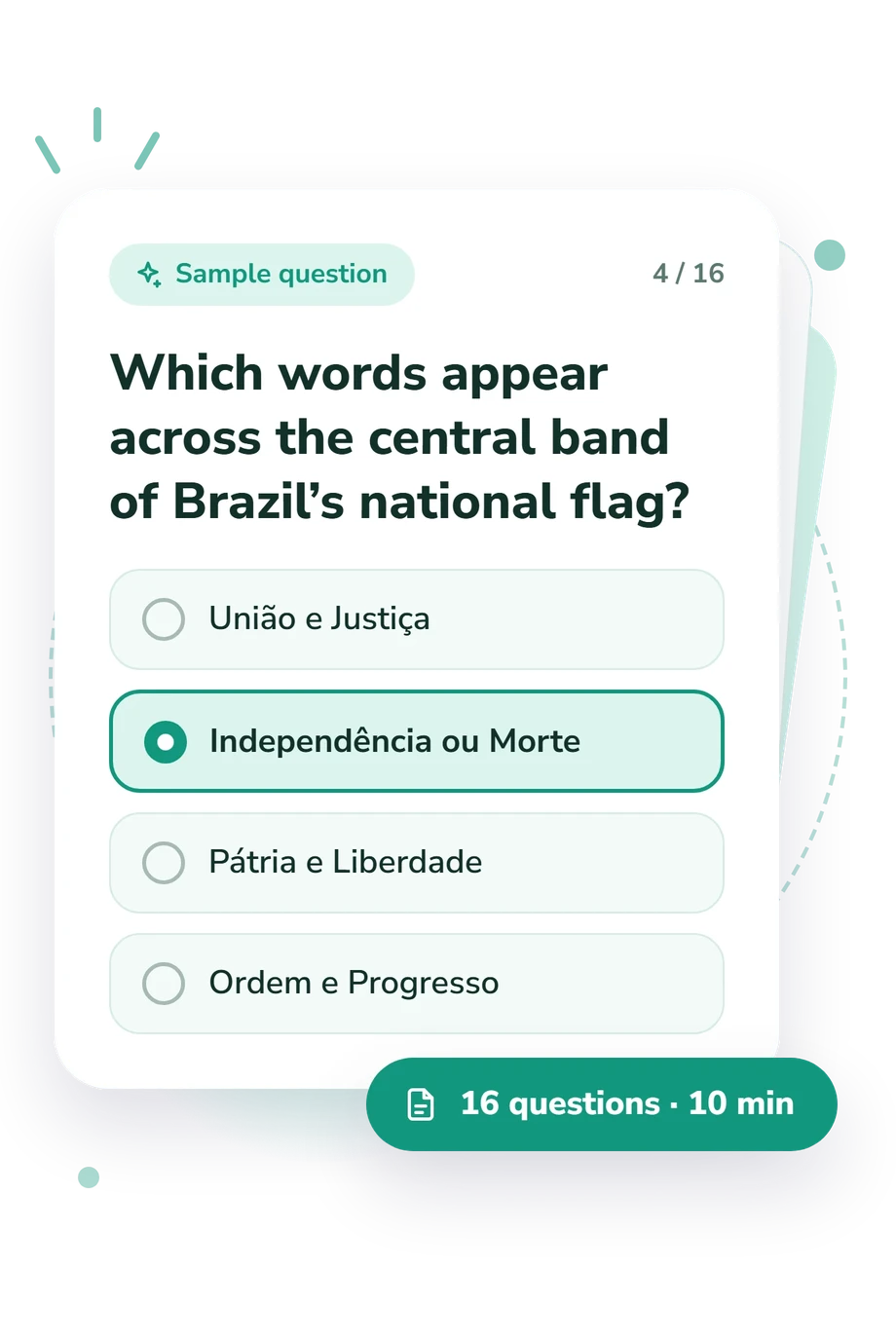
Example Questions From the Test
- Belo Horizonte
- Rio de Janeiro
- Porto Alegre
- Recife
- União e Justiça
- Independência ou Morte
- Pátria e Liberdade
- Ordem e Progresso
- The Maracanã
- The Pelourinho
- The Sambadrome
- The Copacabana Fort
Brazil Quiz - Description and methodology of the test
Designed for travelers, students, and anyone curious about the country, this Brazil Quiz offers a focused way to check existing knowledge and choose subjects worth revisiting. It suits a general reader seeking a broad cultural overview. Its quiz questions about Brazil connect everyday facts with wider themes, making the overall result useful when preparing for a trip, studying the country, or satisfying curiosity.
What This Assessment Explores
The assessment samples ways of knowing Brazil. Questions about geography cover regions, cities, seasons, and biomes, while questions connect symbols, language, food, music, sport, festivals, and heritage. As a quiz about Brazil, it suits readers seeking a broad cultural overview.
The main thematic groups are:
- Geography and environment connect regions, cities, seasons, and biomes to Brazil’s physical scale.
- Culture and heritage show how Indigenous, Portuguese, African, and immigrant influences shape national life.
- Language, food, and music identify Portuguese expressions, culinary traditions, and genres such as bossa nova.
- Landmarks, sport, and symbols connect places, celebrations, emblems, and familiar public references.
The result shows correct answers across the represented topics. The Brazil Knowledge scale runs from 0-16: Foundations to build (0-6), Developing knowledge (7-12), and Strong knowledge (13-16). These bands describe breadth of knowledge on the covered material.
Methodology and Evidence Base
Each item presents a direct prompt or short everyday scenario with four answer choices. Participants select the best-supported response, and the displayed result is based on the number of correct answers. One correct response is counted per item, producing the overall total.
Content is conceptually consistent with historical and cultural scholarship by Green, Langland, Schwarcz, and Sadlier on Brazilian identity and cultural history. Brazil’s Constitution identifies Portuguese as the official language, while UNESCO’s description of the capoeira circle supports that cultural reference. These authorities anchor selected facts and themes; the questionnaire is not an adaptation of their publications.
A Brazil trivia quiz result is best read as a snapshot of performance on the represented material. The displayed bands are descriptive results for this quiz and do not establish a broader measure of Brazilian cultural knowledge. Guessing, prior travel, education, language familiarity, and uneven exposure to Brazilian regions or traditions can affect the score. Reviewing missed topics is more useful than treating the number as a complete measure of cultural understanding.
- Green, James N., Victoria Langland, and Lilia Moritz Schwarcz, eds. The Brazil Reader: History, Culture, Politics. 2nd ed. Durham, NC: Duke University Press, 2019. 10.1215/9780822371793
- Sadlier, Darlene J. Brazil Imagined: 1500 to the Present. Austin: University of Texas Press, 2008.
- Brazil. Constitution of the Federative Republic of Brazil. 1988, Article 13. English translation, Chamber of Deputies of Brazil.
- UNESCO. Capoeira Circle. Representative List of the Intangible Cultural Heritage of Humanity, 2014.
Updated: