
Are you a nerd?
How the Scales are Structured
Who Usually Takes This Test?
See How You Compare
Below is a preview of how scores are typically distributed across each scale.
Example Questions From the Test
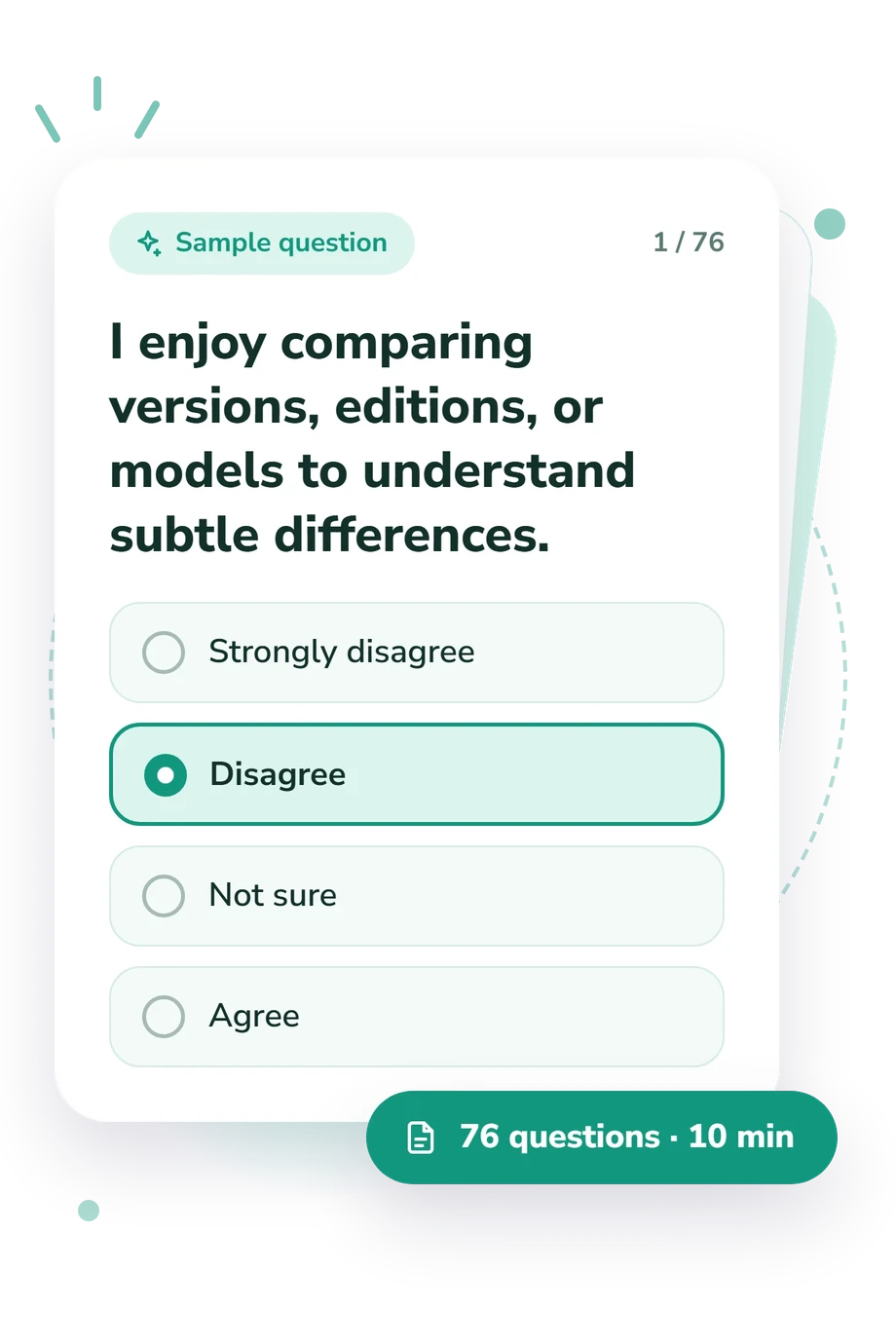
- Strongly disagree
- Disagree
- Not sure
- Agree
- Strongly disagree
- Disagree
- Not sure
- Agree
- Strongly disagree
- Disagree
- Not sure
- Agree
- Strongly agree
Are you a nerd? - Description and methodology of the test
People who enjoy niche interests, detailed lore, collecting, tinkering, or enthusiastic discussion can use this assessment to see how their engagement is organized. The nerd quiz turns everyday preferences into a profile of depth, intensity, and social style without treating “nerdy” as a single personality type. As a nerd test, it suits anyone curious about whether their enthusiasm is casual, immersive, private, or community-facing.
What This Assessment Explores
Rather than asking whether someone is simply a nerd, the questionnaire maps how interests are pursued and shared. Its items cover research, lore, collecting, repeated engagement, tinkering, explanation, and community participation. The profile separates depth, intensity, and social style, helping readers explore different types of nerds without forcing one label.
These are the three dimensions reported:
- Deep-Dive Tendency (0-30) measures how deeply you research, collect, analyze, and immerse yourself in favored topics: Light Explorer (0-10) is lighter, Curious Diver (11-20) explores regularly, and Rabbit-Hole Specialist (21-30) goes deepest.
- Nerdiness Intensity (0-40) measures overall engagement: Casual Nerd (0-13) is occasional, Engaged Nerd (14-27) is sustained, and Intense Nerd (28-40) is highly consistent.
- Social Geek Style (0-20) measures shared versus private interests: Solo Leaning (0-7) favors independence, Balanced (8-14) combines both, and Community-Oriented (15-20) favors participation.
Methodology and Scientific Basis
The questions use first-person self-report statements about habits and preferences. In the sample, agreement options run from Strongly disagree to Agree, with some items adding Strongly agree; frequency items use Never to Often. This lets respondents express degree or regularity rather than choose yes or no.
Answers are combined into three displayed scores, each placed in a named result band. The profile is dimensional rather than pass-or-fail, but the questionnaire does not state how many points each response contributes, so no extra scoring rule should be inferred.
Its closest conceptual reference is the Nerdy Personality Attributes Scale, examined by Finister, Pollet, and Neave (2024). This questionnaire is conceptually consistent with that work, not presented as its adaptation. The Open Source Psychometrics Project’s development notes and McCain, Gentile, and Campbell’s research on geek-culture engagement support treating interest involvement and social participation as related features. As a nerd personality test, it offers descriptive categories rather than population norms or a clinical classification.
Current hobbies, mood, access to communities, and self-perception can shape responses, so the result is a snapshot for reflection rather than a fixed judgment.
- Finister, Calum, Thomas V. Pollet, and Nick Neave. "An exploratory factor analysis of the Nerdy Personality Attributes Scale in a sample of self-identified nerds/geeks." The Social Science Journal, 61(4), 899-907 (2024). 10.1080/03623319.2021.1884775
- Open Source Psychometrics Project. "Development of the Nerdy Personality Attributes Scale." Open Source Psychometrics Project (2015).
- McCain, Jessica, Brittany Gentile, and W. Keith Campbell. "A Psychological Exploration of Engagement in Geek Culture." PLoS ONE, 10(11), e0142200 (2015). 10.1371/journal.pone.0142200
Updated: