
Am I Biromantic Quiz
How the Scales are Structured
Who Usually Takes This Test?
See How You Compare
Below is a preview of how scores are typically distributed across each scale.
Example Questions From the Test
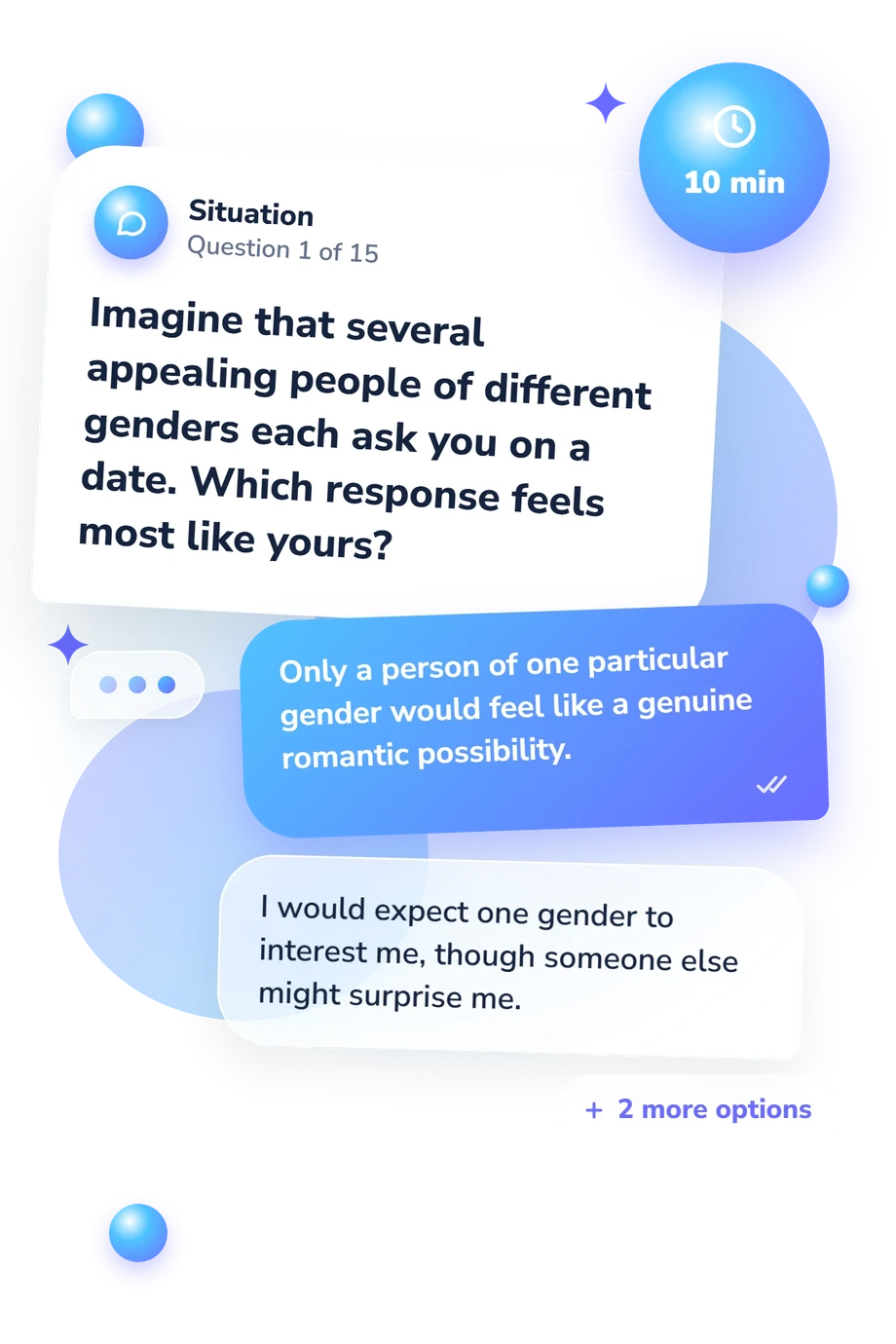
- Only a person of one particular gender would feel like a genuine romantic possibility.
- I would expect one gender to interest me, though someone else might surprise me.
- I could picture accepting dates across genders, but my interest would probably be uneven.
- Gender would not limit which of them could become a genuine romantic possibility for me.
- Characters of one gender consistently feel like the only plausible partners for me.
- I usually imagine one gender, with rare exceptions that feel mostly hypothetical.
- I can imagine dating more than one gender, though some possibilities feel easier to picture.
- Partners of two or more genders can feel genuinely appealing in my imagination.
- It feels inaccurate or disconnected from me.
- It feels possible in theory but not personally settled.
- It brings some recognition, along with uncertainty or adjustment.
- It brings a strong sense of recognition or clarity.
Am I Biromantic Quiz - Description and methodology of the test
People who are questioning whether biromantic describes them, or whose understanding has shifted over time, may use this assessment to organize uncertainty about uneven attraction and changing self-understanding. The Am I Biromantic Quiz offers a structured profile that shows how different parts of that uncertainty fit together. This biromantic quiz can clarify which responses feel settled and which remain open to interpretation.
What This Assessment Explores
The questionnaire examines how crushes, partnership hopes, and reactions to possible partners relate to gender rather than assigning an identity. It separates romantic wishes-dating, tenderness, affection, or partnership-from friendship, admiration, and sexual interest; jealousy appears as an emotional reaction that may prompt reflection on romantic involvement. This romantic attraction quiz may suit people considering whether the biromantic label fits clearly, partly, or remains uncertain.
The profile separates three dimensions; no band proves an orientation:
- Attraction Across Genders (0-15) reflects romantic potential involving two or more genders: Limited alignment (0-5), Emerging breadth (6-10), Clear breadth (11-15).
- Biromantic Label Resonance (0-15) reflects the label's personal usefulness and resonance: Low resonance (0-5), Tentative resonance (6-10), Strong resonance (11-15).
- Romantic Feeling Pattern (0-15) considers romantic feeling rather than friendship, admiration, or sexual interest: Little romantic indication (0-5), Romantic possibility (6-10), Recognizable romantic pattern (11-15).
Methodology and Evidence Base
Each item presents a situation or reflection prompt in this biromantic orientation test, with respondents selecting one of four ordered responses that move from little recognition toward clearer cross-gender romantic possibility or label resonance. The groups cover attraction patterns, romantic-versus-non-romantic feelings, partnership, emotional reactions, and identity language.
Results appear as a profile across the three dimensions. Because individual answer weights are not specified, ranges should not be reverse-engineered into point values; bands summarize response patterns rather than diagnostic cutoffs. Label resonance concerns personal usefulness, not permission to claim an identity, and attraction need not be equal across genders.
The questionnaire is conceptually consistent with work by Vonlanthen and colleagues on bisexual and biromantic identities, attractions, and behaviors, but it is not a direct adaptation. Galupo, Lomash, and Mitchell support a multidimensional view of orientation, while Diamond distinguishes romantic love from sexual desire.
As an online self-report profile, it presents displayed interpretive bands while leaving answer weights unspecified; results therefore depend on self-awareness, honest reporting, and current context. Compare an unexpected profile with the situations that shaped your answers.
- Vonlanthen, Caroline, Savoie, Érica, and Roy-Charland, Annie. "To Bi: An Exploration of Sexual and Romantic Identities, Attractions, and Behaviors." Journal of Bisexuality, 26(1), 78-102, 2026. 10.1080/15299716.2025.2566033
- Galupo, M. Paz, Lomash, Edward, and Mitchell, Renae C. "All of My Lovers Fit Into This Scale": Sexual Minority Individuals' Responses to Two Novel Measures of Sexual Orientation. Journal of Homosexuality, 64(2), 145-165, 2017. 10.1080/00918369.2016.1174027
- Diamond, Lisa M. "What Does Sexual Orientation Orient? A Biobehavioral Model Distinguishing Romantic Love and Sexual Desire." Psychological Review, 110(1), 173-192, 2003. 10.1037/0033-295X.110.1.173
Updated: