
99 Names of Allah Quiz
How the Scales are Structured
Who Usually Takes This Test?
See How You Compare
Below is a preview of how scores are typically distributed across each scale.
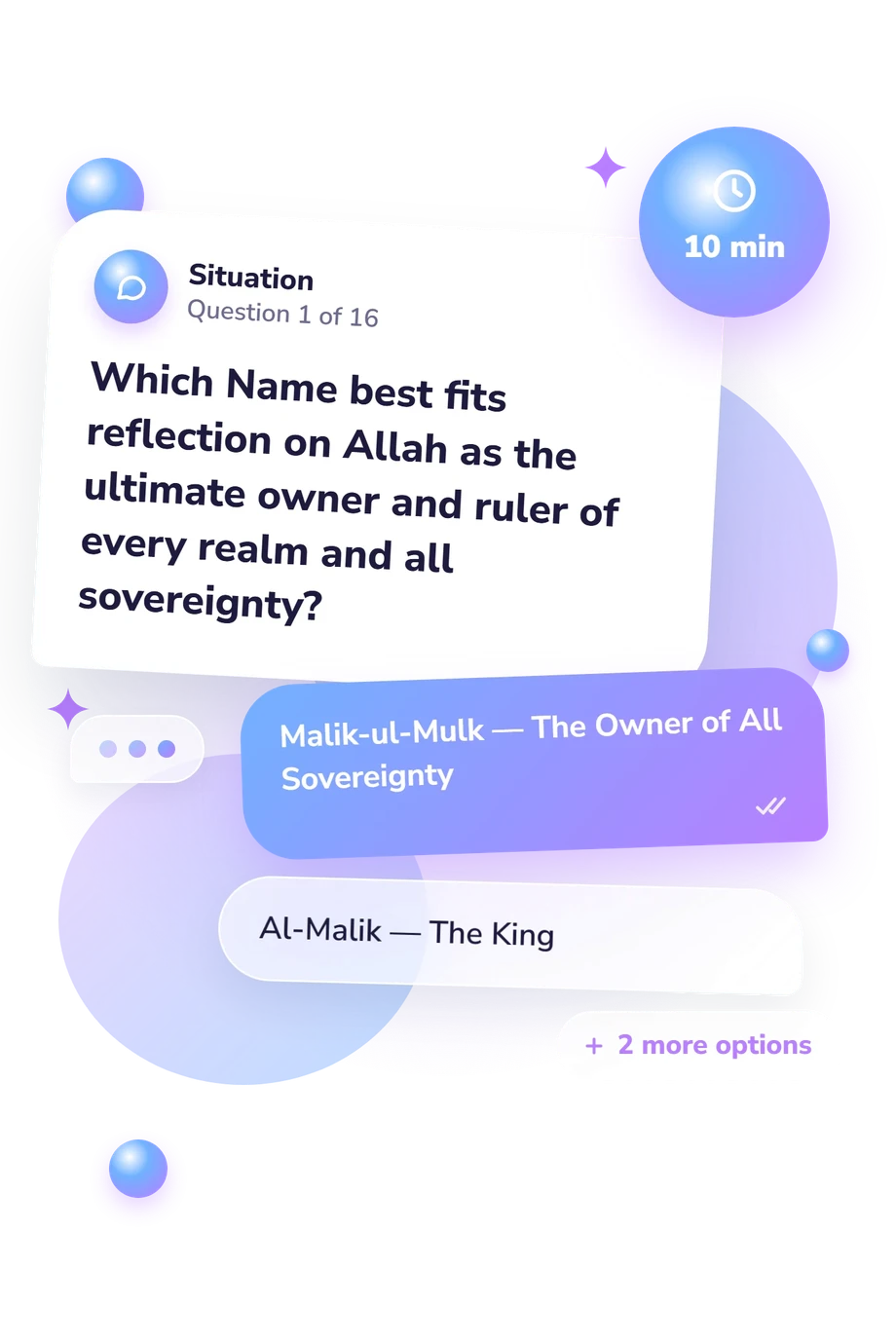
Example Questions From the Test
- Malik-ul-Mulk — The Owner of All Sovereignty
- Al-Malik — The King
- Dhul-Jalali wal-Ikram — The Possessor of Majesty and Honor
- Al-Majid — The Glorious
- Al-Halim — The Forbearing
- As-Sabur — The Perfectly Patient
- Al-Mu'akhkhir — The Delayer
- Al-Ghafur — The All-Forgiving
- Ar-Rahman
- Ar-Rahim
- Al-Wadud
- Al-Latif
99 Names of Allah Quiz - Description and methodology of the test
People studying Islamic vocabulary, theology, or devotional language can use the 99 Names of Allah Quiz to examine recognition of selected divine Names without turning the result into a judgment about personal faith. The Allah quiz gives learners a knowledge check of closely related meanings and a clearer sense of which distinctions they understand and which need review.
What This Assessment Explores
The questions ask you to distinguish closely related Names when a situation or definition points toward one meaning. They cover sovereignty, mercy, creation, reliance, sustaining power, hearing, repentance, provision, justice, knowledge, and gathering. The result reflects recognition of meanings in context, not faith, devotion, or spiritual standing.
The main thematic groups are:
- Sovereignty and justice show how rule, ownership, judgment, and equity are distinguished.
- Mercy and forgiveness separate compassion, forbearance, repentance, pardon, and repeated forgiveness.
- Creation and provision connect forming, originating, sustaining, and supplying with specific Names.
- Knowledge and responsiveness include hearing, awareness, subtlety, protection, and answering.
A learner taking the Names of Allah test sees whether closely related translations are being distinguished. The educational scale is named 99 Names of Allah Knowledge: 0-16, with Foundational (0-6), Developing (7-12), and Strong (13-16) bands; transliterations may vary.
Methodology and Evidence Base
Each item uses four answer choices. Prompts contrast neighbouring meanings or place a Name in a brief situation, so performance involves both translation recall and discrimination among closely related meanings. The result is an educational score measuring knowledge of the sampled Names and the distinctions represented by the questions.
Al-Ghazali (1992) gives theological context by linking accurate meaning with reflection on divine attributes. Casewit (2020) addresses the ethical framework surrounding learning and embodying those meanings, while a hadith in Sahih Muslim places learning the Names within a religious context. The questionnaire is an online educational knowledge check focused on the selected Names and meanings represented in its items.
For someone using this 99 Names of Allah assessment, the score is a snapshot of selected knowledge. It can identify topics for revision, but it cannot establish comprehensive mastery because only selected Names and distinctions are tested. Results also depend on language, transliteration, prior teaching, and the respondent’s chosen answer, so broader study is needed for fuller understanding.
- al-Ghazali, Abu Hamid. The Ninety-Nine Beautiful Names of God: al-Maqsad al-Asna fi Sharh Asma' Allah al-Husna. Translated with notes by David B. Burrell and Nazih Daher. Cambridge: Islamic Texts Society, 1992. ISBN 0946621306.
- Casewit, Yousef. “Al-Ghazali’s Virtue Ethical Theory of the Divine Names: The Theological Underpinnings of the Doctrine of Takhalluq in al-Maqsad al-Asna.” Journal of Islamic Ethics, vol. 4, nos. 1-2, 2020, pp. 155-200. 10.1163/24685542-12340042.
- Muslim ibn al-Hajjaj. Sahih Muslim, Book 48, Hadith 6 (2677b), “The Names of Allah and the Virtue of Learning Them by Heart.”
Updated: