
Understanding, Emotional Attraction, and Authoritativeness Test
How the Scales are Structured
Who Usually Takes This Test?
See How You Compare
Below is a preview of how scores are typically distributed across each scale.
Example Questions From the Test
- Yes
- No
- Don't know
- Yes
- No
- Don't know
- Yes
- No
- Don't know
Understanding, Emotional Attraction, and Authoritativeness Test - Description and methodology of the test
People who want a clearer picture of how they experience a partner can use the Understanding, Emotional Attraction, and Authoritativeness Test as a structured relationship self-reflection exercise. It is especially relevant for relationship dynamics involving affection, curiosity, comfort, respect, and agreement. The result keeps understanding of the partner distinct from attraction and authoritativeness.
What This Assessment Explores
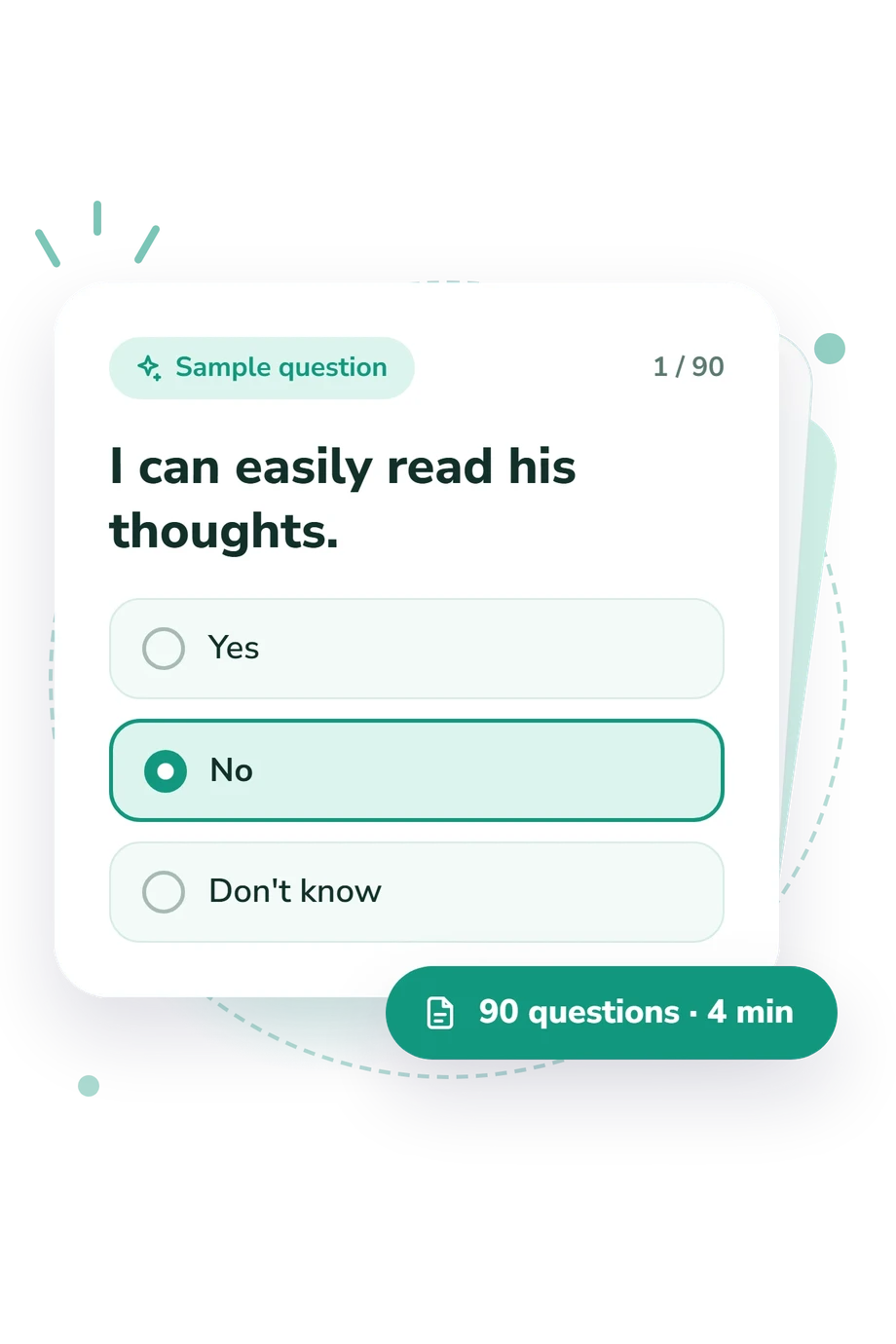
Items cover understanding a partner, feelings during contact, and responses to partner qualities and views. The questionnaire uses Yes, No, and Don’t know for prediction, attraction, comfort, irritation, respect, and interest in the partner’s world. Result dimensions are:
- Understanding (0-30) measures knowledge of personality and traits; higher scores indicate ease interpreting behavior, thoughts, and feelings, while lower scores indicate difficulty explaining them. Bands: Low understanding 0-14, Moderate understanding 15-22, High understanding 23-30.
- Emotional Attraction (0-30) measures attraction, desire for contact, and positive interaction; higher scores indicate wanting contact, while lower scores indicate communication difficulty and fatigue. Bands: Low 0-10, Moderate 11-20, High 21-30.
- Authoritativeness (0-30) measures acceptance and agreement with the partner’s worldview, interests, and opinions; higher scores indicate seeing them as a model, while lower scores indicate disrespect or rejection. Bands: Low 0-10, Moderate 11-20, High 21-30.
Methodology and Scientific Basis
Each statement uses Yes, No, or Don’t know, making this a structured self-report rather than an interview. The items cover knowing the partner, experiencing contact, and evaluating the partner’s qualities and views. The questionnaire presents separate scale results with displayed bands; the contribution of individual responses and any norming or validation status are not specified.
Conceptually, the three-part structure is consistent with the UEA questionnaire by Volkova and Trapeznikova (1985), but this online questionnaire is not presented as an adaptation of it. Its items address knowing the partner’s patterns, the effect of contact, and the extent to which the partner’s qualities, opinions, and interests command respect or influence.
Interpret the relationship profile as a pattern: strength in one area may coexist with difficulty in another, while uncertainty may reflect limited knowledge, ambivalence, or circumstances. Self-reported answers can shift with mood, conflict, idealization, defensiveness, and self-awareness. The test is a self-reflection tool rather than a diagnosis or substitute for broader assessment. Use the profile as a prompt for specific reflection rather than a fixed judgment about the relationship.
- Volkova, A. N., & Trapeznikova, T. M. (1985). Methodological techniques for diagnosing marital relations [Psychological diagnosis of married couples]. Questions of Psychology, 5, 110-116.
- Klymenko, I. V. (2020). The impact of volunteering aimed at helping the combatants and victims of the war on volunteers' family well-being. Ukrainian Psychological Journal, 2(14), 100-118. 10.17721/upj.2020.2(14).5
- Zinovieva, E. V., Kazantseva, T. V., Pleshkova, A. N., & Kostromina, S. N. (2018). The quality of paternal relationship in modern Russia. The European Proceedings of Social and Behavioural Sciences, 249-256. 10.15405/epsbs.2018.07.33
Updated: