
Comma Quiz
How the Scales are Structured
Who Usually Takes This Test?
See How You Compare
Below is a preview of how scores are typically distributed across each scale.
Example Questions From the Test
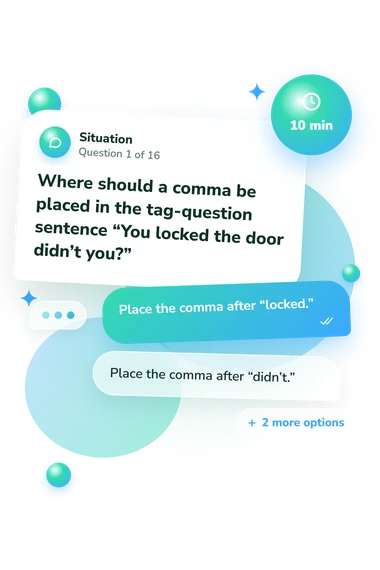
- Place the comma after “locked.”
- Place the comma after “didn’t.”
- Do not separate the tag from the statement.
- Place the comma after “door,” before the tag question.
- Add commas after “Austin,” “Texas,” and “Portland.”
- Add commas after “Austin” and “Portland” only.
- Add a comma after “Texas” only.
- Add commas after “Texas” and “Oregon” only.
- Place the comma immediately after “storm.”
- Place the comma immediately after “ended.”
- Place the comma immediately after “crew.”
- Leave the sentence without a comma.
Comma Quiz - Description and methodology of the test
Readers who want to sharpen everyday punctuation can use this comma quiz to decide which conventions deserve review. It is intended for students, writers, editors, and anyone reviewing sentence structure; the comma practice quiz turns missed or uncertain answers into concrete topics for study. The result helps prioritize review rather than measure writing ability broadly.
What This Assessment Explores
This questionnaire examines punctuation decisions in edited English, not vocabulary or overall style. Its situations involve clause boundaries, introductory elements, direct address, quotations, dates, lists, coordinate adjectives, interrupters, and appositives. By testing comma rules in this comma rules quiz, the questionnaire checks when grammatical units need separation and when commas are incorrect.
The result reflects these thematic groups:
- Clause boundaries show whether independent clauses and essential subordinate clauses are punctuated appropriately.
- Supplementary material shows whether extra relative clauses and renaming phrases are set off.
- Position-sensitive conventions test comma placement with introductions, direct address, and dates.
- Lists, coordinate adjectives, interrupters, and quotations reveal control of common patterns.
The single reported scale, Comma Knowledge, ranges from 0-16. Foundations to Build covers 0-6, Developing Control covers 7-12, and Strong Mastery covers 13-16. These bands describe the level represented by the total and indicate where review may help.
Methodology and Evidence Base
Each prompt presents a sentence or editing situation with four choices. You select the placement or omission matching standard written English, so the format tests recognition rather than free-form composition. Because it functions as a comma usage quiz, the result is most informative when you note which sentence relationships cause hesitation.
The selected responses produce one displayed total; no separate subscale is reported. This score reflects performance on the conventions represented here and may vary with attention, prior instruction, or familiarity with a style preference.
Conceptually, the content is consistent with Cambridge Grammar on clause structure and essential versus supplementary material. It is also consistent with Chicago style on practical conventions involving dates, quotations, lists, and parenthetical wording. These are shared principles, not evidence that the online questionnaire reproduces either source.
The single score covers only comma situations represented by these items, so it is a focused practice result rather than a complete measure of punctuation ability. Reviewing missed items, comparing decisions with a broader writing sample, or getting feedback from a teacher or editor can show whether the skill transfers.
- Huddleston, Rodney, and Geoffrey K. Pullum. The Cambridge Grammar of the English Language. Cambridge University Press, 2002. 10.1017/9781316423530.
- The University of Chicago Press Editorial Staff. The Chicago Manual of Style, 18th Edition. University of Chicago Press, 2024.
Updated: