
Roommate Compatibility Quiz
How the Scales are Structured
Who Usually Takes This Test?
See How You Compare
Below is a preview of how scores are typically distributed across each scale.
Example Questions From the Test
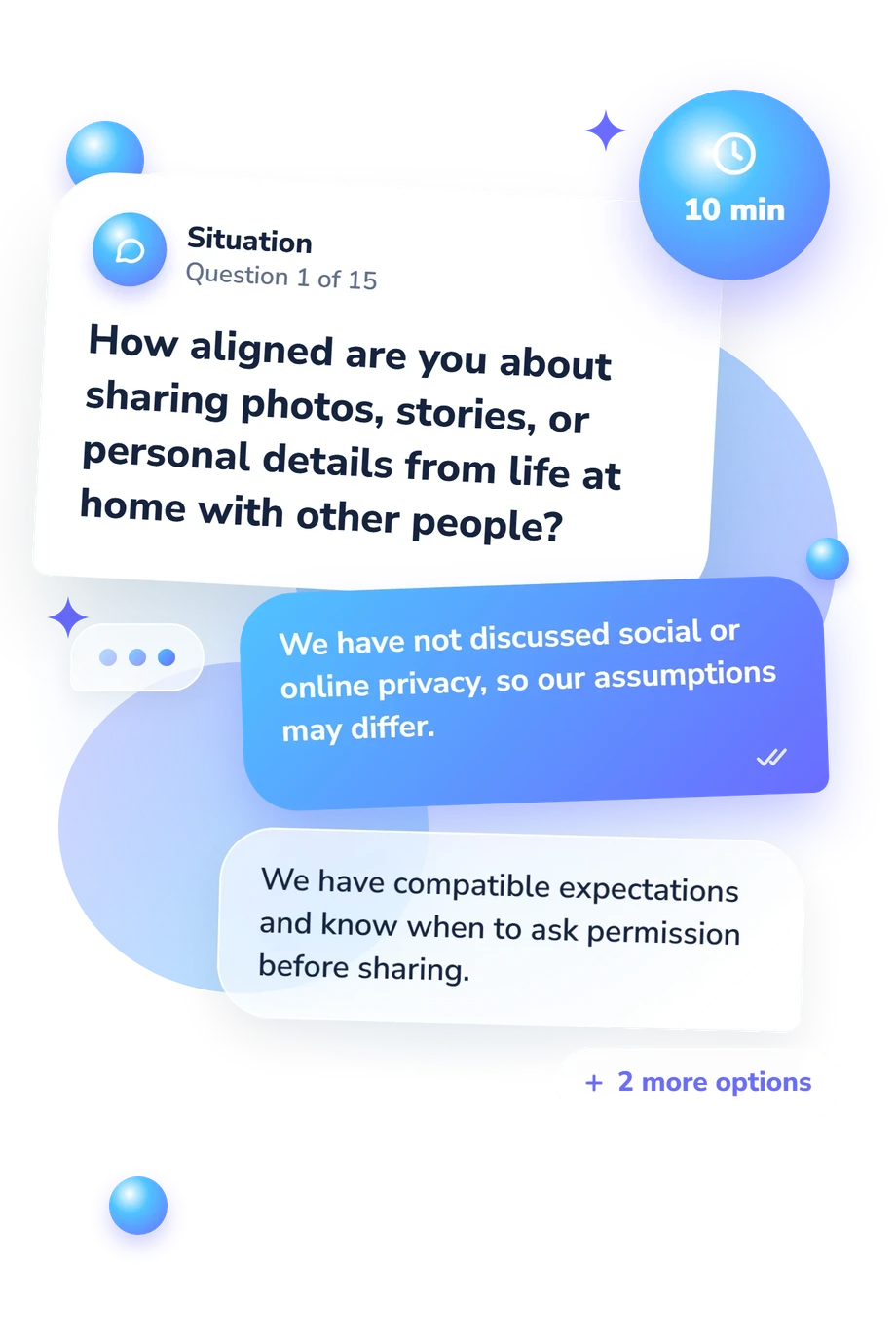
- We have not discussed social or online privacy, so our assumptions may differ.
- We have compatible expectations and know when to ask permission before sharing.
- One of us prefers open sharing while the other wants strong privacy, and the difference remains unresolved.
- Our preferences differ somewhat, but we can agree on clear topics or situations that require consent.
- Our routines and expectations for quiet line up closely.
- Our schedules differ, but we have agreed on quiet hours that suit both of us.
- We have only discussed this generally and expect to adapt as needed.
- One person's necessary activity would regularly disrupt the other's rest, and we have no workable plan.
- We have not seen each other make shared decisions, so we are mostly guessing about compatibility.
- One person expects to decide independently while the other expects equal input, and this remains unresolved.
- We both know what requires joint input and can reach a practical decision under time pressure.
- Our pace differs, but we can use an agreed method to make the immediate choice and review it later.
Roommate Compatibility Quiz - Description and methodology of the test
People deciding whether to share a home can use this assessment to examine practical fit before a lease, move, or housing commitment. The roommate compatibility quiz is intended for friends, partners, classmates, or other prospective housemates who want a structured conversation about expectations rather than relying on goodwill alone. The roommate quiz format gives prospective housemates a structured way to compare and discuss everyday arrangements.
What This Assessment Explores
It assesses shared-home fit. Items address privacy, guests, possessions, quiet, sleep, solitude, chores, cleanliness, food, expenses, decisions, and concerns. As a quiz for college roommate compatibility, it exposes friction hidden by friendship or first impressions and applies to other shared homes.
Three dimensions show where attention is needed:
- Boundaries and Social Fit (0-15) measures alignment on guests, possessions, privacy, alone time, and quiet; bands are Needs Attention (0-5), Partial Fit (6-10), and Strong Fit (11-15).
- Communication and Conflict Fit (0-15) measures fit in communication, problem-solving, and follow-through; bands are Communication gap (0-5), Developing process (6-10), and Strong fit (11-15).
- Daily Living Alignment (0-15) measures alignment in routines, cleanliness, chores, expenses, and kitchen use; bands are Needs negotiation (0-5), Workable alignment (6-10), and Strong routine fit (11-15).
Methodology and Evidence Base
Each item presents a concrete household situation with four response choices. Options range from close alignment and established agreements to partial discussion or unresolved differences, asking respondents to judge a likely shared pattern rather than an abstract personality type. This keeps attention on expectations roommates can clarify before moving in.
The questionnaire reports results on the three displayed dimensions and their result bands, but the contribution made by each response is not stated.
The closest conceptual source is the Roommate Relationship Scale from Willis and Lane in 2022. This questionnaire is conceptually consistent with that work, not an adaptation. Carey and colleagues' 1988 work offers a roommate-rapport precedent, and Erb and colleagues' 2014 work places roommate relationships in a broader shared-living context.
The cited studies do not validate or provide norms for this online questionnaire. With college housing as one context, this assessment can serve as a roommate quiz for college students while helping other prospective housemates prepare for a move. Self-report may reflect current circumstances, wishful answers, incomplete conversations, or limited self-awareness. A strong result cannot guarantee easy conflict resolution.
- Willis, Mairéad A., and Sean P. Lane. (2022). Preliminary evidence for the factor structure, concurrent validity, and construct validity of the Roommate Relationship Scale in a college sample. Frontiers in Psychology, 13, 960421. 10.3389/fpsyg.2022.960421
- Carey, John C., D'Lisa A. Stanley, Charles J. Werring, and Douglas W. Yarbrough. (1988). Development of a short form of the roommate rapport scale. Measurement and Evaluation in Counseling and Development, 20(4), 175-180. 10.1080/07481756.1988.12022869
- Erb, Sarah E., Keith D. Renshaw, Jerome L. Short, and Jeffrey W. Pollard. (2014). The importance of college roommate relationships: A review and systemic conceptualization. Journal of Student Affairs Research and Practice, 51(1), 43-55. 10.1515/jsarp-2014-0004
Updated: