
Naughty or Nice List Quiz
How the Scales are Structured
Who Usually Takes This Test?
See How You Compare
Below is a preview of how scores are typically distributed across each scale.
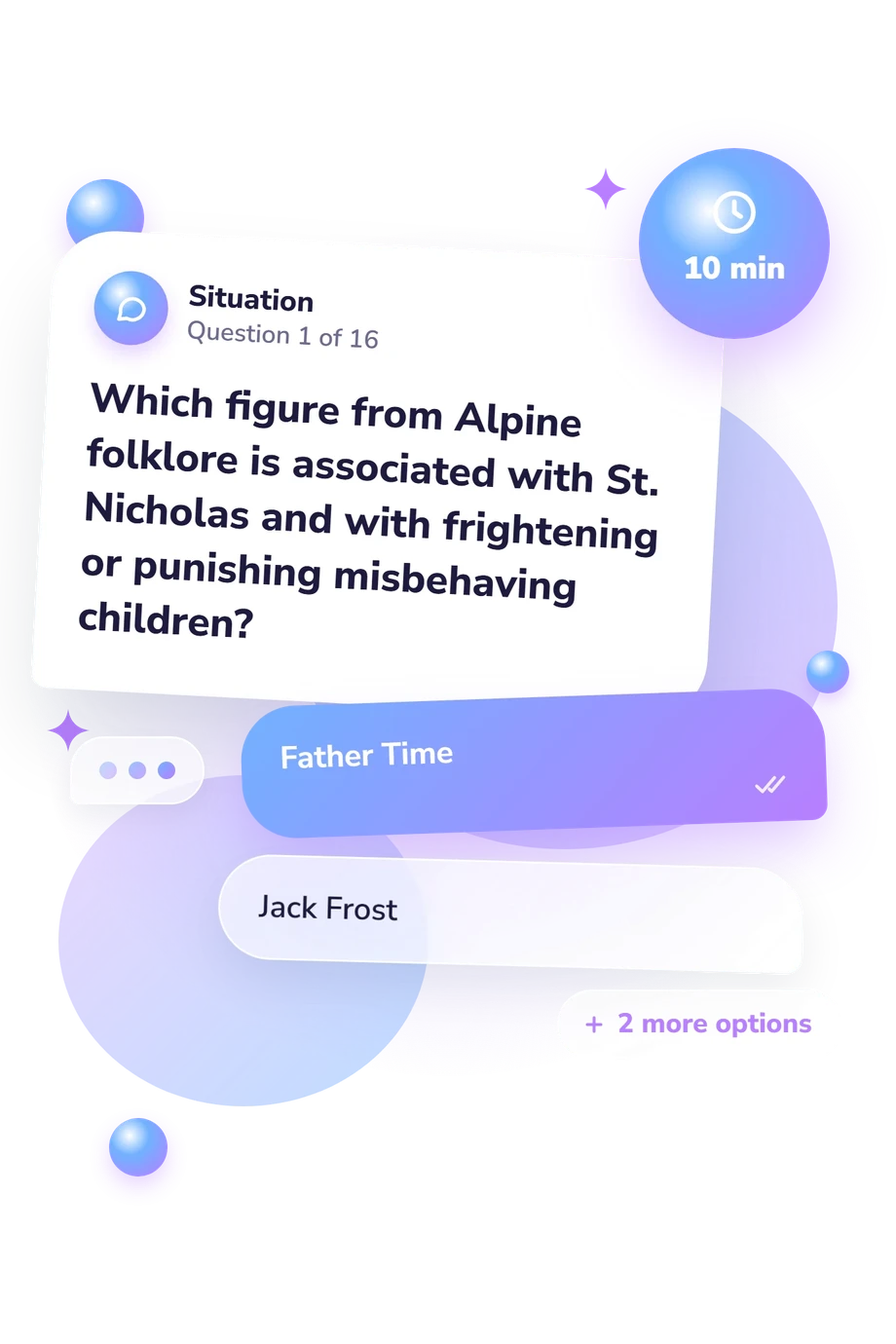
Example Questions From the Test
- Father Time
- Jack Frost
- Krampus
- The Nutcracker
- “You better watch out.”
- “You better not pout.”
- “Santa Claus is comin’ to town.”
- “He knows if you’ve been bad or good.”
- He hides it until Christmas morning.
- He makes it and checks it twice.
- He sends it to every household.
- He replaces it with children’s letters.
Naughty or Nice List Quiz - Description and methodology of the test
Readers deciding whether they want a playful test of seasonal knowledge can use the Naughty or Nice List Quiz to check their familiarity with the cultural idea behind Santa’s list. This naughty or nice quiz suits anyone curious about how holiday traditions distinguish conduct in stories, without turning the title into a judgment of personal behavior. It offers a light, self-guided challenge for curious holiday readers.
What This Assessment Explores
This questionnaire examines the conduct-list motif across Santa stories, songs, folklore, and films. It asks readers to identify figures such as Krampus, Sinterklaas, and La Befana, recognize lyrics and plots, and interpret symbolic gifts. Seasonal knowledge, not personal behavior, is the focus.
Some readers may expect this to be an am i on the nice list quiz that delivers a personal verdict, but the questionnaire measures familiarity with a fictional and folkloric motif. It does not rate kindness or obedience.
One scale, Naughty or Nice List Knowledge, ranges from 0-16. Its bands describe recognition of the motif:
- List Learner (0-6) means several seasonal ideas, lyrics, or story details may still be new.
- Cheerful Scholar (7-12) shows solid knowledge of the motif, folklore, and screen stories.
- North Pole Expert (13-16) reflects accurate recognition of related traditions and familiar canon.
Methodology and Evidence Base
Each item presents four choices and asks for the best identification or interpretation. The content moves among lyrics, folklore, character relationships, and film plots, so performance depends on recall and cultural familiarity. Context matters when traditions use similar ideas about gifts or punishment.
The questionnaire reports one overall score for knowledge of this selected seasonal content. It is a content-based entertainment knowledge questionnaire rather than a published instrument with a documented validation record, and the displayed score is not presented as a standardized psychological measure. The items themselves make the am i naughty or nice quiz a knowledge check: they ask readers to attend to wording and cultural distinctions in the material.
The test’s status is therefore straightforward: it offers a structured way to check recognition of selected holiday references, while its score does not establish knowledge beyond the selected references or broader cultural expertise. Media exposure, language, cultural background, memory, and current attention can affect performance, so the result is best read within the narrow content scope of this questionnaire.
- Rohan Kapitany, Kathryn B. Francis, Matti Wilks, Christopher Michael Kavanagh, and Harvey Whitehouse (2025). “Children’s belief in Santa Claus and Moral behavior: A two-wave longitudinal study of children’s prosocial behavior during Christmas.” Current Research in Behavioral Sciences, 9, 100188. 10.1016/j.crbeha.2025.100188
- Ann-Marie Kennedy, Martin K. J. Waiguny, and Maree Alice Lockie (2021). “Children’s consumption culture development through Christmas myths: ethical implications.” Young Consumers, 23(2), 321-343. 10.1108/YC-05-2021-1333
- Gerald Bowler (2005). Santa Claus: A Biography. McClelland & Stewart.
Updated: