
Body Systems Quiz
How the Scales are Structured
Who Usually Takes This Test?
See How You Compare
Below is a preview of how scores are typically distributed across each scale.
Example Questions From the Test
- Stomach
- Esophagus
- Large intestine
- Small intestine
- Nervous system
- Muscular system
- Endocrine system
- Lymphatic system
- Bone marrow
- Articular cartilage
- Skeletal muscle
- Adipose tissue
Body Systems Quiz - Description and methodology of the test
For learners, educators, and people reviewing body-systems knowledge, this body systems quiz offers a structured way to connect major organs with the jobs they perform and the systems that coordinate them. It is useful when you want to check foundational anatomy knowledge without treating isolated facts as the whole subject. This quiz about human body systems can also point toward topics that deserve closer review or classroom discussion.
What This Assessment Explores
Questions ask respondents to identify structures, explain functions, and apply relationships across digestion, movement, respiration, circulation, protection, hormonal regulation, excretion, immunity, acid-base balance, and reproduction. The assessment combines these topics in a biology quiz about body systems, testing more than naming: it asks which process or system best explains situations such as withdrawing from heat or transporting oxygen during exercise.
The main content areas are:
- Organ functions and system coordination show how structures perform tasks and cooperate.
- Protection and communication connect skin, immunity, nerves, and hormones with body responses.
- Movement, digestion, excretion, and reproduction show how tissues and organs support whole-body function.
Your result is Body Systems Knowledge on a 0-16 scale. Foundations to build (0-6) suggests reviewing major organs and primary functions; Developing knowledge (7-12) indicates many core relationships with distinctions to strengthen; Strong knowledge (13-16) reflects well-developed understanding of major systems and their cooperation.
Methodology and Scientific Basis
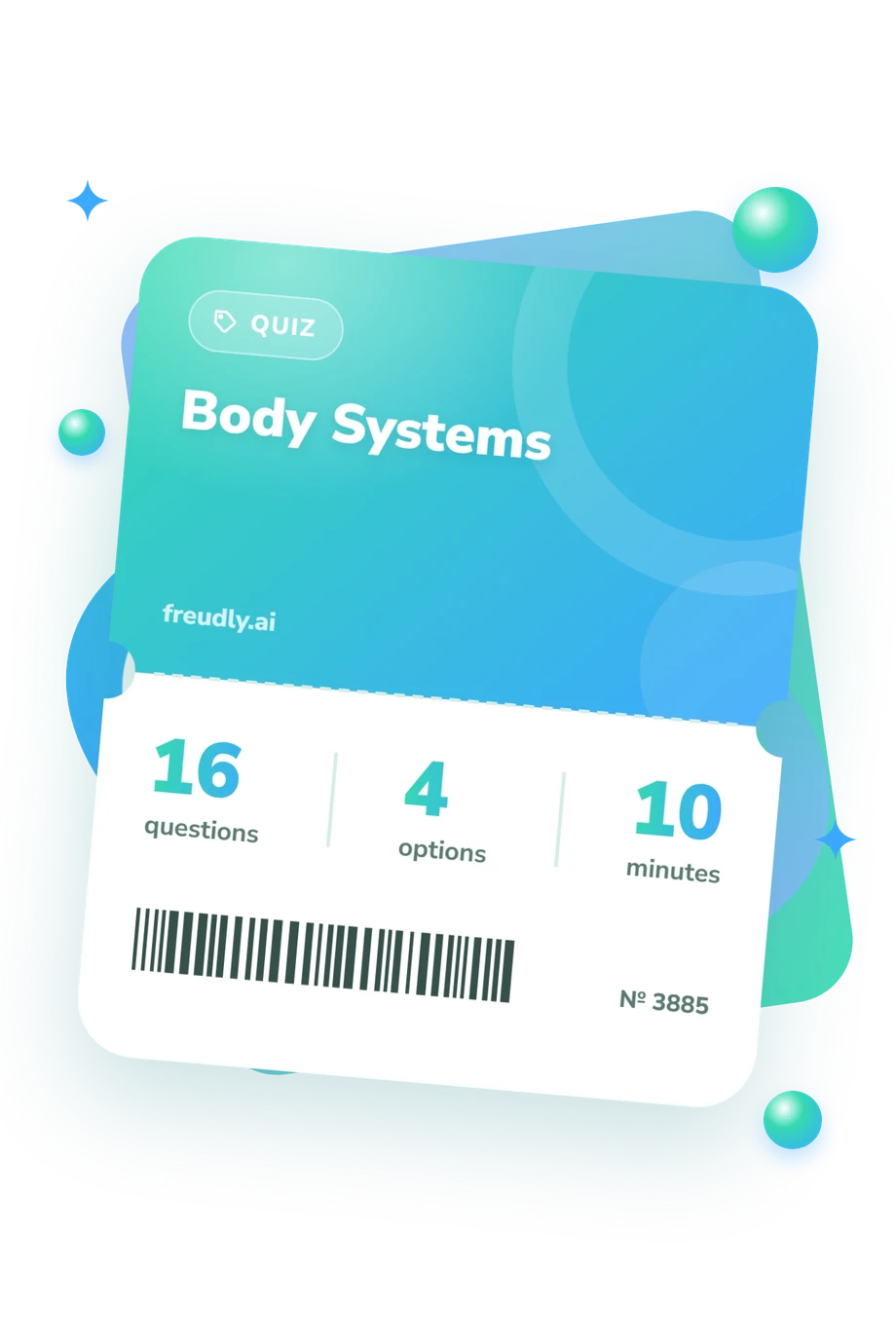
Each item presents a multiple-choice prompt with four answer options. Questions ask for an organ, tissue, or system, or describe exercise, infection, temperature, swallowing, or blood chemistry. The format combines recognition with basic application, so the selected answer reflects factual recall and understanding of relationships.
Scoring produces the questionnaire’s single educational outcome. One displayed educational scale summarizes the answers, and its bands describe performance within this learning format, helping readers decide whether to review organ functions, system relationships, or the cooperation among systems.
Conceptually, the content is consistent with Achievement Test on Body Systems (Yerlikaya and Güneş, 2016), but it is not presented as a reproduction or validated adaptation. OpenStax anatomy and physiology (Betts et al., 2022) supports the organ functions and system interactions, while Choudhury and Freemont (2017) place structured anatomical assessment in an educational context.
For study planning, this human systems quiz asks how body systems interact and offers a useful snapshot. Results can vary with prior coursework, terminology familiarity, guessing, attention, and current context, so the score is an educational indicator rather than a medical assessment or diagnosis.
- Aslı Yerlikaya and M. Handan Güneş (2016). Development and Validation of the Achievement Test on Body Systems. Participatory Educational Research, 4(1), 68-76.
- J. Gordon Betts, Kelly A. Young, James A. Wise, Eddie Johnson, Brandon Poe, Dean H. Kruse, Oksana Korol, Jody E. Johnson, Mark Womble, and Peter DeSaix (2022). Anatomy and Physiology 2e. OpenStax, Rice University, Houston, Texas.
- Bipasha Choudhury and Anthony Freemont (2017). Assessment of anatomical knowledge: Approaches taken by higher education institutions. Clinical Anatomy, 30(3), 290-299. 10.1002/ca.22835
Updated: