
Long Bone Labeling Quiz
How the Scales are Structured
Who Usually Takes This Test?
See How You Compare
Below is a preview of how scores are typically distributed across each scale.
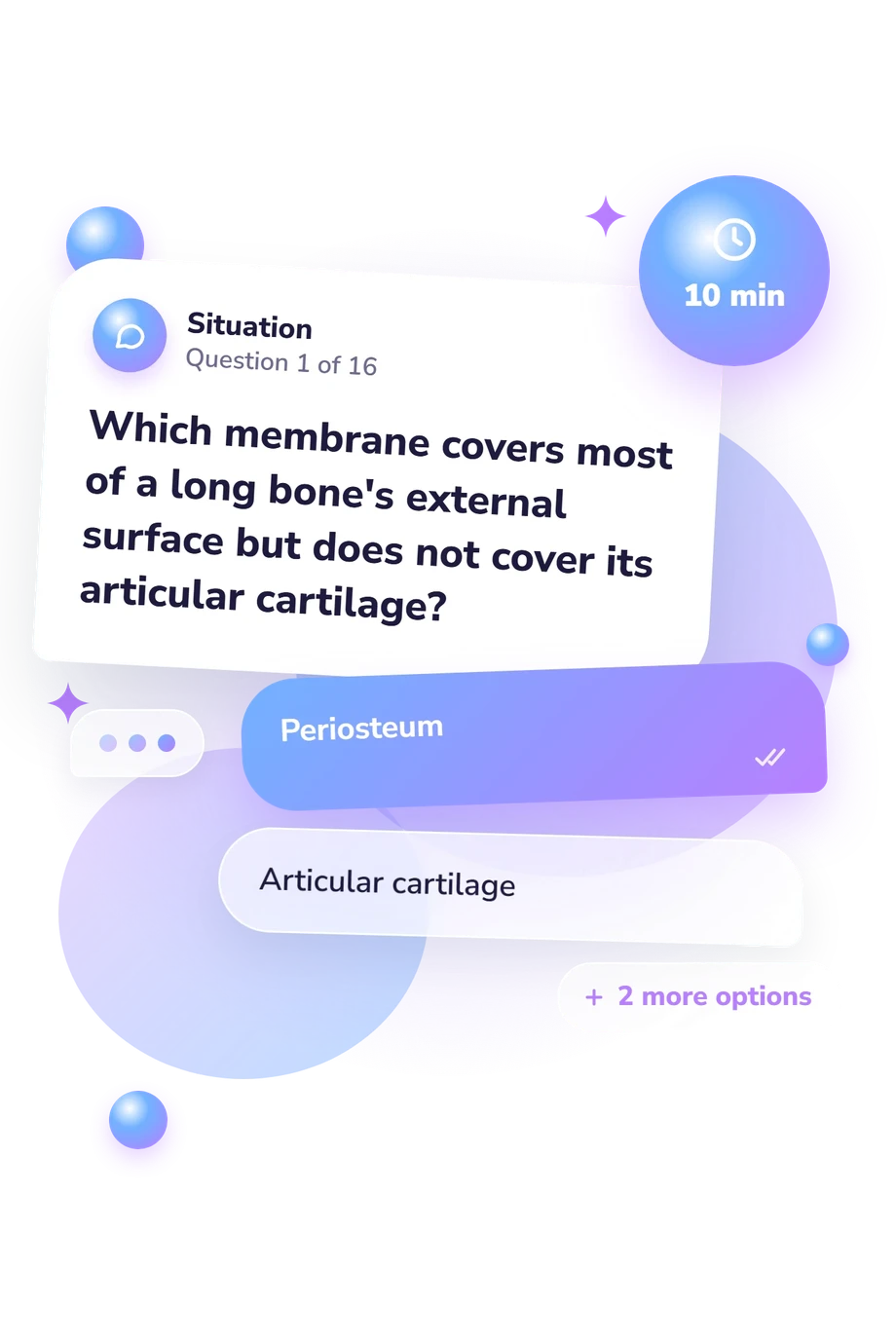
Example Questions From the Test
- Periosteum
- Articular cartilage
- Endosteum
- Synovial membrane
- Diaphysis
- Nutrient foramen
- Medullary cavity
- Epiphysis
- Spongy bone
- Compact bone
- Yellow marrow
- Articular cartilage
Long Bone Labeling Quiz - Description and methodology of the test
Students, instructors, and independent learners who want to check their grasp of skeletal anatomy can use the long bone labeling quiz as a focused knowledge check. It is especially useful when terms such as diaphysis, epiphysis, periosteum, marrow, and trabeculae feel easy to confuse. A long bone anatomy quiz of this kind produces a practical profile of which structural labels are secure and which deserve review.
What This Assessment Measures
Questions cover regions, coverings, tissues, cavities, marrow, and vascular or growth landmarks. The result shows how reliably a written clue becomes a precise label, making the long bone quiz useful for learners connecting location, appearance, function, and development.
The main thematic groups represented in the result are:
- Regional landmarks show whether you identify the shaft, ends, metaphysis, and proximal or distal position.
- Coverings and surfaces indicate whether you separate periosteum, endosteum, and articular cartilage.
- Internal tissues and spaces reveal how you label bone, marrow, cavities, and trabeculae.
- Growth and vascular landmarks reflect recognition of the epiphyseal plate or line and nutrient foramen.
Long Bone Labeling Knowledge (0-16) measures identification from written clues: Foundation Building (0-6) calls for review; Developing Knowledge (7-12) shows many correct labels with some confusion; Strong Knowledge (13-16) reflects accurate identification of most landmarks.
Methodology and Evidence Base
Methodologically, this is a structured multiple-choice knowledge assessment. Each item presents an anatomical situation with four answer choices, requiring recognition of the best term from location, tissue, function, or development. Although verbal rather than image-based, the long bone diagram quiz format tests figure-labeling distinctions and focuses on identification.
As an anatomy of a long bone quiz, it reports one overall knowledge result rather than separate subscores. Its answer weighting is not specified, so interpretation should follow the displayed band rather than an assumed formula.
Betts et al. (2022) supplies the core framework for regions, coverings, cavities, and marrow. Drake, Vogl, and Mitchell (2019) supports regional terminology; Mescher (2021) clarifies tissue distinctions; and Florencio-Silva et al. (2015) adds focused bone-tissue biology. The questionnaire is conceptually consistent with these sources, not an adaptation or validated reproduction of any one of them.
Without stated norming or reliability evidence for this version, the result is best treated as a current study signal. Prior exposure, honest responding, and anatomical vocabulary can affect performance, so the band identifies review priorities rather than overall competence.
- Betts, J. Gordon, Kelly A. Young, James A. Wise, Eddie Johnson, Brandon Poe, Dean H. Kruse, Oksana Korol, Jody E. Johnson, Mark Womble, and Peter DeSaix. Anatomy and Physiology 2e. Houston, TX: OpenStax, Rice University, 2022.
- Drake, Richard L., A. Wayne Vogl, and Adam W. M. Mitchell. Gray's Anatomy for Students. 4th ed. Elsevier, 2019.
- Mescher, Anthony L. Junqueira's Basic Histology: Text and Atlas. 16th ed. New York: McGraw Hill, 2021.
- Florencio-Silva, Rinaldo, Gisela Rodrigues da Silva Sasso, Estela Sasso-Cerri, Manuel Jesus Simoes, and Paulo Sergio Cerri. Biology of Bone Tissue: Structure, Function, and Factors That Influence Bone Cells. BioMed Research International, 2015, article 421746. 10.1155/2015/421746
Updated: