
Sexual Archetype Quiz
How the Scales are Structured
Who Usually Takes This Test?
See How You Compare
Below is a preview of how scores are typically distributed across each scale.
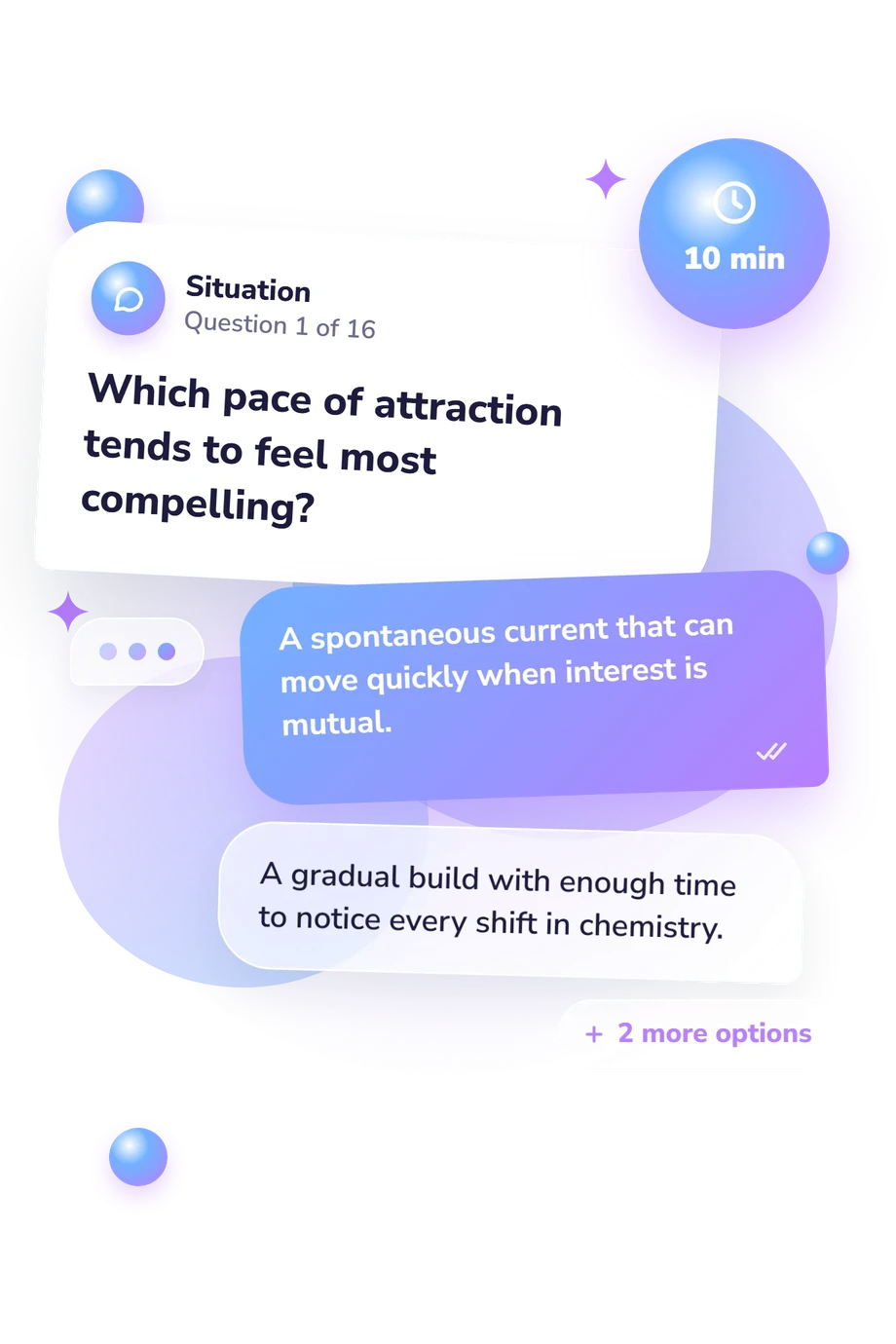
Example Questions From the Test
- A warm check-in that makes my interest easy to understand.
- A playful callback to an inside joke we have developed.
- A curious question with a lightly suggestive double meaning.
- A friendly invitation with a touch of humor.
- I initiate after receiving several encouraging signals.
- I often initiate when the moment feels promising.
- I generally prefer the other person to set things in motion.
- I enjoy taking the lead and making my attraction clear.
- Keep the routine but add one amusing or unexpected detail.
- Replace the plan with a surprise adventure or invented challenge.
- Enjoy the familiarity rather than changing something that works.
- Choose a different activity together after comparing a few ideas.
Sexual Archetype Quiz - Description and methodology of the test
People who want clearer language for how they experience attraction, create chemistry, and express interest can use this sexual archetype quiz to reflect on patterns that make connection engaging, intimate, and mutually desired. The test is designed for adults considering their own patterns rather than seeking a fixed label. This sex archetype quiz explores recurring ways of experiencing attraction, creating chemistry, and expressing interest rather than assigning a permanent identity.
What This Assessment Explores
Four routes through chemistry are examined: emotional attunement, direct initiation, playful novelty, and sensory pacing. The situations involve flirting, planning, atmosphere, personal disclosure, first moves, and changing romantic circumstances. The resulting sexual archetype profile presents a preferred attraction style while allowing preferences to overlap.
The four displayed scales describe the result as follows:
- Attuned Romantic (0-12) measures attraction through personal recognition: Independent Chemistry 0-4, Selective Attunement 5-8, Signature Attunement 9-12.
- Direct Spark (0-12) measures clear initiation: Receptive Presence 0-4, Situational Spark 5-8, Signature Spark 9-12.
- Playful Tease (0-12) measures chemistry through wit and novelty: Steady Expression 0-4, Playful Accent 5-8, Signature Play 9-12.
- Sensual Slow-Burn (0-12) measures atmosphere and anticipation: Immediate Flow 0-4, Selective Slow-Burn 5-8, Signature Slow-Burn 9-12.
Methodology and Scientific Basis
Each item presents a romantic or intimate situation with four response options. The choices vary in pace, initiative, emotional personalization, sensory attention, or playfulness. Selecting the response that best matches your usual inclination creates a comparative profile rather than a measure of how much desire you should have.
The questionnaire functions as a sexual archetype assessment and is conceptually consistent with Questionnaire for Turn-On Initiation Preference (Zebroff, 2021), particularly its distinction between initiating desire and responding to it. Women’s Sexual Self-Schema (Andersen and Cyranowski, 1994) and the Sexual Desire Inventory (Spector, Carey, and Steinberg, 1996) offer background on adjacent constructs-sexual self-concept and desire-not on these four attraction styles. The questionnaire is not an adaptation of those instruments, and their psychometric findings do not support or validate this profile.
The displayed scoring presents a reflective profile with descriptive bands; it is not a validated or diagnostic classification. Self-report can be shaped by current mood, relationship context, self-awareness, or the wish to present oneself favorably, so use the profile to notice preferences and discuss mutual comfort, boundaries, and consent.
- Zebroff, P. (2021). Questionnaire for Turn-On Initiation Preference: Development and Initial Reliability and Validation. Journal of Sex Research, 58(8), 1019-1034. 10.1080/00224499.2021.1898525
- Andersen, B. L., & Cyranowski, J. M. (1994). Women's Sexual Self-Schema. Journal of Personality and Social Psychology, 67(6), 1079-1100. 10.1037/0022-3514.67.6.1079
- Spector, I. P., Carey, M. P., & Steinberg, L. (1996). The Sexual Desire Inventory: Development, Factor Structure, and Evidence of Reliability. Journal of Sex & Marital Therapy, 22(3), 175-190. 10.1080/00926239608414655
Updated: