
Vacation Finder Quiz
How the Scales are Structured
Who Usually Takes This Test?
See How You Compare
Below is a preview of how scores are typically distributed across each scale.
Example Questions From the Test
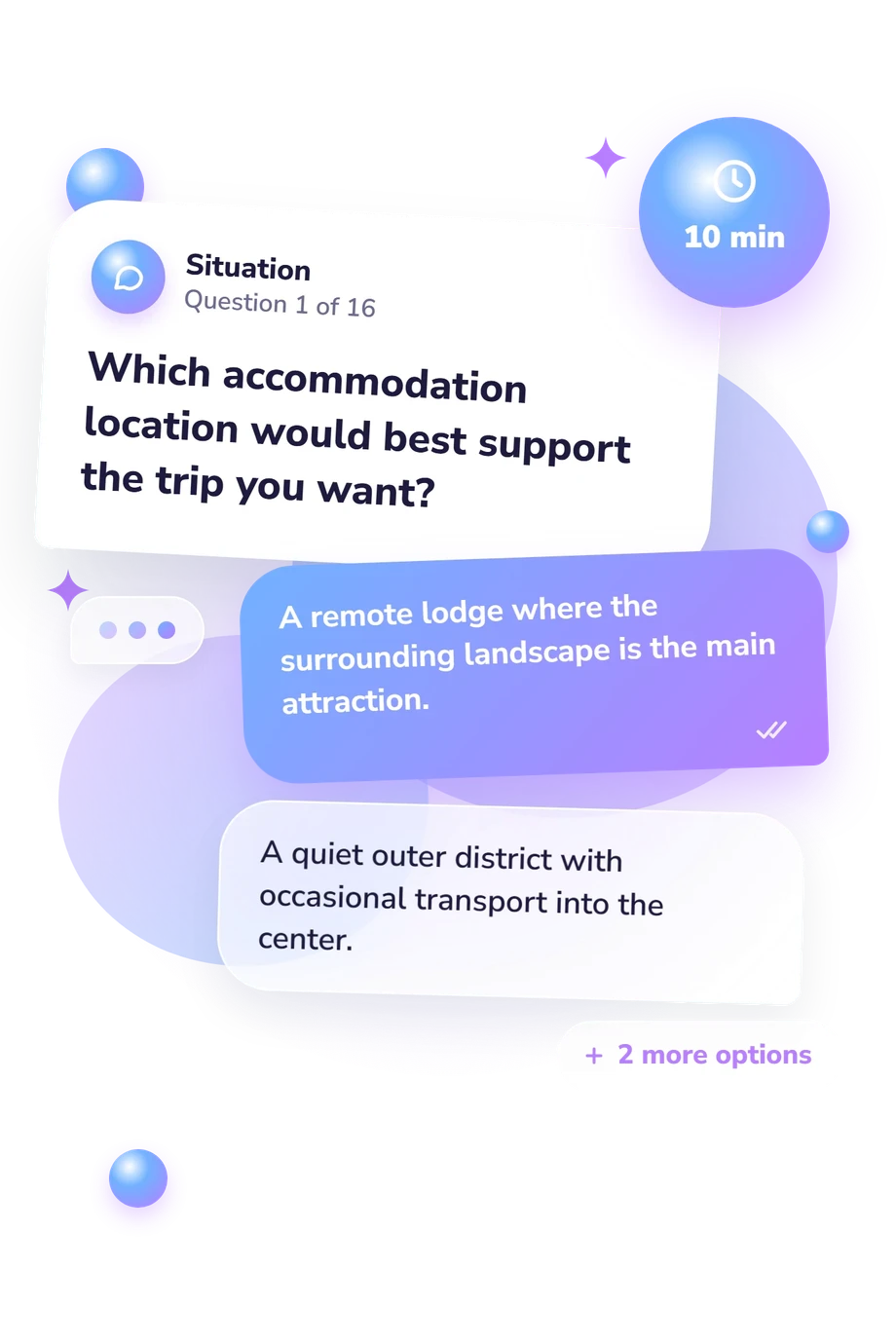
- A remote lodge where the surrounding landscape is the main attraction.
- A quiet outer district with occasional transport into the center.
- A walkable neighborhood with restaurants and a few major sights nearby.
- A central base with easy access to many districts, venues, and late-night options.
- It would still be an excellent match because the coastline can anchor the trip.
- I might visit briefly, but I would choose a place with more inland variety for a full trip.
- It could work if I could alternate beach days with a few other activities.
- I would probably select another destination with more cultural sightseeing.
- A central location near restaurants, shops, and transit.
- A pleasant pool area with an occasional shuttle to the shore.
- A coastal view and a walkable route to several local attractions.
- Direct beach access with space to swim or relax by the sea.
Vacation Finder Quiz - Description and methodology of the test
Travelers comparing destinations with different kinds of appeal can use the vacation finder quiz to clarify what they want from a trip. It suits someone weighing cultural variety against outdoor challenge, quiet local routines, or dependable beach time. Read as a what country should i visit quiz, it turns broad preferences into a practical travel-style profile rather than a single destination recommendation.
What This Assessment Explores
The questionnaire compares four vacation settings by surroundings, activities, pace, and practical trade-offs. It shows which style fits the respondent; it does not name a country.
Four dimensions organise results:
- Culture-Rich City Break (0-12) measures urban culture and pace: City Side Trip (0-4), Urban Explorer (5-8), or Culture-Centered Break (9-12).
- Mountain & Wilderness Adventure (0-12) measures outdoor challenge and terrain: Scenic Glimpse (0-4), Outdoor Mix (5-8), Wilderness Calling (9-12).
- Slow Countryside Retreat (0-12) measures rural calm and local pacing: Rural Detour (0-4), Restful Roamer (5-8), Slow-Country Retreat (9-12).
- Tropical Beach Escape (0-12) measures coast-centered relaxation: Optional Shoreline (0-4), Coastal Appeal (5-8), Ocean-Led Escape (9-12).
A where to go on vacation quiz can show which settings deserve priority. The profile concerns fit. For this test, a perfect vacation quiz means one that reflects the respondent’s preferences, not a universally best destination.
Methodology and Evidence Base
Each item presents a travel situation with four response choices. Scenarios vary location, crowds, cultural access, outdoor demands, convenience, beach time, and free space. Choosing the closest option expresses preference without naming a destination.
Answers produce four affinity scores, not one total. The highest marks the strongest match; scores within one point form a blended result. It helps answer the practical question behind a which country should i travel to quiz by showing whether a destination needs cultural variety, demanding landscapes, rural calm, coastal access, or a mix.
The method is conceptually consistent with travel-motivation and activity-based destination-choice research. Varela et al. (2004) is the closest source for grouping travelers by tourism preferences; Moscardo et al. (1996) connects destination choice with motivations and activities. Levina et al. (2016) presents a related needs questionnaire, but this online questionnaire is not an adaptation of those instruments.
Read results as relative preference signals. Self-report can shift with mood, companions, budget, season, or imagined circumstances, and no published norms establish universal cutoffs. Cost, access, weather, and local conditions still shape practical suitability.
- Varela Mallou, Jesús, Eduardo Picón Prado, and Teresa Braña Tobío. (2004). Segmentation of the Spanish domestic tourism market. Psicothema, 16(1), 76-83.
- Moscardo, Gianna, Alastair M. Morrison, Philip L. Pearce, Cheng-Te Lang, and Joseph T. O’Leary. (1996). Understanding vacation destination choice through travel motivation and activities. Journal of Vacation Marketing, 2(2), 109-122. 10.1177/135676679600200202
- Levina, Jelena, Jelena Kolesnikova, and Tatjana Kanonire. (2016). Psychometric Properties of Travelers Needs Questionnaire (TNQ). Society. Integration. Education. Proceedings of the International Scientific Conference, 1, 422-430. 10.17770/sie2016vol1.1523
Updated: