
Woke Quiz
How the Scales are Structured
Who Usually Takes This Test?
See How You Compare
Below is a preview of how scores are typically distributed across each scale.
Example Questions From the Test
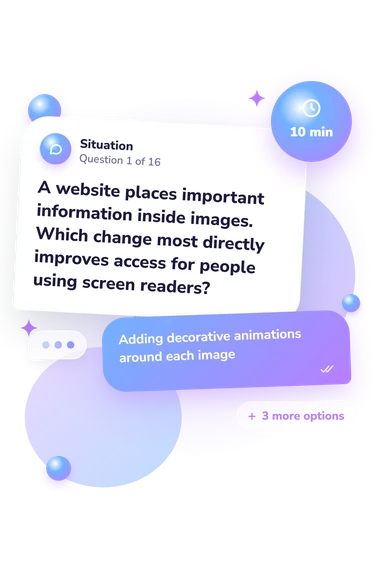
- Adding decorative animations around each image
- Replacing standard fonts with handwritten lettering
- Providing meaningful alternative text for the relevant visual content
- Using color alone to distinguish every instruction
- Economic individualism
- Environmental justice
- Cultural preservation
- Electoral neutrality
- Reject every traditional social custom
- Remain alert to racial injustice and social threats
- Follow breaking political news throughout the day
- Avoid discussing controversial issues in public
Woke Quiz - Description and methodology of the test
Readers who want to check their grasp of social-awareness concepts can use this questionnaire as a focused learning exercise. The woke quiz examines distinctions among accessibility, equity, bias, cultural respect, and allyship without turning the result into a judgment of character, politics, or lived experience. By identifying concepts to review, it gives an am I woke reflection a more precise, knowledge-based answer.
What This Assessment Explores
The questions ask whether a respondent can recognize social-awareness concepts and choose a respectful or equitable response to a situation. They cover access, overlapping identities, historical inequality, cultural boundaries, bias, discrimination, communication, and allyship. Framed by the question how woke are you, the result measures conceptual familiarity-not political identity, moral character, or lived experience.
The themes are:
- Accessibility and equity show whether the respondent distinguishes identical treatment from support for different barriers.
- Identity and power show whether the respondent recognizes intersectionality, redlining, environmental injustice, stereotypes, and systemic discrimination.
- Communication and allyship show whether the respondent identifies respectful language, appropriation, performative support, tone policing, and microaggressions.
Woke Knowledge (0-16) is reported as Foundations to build (0-6), Developing understanding (7-12), or Strong understanding (13-16). These bands indicate increasing recognition and application of the concepts, not a judgment of the person.
Methodology and Scientific Basis
Each item presents a situation or definition with four answer choices. Choosing the option that best identifies the concept or response makes the task one of recognition and application, not agreement. A total is displayed, but no weighting formula is stated; the range alone cannot show how many points an answer adds.
Conceptually, the questionnaire is consistent with the Diversity and Oppression Scale (Windsor et al., 2015), a precedent for assessing learning about diversity and oppression. This is a thematic relationship, not a claim that the online version adapts or shares validation with that instrument.
Lahtinen (2024) offers related context for critical social justice attitudes, and Crenshaw’s framework explains why overlapping identities and structural conditions appear among the concepts. These sources do not establish authorship, norms, reliability, or standardization for this questionnaire.
An are you woke reflection can guide review of unfamiliar terms and examples. As a self-report learning check, results remain sensitive to attention, current context, self-awareness, and social-desirability pressure. The question how woke am I is best treated as a learning signal, not a complete account of understanding.
- Windsor, Liliane Cambraia, Clay Shorkey, and DuWayne Battle. (2015). Measuring Student Learning in Social Justice Courses: The Diversity and Oppression Scale. Journal of Social Work Education, 51(1), 58-71. 10.1080/10437797.2015.977133
- Lahtinen, Oskari. (2024). Construction and validation of a scale for assessing critical social justice attitudes. Scandinavian Journal of Psychology, 65(4), 693-705. 10.1111/sjop.13018
- Crenshaw, Kimberlé W. (1989). Demarginalizing the Intersection of Race and Sex: A Black Feminist Critique of Antidiscrimination Doctrine, Feminist Theory and Antiracist Politics. University of Chicago Legal Forum, 1989(1), 139-167.
Updated: