
Bible Quiz App
How the Scales are Structured
Who Usually Takes This Test?
See How You Compare
Below is a preview of how scores are typically distributed across each scale.
Example Questions From the Test
- They remained and stopped the jailer from harming himself
- They escaped before the guards arrived
- They demanded that the jailer be punished
- They hid until the prison was empty
- Prayer offered by church leaders
- The shield of faith
- The word of God
- The breastplate of righteousness
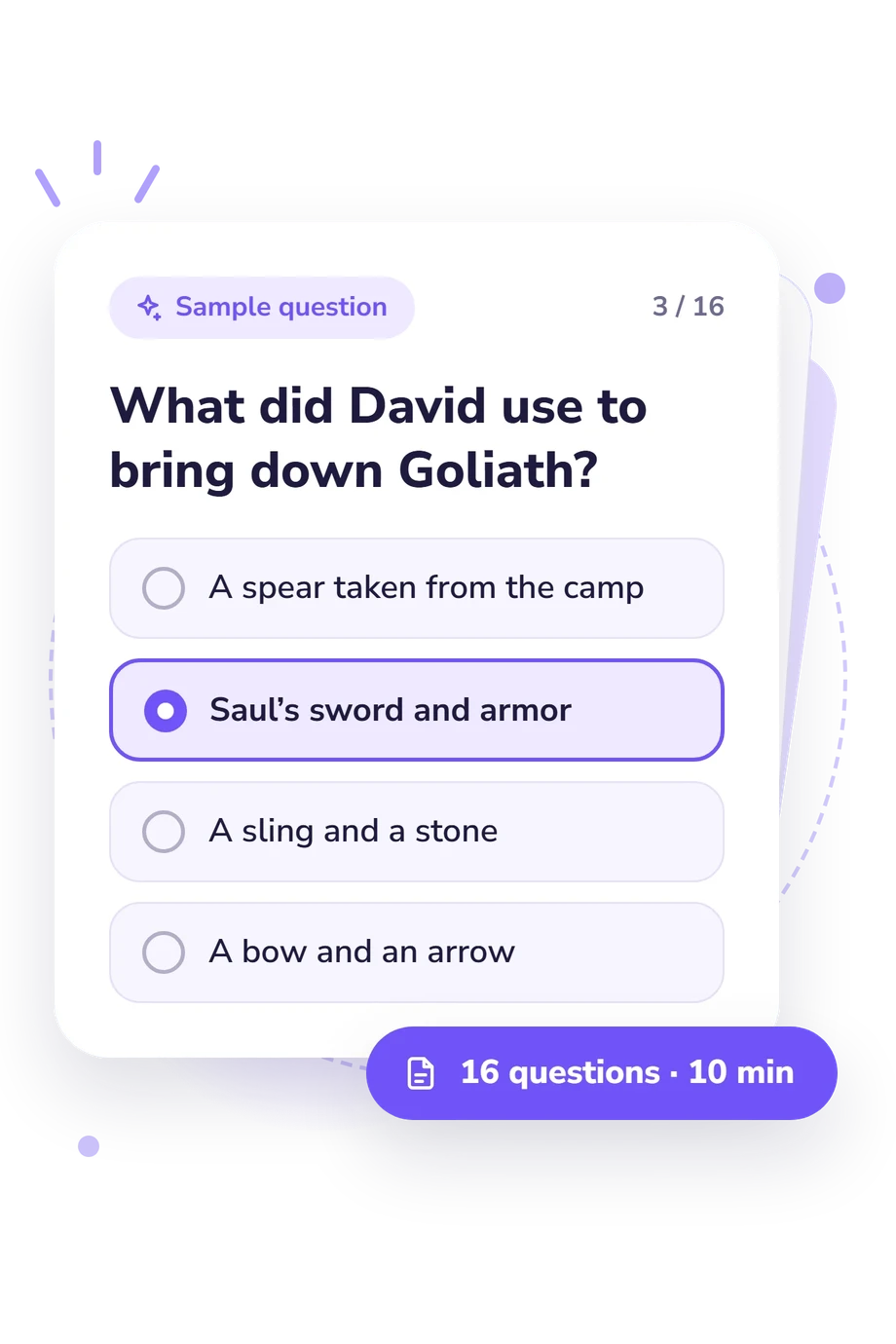
- A spear taken from the camp
- Saul’s sword and armor
- A sling and a stone
- A bow and an arrow
Bible Quiz App - Description and methodology of the test
People who want to revisit scripture through familiar stories and teachings can use the Bible Quiz App as a focused self-check. It suits readers who enjoy free bible quiz games and want a structured way to test recall across both Testaments. The result can point toward passages to reread, topics to discuss, or gaps to revisit without turning a short exercise into a judgment about faith or devotion.
What This Assessment Explores
Questions cover biblical narratives, named people and places, historical events, teachings, parables, and principles such as mercy, faith, forgiveness, and love of enemies. Some require you to apply a teaching to a situation rather than recall a phrase.
The Bible Knowledge scale runs from 0-16: Foundations to Build (0-6) reflects some central familiarity; Developing Knowledge (7-12) reflects a useful grasp with challenging details; Strong Knowledge (13-16) reflects broad, accurate familiarity across both Testaments. The bands describe performance here, not spiritual maturity.
The result highlights three content areas:
- Narrative recall shows whether you identify key events and outcomes.
- People and places reveal whether you connect figures and locations with their stories.
- Teachings in practice indicates whether you recognize biblical principles in context.
For readers choosing the best app for Bible quizzes, this is a practical route to targeted review.
Methodology and Evidence Base
Each item presents a question followed by four answer choices, and you select the option that best matches the biblical account or teaching. The responses are combined into a total and reported through the displayed bands; no additional weighting or point value per option is stated.
The closest conceptual reference is Biblical Literacy Assessment (Dennery, 2012), which uses structured knowledge questions to examine biblical literacy. The format is also compatible with the ABHE Bible Knowledge Exam and with the religious-knowledge questionnaire developed by Schnaufer and colleagues in 2023. These works support the construct and selected-response approach, but this questionnaire is not presented as an adaptation or validation of them.
The questionnaire is an online self-reflection measure rather than a standardized test with published norms, reliability estimates, or clinical cutoffs. Results may shift with Bible translation, previous study, guessing, concentration, and how readily a respondent recognizes contextual meaning. As one of the Bible quiz games available for free download, this assessment is best read as a snapshot for study planning, not a complete account of biblical literacy.
- Dennery, Cecilia Arona Baptiste. (2012). A Correlational Study of Biblical Literacy and the Level of Leadership, Discipleship, and Demographics in an African American Church in Delaware. Doctoral dissertation, Wilmington University.
- Association for Biblical Higher Education. (2020). Bible Knowledge Exam: An ABHE Bible Knowledge Assessment Tool.
- Schnaufer, Evelyn, Mirjam Rutkowski, Antti Räsänen, Christina Osbeck, and Friedrich Schweitzer. (2023). Developing a Research Tool for Investigating Religious Knowledge as Part of Religious Literacy: The Questionnaire - First Results - Possibilities for International Comparisons. JET. Journal of Empirical Theology, 35(2), 223-250. 10.1163/15709256-20231146
Updated: