
Golf Quiz
How the Scales are Structured
Who Usually Takes This Test?
See How You Compare
Below is a preview of how scores are typically distributed across each scale.
Example Questions From the Test
- Removing a loose impediment without causing the ball to move
- Digging the feet into the sand to take a stance
- Touching the sand with the club immediately behind the ball
- Making a practice swing without touching the sand
- Sam, because tied players always play before the hole winner
- Priya, because she recorded the lowest score on the previous hole
- Lee, because the previous playing order must be reversed
- Any player, because the previous hole never affects teeing order
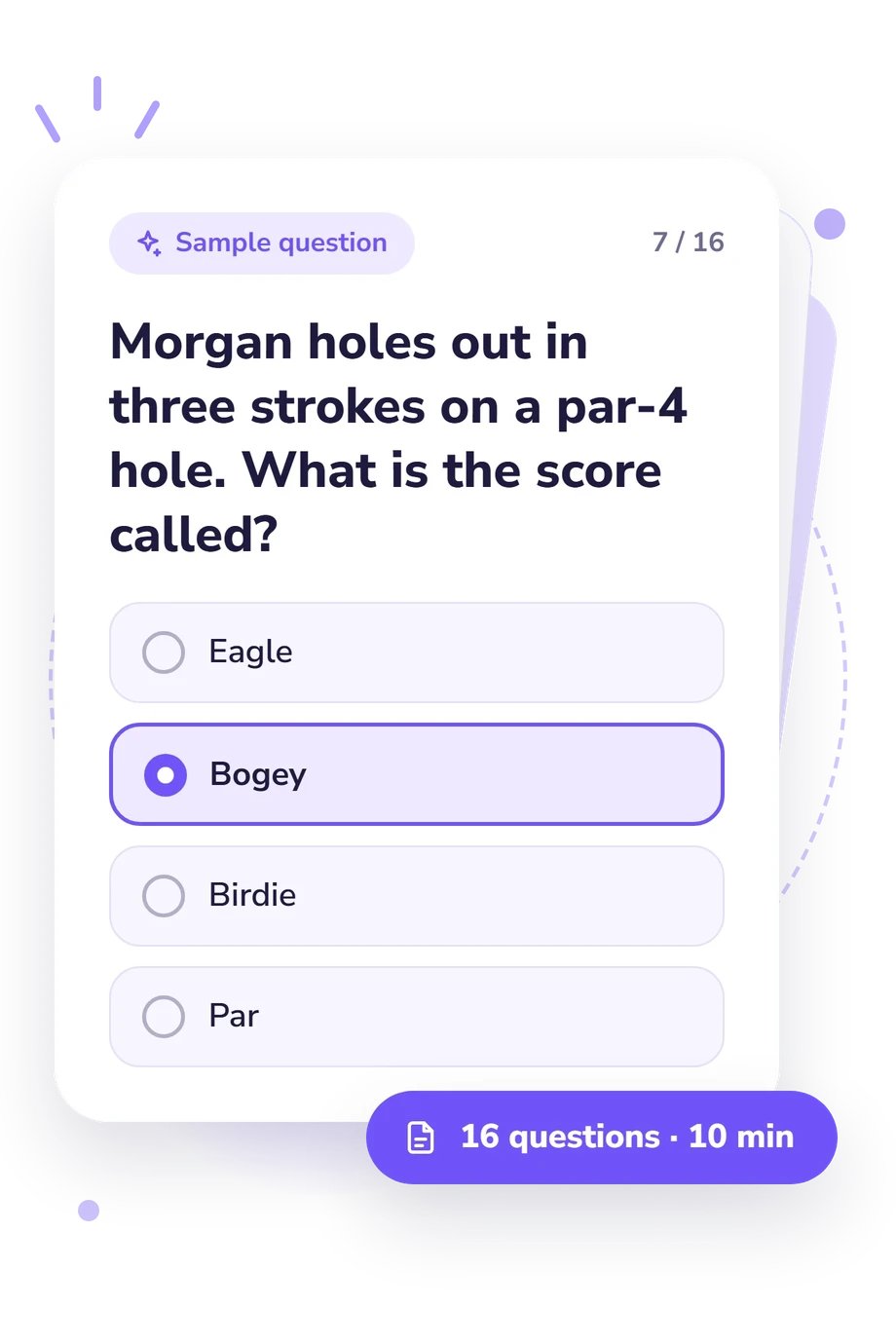
- Eagle
- Bogey
- Birdie
- Par
Golf Quiz - Description and methodology of the test
People seeking a practical check of their understanding of golf rules can use this golf quiz to focus on knowledge rather than swing technique or physical performance. It is suited to casual players, learners, and readers preparing to spend more time on a course. The questions in this quiz about golf show which areas feel secure and which topics may deserve a closer review.
What This Assessment Measures
Content centers on practical rule application and common game knowledge. It covers penalties, out-of-bounds shots, bunker restrictions, teeing areas, provisional balls, putting-green procedures, scoring terms, match play, stroke play, handicaps, alternate shot, club loft, par, and on-course safety.
It also works as a quiz for beginners learning golf, while giving recreational players a way to test whether familiar rules can be applied in concrete situations. The result reflects demonstrated knowledge, not technique, fitness, or competitive ability.
Golf Knowledge is the displayed scale, ranging from 0-16. Its bands describe the score as follows:
- Foundation (0-6) indicates recognition of some basics, with review helpful for scoring language, formats, and core rules.
- Developing (7-12) indicates useful working knowledge, although familiar situations or conventions may still create uncertainty.
- Strong (13-16) indicates broad practical knowledge of terminology, play, equipment, and common on-course decisions.
Methodology and Evidence Base
Each item gives a rule situation or factual prompt with four choices. Topics include rules, scoring, formats, handicaps, equipment, course conventions, and safety.
It can also function as a trivia quiz about golf: some prompts ask for terms such as birdie, bogey, eagle, or par, while others require applying a rule to a situation, such as choosing stroke-and-distance relief or a provisional ball.
The questionnaire is conceptually consistent with Golf Rules Knowledge Test (Chung et al., 2015), a published study using item response theory to examine golf-rules knowledge. It is not presented as a direct adaptation or validated administration. Its content follows the 2023 Rules of Golf and 2024 World Handicap System framework.
Responses are compared with the relevant keyed answer and combined into the displayed total; no separate weighting rule is stated. The online measure has no documented norms, reliability estimate, or external cutoff, so the bands describe demonstrated knowledge rather than population ranking. Memory, wording, rule changes, and practical experience can affect performance, so the result is best used to target review and check current official rules before play.
- Chung, Il-Mi, Junwoo Lee, and Ji Hun Hwang. "Development of the Knowledge Test for Golf Rules using the IRT Analysis." The Korean Journal of Measurement and Evaluation in Physical Education and Sports Science, vol. 17, no. 2, 2015, pp. 87-98. 10.21797/ksme.2015.17.2.007
- United States Golf Association and The R&A. The Rules of Golf, effective January 2023. USGA and The R&A, 2023.
- United States Golf Association and R&A Rules Limited. Rules of Handicapping, effective January 2024. World Handicap System, 2023.
Updated: