
Which Deity Am I Connected To Quiz
How the Scales are Structured
Who Usually Takes This Test?
See How You Compare
Below is a preview of how scores are typically distributed across each scale.
Example Questions From the Test
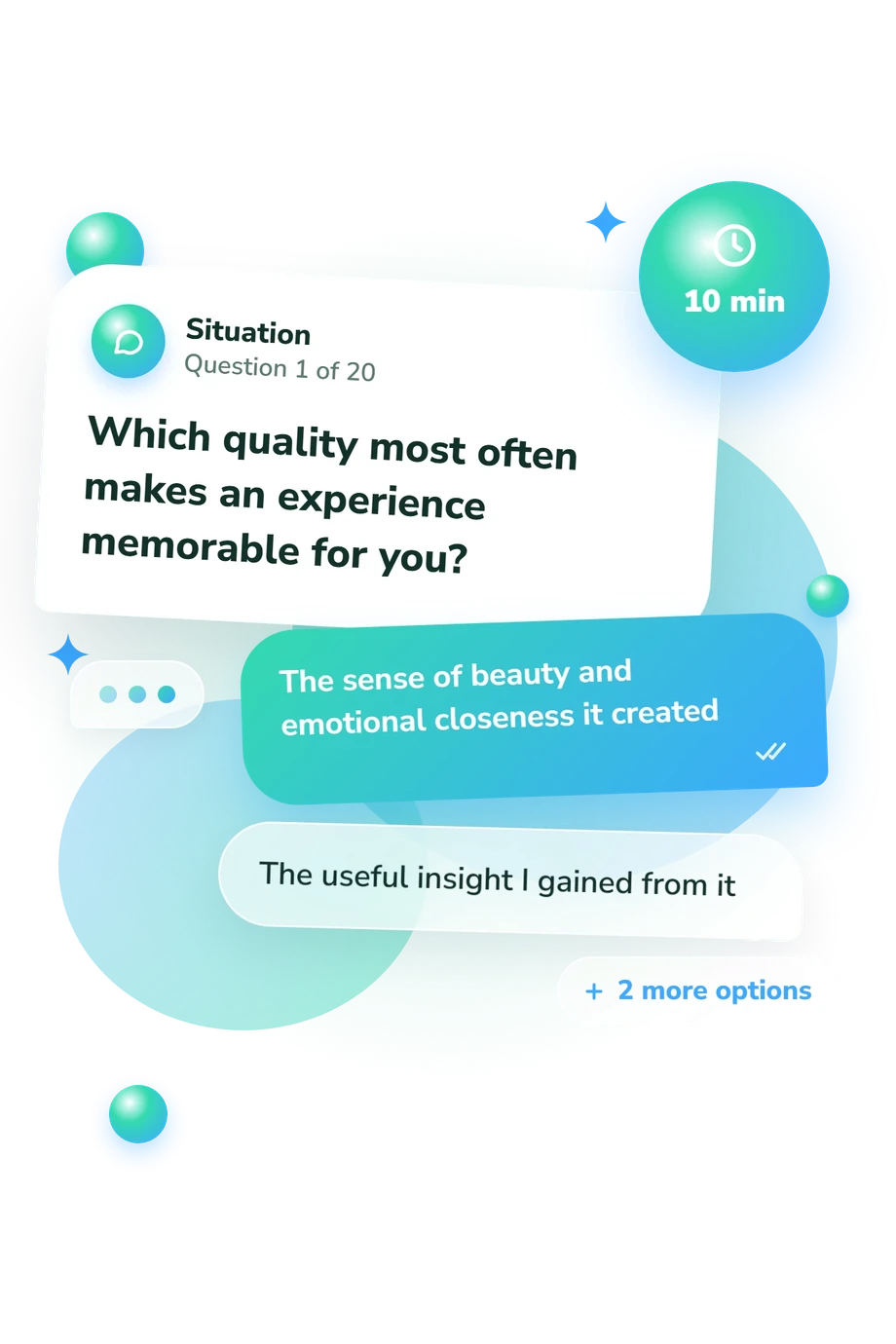
- The sense of beauty and emotional closeness it created
- The useful insight I gained from it
- The freedom to act without a fixed schedule
- The surprising people and stories I encountered
- Lift morale by reminding everyone why the project matters
- Step back and let the strongest preference win
- Map the trade-offs and build a workable strategy
- Try a quick experiment and adjust as events unfold
- Offer affectionate presence and help them feel cherished
- Analyze what happened and suggest a stronger plan
- Invite them somewhere new to shift their perspective
- Ask what kind of companionship would feel good right now
Which Deity Am I Connected To Quiz - Description and methodology of the test
People drawn to Greek mythology or symbolic self-reflection may use the Which Deity Am I Connected To Quiz to compare five mythic themes side by side. This deity quiz does not ask you to prove a belief; it organizes everyday preferences and reactions into a readable symbolic profile. The comparison can help you notice which values or preferences consistently stand out when you reflect on the result.
What This Assessment Explores
Symbolic affinities-not belief-span affection, beauty, autonomy, strategy, creativity, movement, conversation. Questions about which deity is calling me quiz the reader’s responses, revealing personal values.
- Aphrodite Affinity (0-12) measures connection and allure-Different Compass 0-4, Awakening Magnetism 5-8, Strong Aphrodite Affinity 9-12.
- Apollo Affinity (0-12) measures clarity and expression-Different Compass 0-4, Growing Radiance 5-8, Strong Apollo Affinity 9-12.
- Artemis Affinity (0-12) measures autonomy and wild kinship-Different Compass 0-4, Independent Spirit 5-8, Strong Artemis Affinity 9-12.
- Athena Affinity (0-12) measures strategy and reasoned leadership-Different Compass 0-4, Emerging Strategist 5-8, Strong Athena Affinity 9-12.
- Hermes Affinity (0-12) measures wit, movement, and connection-Different Compass 0-4, Agile Messenger 5-8, Strong Hermes Affinity 9-12.
The highest affinity leads; scores within one point blend.
Methodology and Evidence Base
Each question offers four response choices for a social, creative, practical, or uncertain situation. The respondent selects the reaction that feels most natural, so the profile reflects comparative preferences rather than factual knowledge or theological agreement. Questions about how to find your deity quiz the reader’s assumptions; recurring patterns matter more than external events.
Affinity scores are compared across parallel scales. The leading result marks the strongest symbolic resonance, while close scores support a blended reading. The displayed bands describe intensity within each affinity, not population norms or clinical cutoffs.
The framework is conceptually consistent with Bolen's archetypal accounts of goddesses and gods, Jung and Kerényi's mythological context, and Lester's multiple-self theory. These works provide interpretive context; this separate questionnaire is not an adaptation of their books or theories. Questions about what deity is reaching out to me quiz the reader’s assumptions; the result remains symbolic rather than evidence of an external message.
As an unstandardized self-report, it can vary with context, self-awareness, and candor, so it is not diagnostic.
- Bolen, Jean Shinoda. Goddesses in Everywoman: A New Psychology of Women. San Francisco: Harper & Row, 1984.
- Bolen, Jean Shinoda. Gods in Everyman: A New Psychology of Men's Lives and Loves. New York: Harper & Row, 1989.
- Lester, David. “A Multiple Self Theory of the Mind.” Comprehensive Psychology, vol. 1, 2012, article 5. 10.2466/02.09.28.CP.1.5.
- Jung, C. G., and Karl Kerényi. Essays on a Science of Mythology: The Myth of the Divine Child and the Mysteries of Eleusis. Translated by R. F. C. Hull. New York: Pantheon Books, 1949.
Updated: