
Outsiders Quiz
How the Scales are Structured
Who Usually Takes This Test?
See How You Compare
Below is a preview of how scores are typically distributed across each scale.
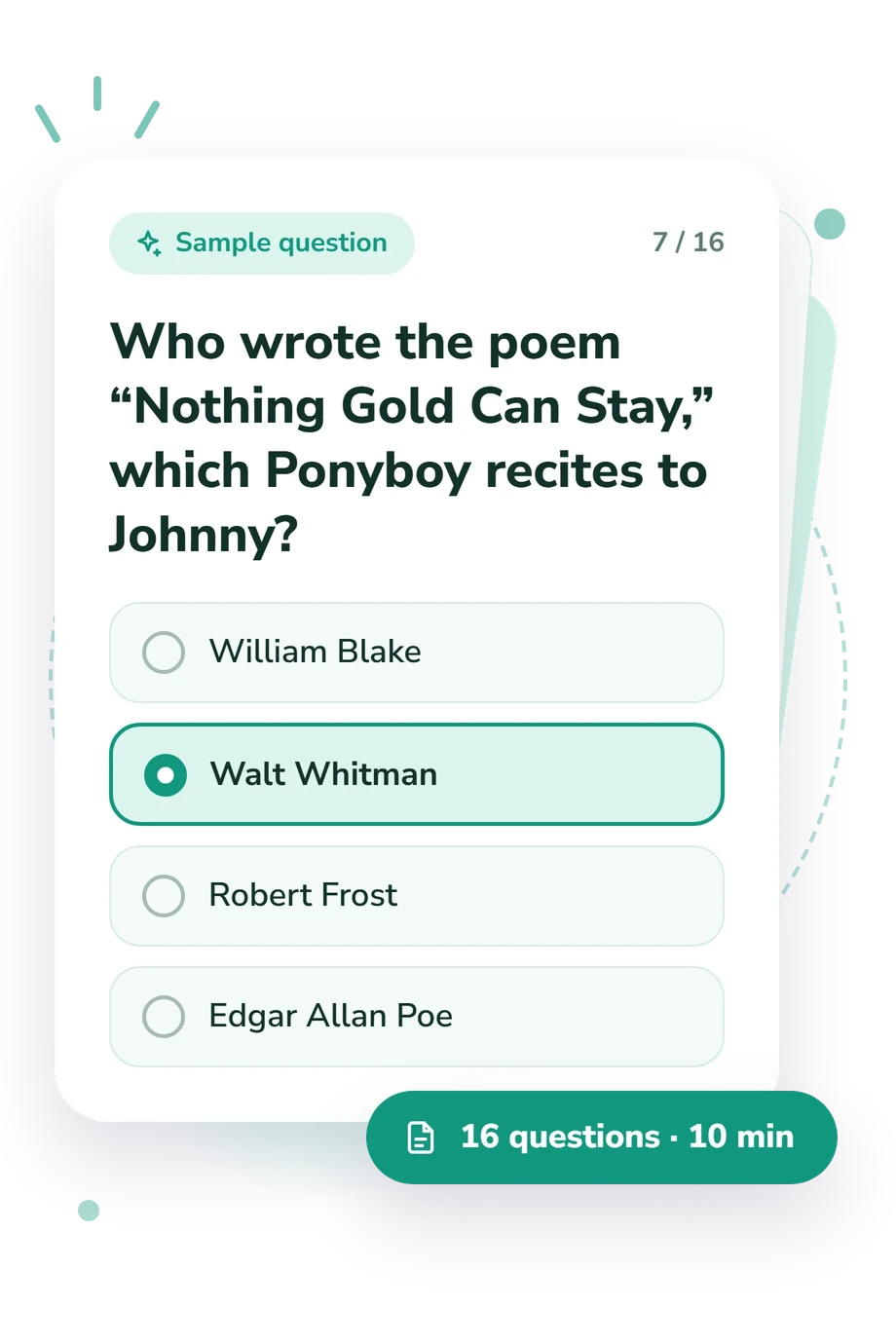
Example Questions From the Test
- The Brumly boys and the Shepard gang
- The East Side students and the West Side teachers
- The Curtis family and the Cade family
- The Greasers and the Socs
- His hair is tied to his identity and pride as a Greaser
- He had promised Darry that he would never change it
- Long hair is required for his role on the track team
- It makes him look more like Bob, whom he fears resembling
- He believes the fighting will not truly change anything
- Cherry asks him to take Bob’s place at home
- He has been ordered to leave town by the police
- He plans to join the Greasers instead
Outsiders Quiz - Description and methodology of the test
Readers who want to check their grasp of S. E. Hinton’s novel can use the Outsiders Quiz Who Are You to gauge their reading. For students, book-club members, and independent readers, this novel knowledge assessment offers a clear way to decide whether to revisit the text or move on to discussion. Its result indicates how confidently the respondent recalls and interprets the story.
What This Test Measures
The questionnaire checks literary knowledge rather than similarity to a fictional character. Its items cover the Greaser-Soc conflict, turning points, motives, settings, narration, recurring images, and themes including identity, loyalty, grief, social division, and compassion.
It suits readers studying The Outsiders, discussing it in a book club, or revisiting it independently. The result is a literary knowledge score for The Outsiders: it reflects how securely the respondent recognizes and interprets the text, not the respondent’s personality.
The single scale is The Outsiders Knowledge, scored from 0-16. Its bands describe the result:
- Starting Point (0-6) shows recognition of some elements, with review likely useful.
- Developing Knowledge (7-12) shows broad understanding, with details or interpretations to strengthen.
- Strong Knowledge (13-16) shows confident command of plot, characters, symbols, and themes.
Methodology and Evidence Base
Each item presents a question with four answer choices, so the respondent selects the option that best matches the novel. The questions combine factual recall with interpretation, covering events, relationships, motives, settings, narration, symbolism, and links between scenes. This format checks more than isolated names while keeping the task centered on Hinton’s text.
Together, these items form a text comprehension measure: every answer choice tests a detail or interpretation from the novel, and the combined result describes text knowledge rather than fictional identity. The total summarizes tested-item performance as an overall knowledge snapshot.
Hinton (1967) supplies the questions’ content, while Wistisen (2021) offers literary context for themes such as conflicting emotions, identity, and socialization. Wistisen’s study provides thematic context, not validation of this questionnaire’s items, scoring, or interpretation. The result summarizes questions about plot events, motives, relationships, and interpretation.
Interpret the result as a snapshot of recall and reading comprehension. Performance can vary with reading recency, attention, and how closely the novel was read, so use the score alongside reflection or discussion.
- Hinton, S. E. The Outsiders. New York: Viking Press, 1967.
- Wistisen, Lydia. "Too Much Feeling: S.E. Hinton’s The Outsiders (1967), Conflicting Emotions, Identity, and Socialization." Children’s Literature in Education, 52, 200-216, 2021. 10.1007/s10583-020-09410-z.
- Pope, Carol, Candy Beal, Sheryl Long, and Lodge McCammon. "They Teach Us How to Teach Them: Teacher Preparation for the 21st Century." Contemporary Issues in Technology and Teacher Education, 11(4), 2011.
- Sun, Xiaomei. "Teaching Young Adult Literature in Secondary L2 Classrooms: A Case Study of The Outsiders Reading Programme." The Language Learning Journal, 52(3), 233-254, 2024. 10.1080/09571736.2022.2107694
Updated: