
Freudly+971 508685814hello@freudly.ai
Freudly
identity

What Piercing Should I Get Quiz
What Piercing Should I Get Quiz - Free Get Test - FreudlyTake a free what piercing should i get quiz to find out what piercing should i get is the perfect fit for. Quick, no sign-up needed. Start now!en
With 20 questions taking about 10 minutes, the What Piercing Should I Get Quiz explores which placements and styles align with your visibility preferences, jewelry taste, lifestyle, and healing considerations. Your result highlights the piercing options that fit your current priorities, supporting more focused self-reflection before speaking with a professional piercer.
Questions: 2010 minutes
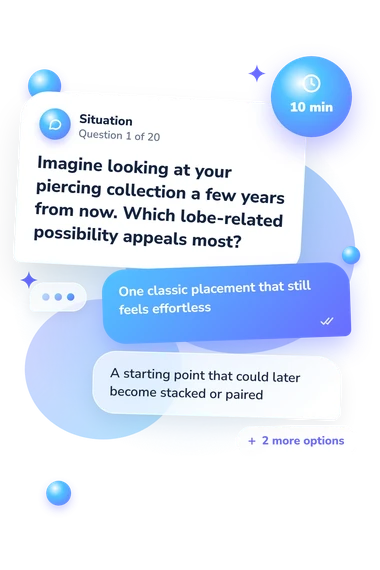
What Piercing Should I: situation and reply bubbles
July 22, 2026July 22, 2026Material has been updatedJuly 22, 2026Material has been published
6,037 views
550 completions
470 likes
Daniel HallPsychologist · Test reviewer
470 likes
Scale Explorer

How the Scales are Structured

Classic Nostril PiercingCNP
Measures how strongly your style and day-to-day preferences align with a Classic Nostril Piercing as a visible facial accent.
example score10/12
10/12Strong affinityexample score
0 – 4Different direction
5 – 8Possible match
9 – 12Strong affinity
A score of 10 indicates a strong affinity for a Classic Nostril Piercing, suggesting you like having a small facial focal point with flexible jewelry options like a subtle stud or hoop.
Expressive Septum PiercingESP
Measures how strongly a centered septum piercing aligns with your desired style, visibility, and everyday comfort preferences.
example score4/12
4/12Different directionexample score
0 – 4Different direction
5 – 8Experimental possibility
9 – 12Strong affinity
A score of 4 suggests a septum piercing is not a strong match for the impression or visibility level you want compared with other options.
Navel Statement PiercingNSP
Measures how strongly a navel piercing fits your style preferences, desired visibility, and day-to-day practicality.
example score5/12
5/12Selective possibilityexample score
0 – 4Different direction
5 – 8Selective possibility
9 – 12Strong affinity
A score of 5 suggests a selective interest in a navel statement piercing—you like its styling potential but may have practical reservations about clothing or routine.
Sculptural Helix PiercingSHP
Measures how well a sculptural helix (upper-ear cartilage) piercing fits your style preferences and tolerance for visibility and healing routine.
example score7/12
7/12Considered matchexample score
0 – 4Different direction
5 – 8Considered match
9 – 12Strong affinity
A score of 7 indicates a considered match, suggesting you like the helix look but may want to weigh visibility, sleeping habits, and patience with healing.
Versatile Lobe PiercingVLP
This scale measures how strongly you prefer the adaptable, easy-to-style look and everyday practicality of a lobe piercing.
example score7/12
7/12Flexible possibilityexample score
0 – 4Different direction
5 – 8Flexible possibility
9 – 12Strong affinity
A score of 7 suggests a lobe piercing could fit your preferences, especially if you want flexible styling that can shift from subtle to more curated.
just completed the test
DATA-BASED USER COHORTS

Who Usually Takes This Test?

First-time piercing planners
41%OF USERS
People considering their first piercing and wanting a low-stress match based on style, pain tolerance, and healing upkeep.
Style refresh seekers
34%OF USERS
People who already have one or more piercings and want a new look that still fits work, school, or family visibility preferences.
Low-maintenance routine types
25%OF USERS
People with busy schedules who want the option most likely to suit their daily habits, comfort needs, and aftercare commitment.
BASED ON AGGREGATED, ANONYMIZED DATA FROM TENS OF THOUSANDS OF FREUDLY USERS.
Benchmarking

See How You Compare

Once you complete the test, your results are compared with real-world data from people in your country.
Below is a preview of how scores are typically distributed across each scale.
Shaded area — where most people score
Dot — the average
You — your score lands on each curve after the test— your score, after the test
Classic Nostril PiercingCNP
You?
Average8.2
Typical rangeTypical6.4 – 10
Possible0 – 12
Expressive Septum PiercingESP
You?
Average4
Typical rangeTypical1.8 – 6.2
Possible0 – 12
Navel Statement PiercingNSP
You?
Average4
Typical rangeTypical2 – 6
Possible0 – 12
Sculptural Helix PiercingSHP
You?
Average8.6
Typical rangeTypical6.4 – 10.8
Possible0 – 12
Versatile Lobe PiercingVLP
You?
Average7.6
Typical rangeTypical5.6 – 9.6
Possible0 – 12
Featured On
SAMPLE QUESTIONS

Example Questions From the Test

    • One classic placement that still feels effortless
    • A starting point that could later become stacked or paired
    • An ear composition focused mainly on upper cartilage
    • A collection where the main impact comes from outside the ears
    • I like the idea of a noticeable but compact facial detail
    • I am interested, although I would want it to look very subtle
    • I prefer piercings that appear only from certain angles
    • I would rather keep jewelry away from the center of attention
    • It gives my face a stronger, more distinctive center
    • A delicate version adds interest without feeling too bold
    • It confirms that I prefer a nostril accent instead
    • It confirms that ear or body jewelry feels more natural to me
WHAT THE TEST MEASURES

What Piercing Should I Get Quiz - Description and methodology of the test

identity

People choosing a first or next piercing can use this assessment to compare styles without reducing the decision to appearance alone. The What Piercing Should I Get Quiz connects jewelry preferences with visibility, clothing, habits, and healing patience. It offers a piercing quiz for readers who want a clearer shortlist before discussing placement, anatomy, and aftercare with a professional.

What This Assessment Explores

For someone using a piercing placement quiz, the questions examine the visual presence and daily fit you want from jewelry, not anatomical safety. They address facial visibility, symmetry, clothing exposure, sleeping position, styling flexibility, and willingness to manage a slower healing routine. The result compares appeal with practical reservations.

Five displayed scales organize that profile:

  • Classic Nostril Piercing (0-12) reflects facial-accent affinity: Different direction 0-4; Possible match 5-8; Strong affinity 9-12.
  • Expressive Septum Piercing (0-12) reflects centered facial affinity: Different direction 0-4; Experimental possibility 5-8; Strong affinity 9-12.
  • Navel Statement Piercing (0-12) reflects torso-styling affinity: Different direction 0-4; Selective possibility 5-8; Strong affinity 9-12.
  • Sculptural Helix Piercing (0-12) reflects upper-ear affinity and patience: Different direction 0-4; Considered match 5-8; Strong affinity 9-12.
  • Versatile Lobe Piercing (0-12) reflects adaptable ear-styling affinity: Different direction 0-4; Flexible possibility 5-8; Strong affinity 9-12.

Methodology and Scientific Basis

Each prompt presents a concrete styling or routine situation with four response options. Choices distinguish visibility, symmetry, clothing and activity demands, sleeping habits, styling flexibility, and willingness to accept a more involved healing period. The questionnaire turns those preferences into separate 0-12 profiles; the scoring description gives no item-by-item weighting formula or population norms.

The approach is a self-report preference exercise. Its themes are conceptually consistent with Wohlrab et al. (2007), whose work discusses motivations for tattooing and piercing, and they also fit Forbes (2001) on motives and social perception and Stirn (2003) on psychological motivations and medical consequences. This questionnaire is not an adaptation or validated version of those studies.

Results suggest which placement may feel most compatible with your current style and routine, including the best piercing for me question, but scores can shift with context and self-awareness. They cannot determine anatomy, placement, or healing suitability; a professional piercer must assess those factors, and concerning symptoms require medical care.

Literature:
  • Silke Wohlrab, Jutta Stahl, and Peter M. Kappeler. "Modifying the body: Motivations for getting tattooed and pierced." Body Image 4, no. 1 (2007): 87-95. 10.1016/j.bodyim.2006.12.001
  • Gordon B. Forbes. "College Students with Tattoos and Piercings: Motives, Family Experiences, Personality Factors, and Perception by Others." Psychological Reports 89, no. 3 (2001): 774-786. 10.2466/pr0.2001.89.3.774
  • Aglaja Stirn. "Body piercing: medical consequences and psychological motivations." The Lancet 361, no. 9364 (2003): 1205-1215. 10.1016/S0140-6736(03)12955-8
Popular tests
Comments
Leave a Comment