
Which Martial Art Should I Learn Quiz
How the Scales are Structured
Who Usually Takes This Test?
See How You Compare
Below is a preview of how scores are typically distributed across each scale.
Example Questions From the Test
- How punches, kicks, defensive checks, and clinch entries connect
- How to score with precise long-range techniques and reset cleanly
- How to evade and counter in a punches-only exchange
- How to gain control after taking a partner to the mat
- Using blocks and distance against a wider variety of strikes
- Slipping, rolling, and stepping away from punches
- Closing distance to clinch or redirect the exchange
- Escaping a grip or improving position on the ground
- Controlled rolling where both partners can tap and restart
- Light stand-up sparring focused on distance and timing
- Repetitions of a formal sequence followed by basic partner drills
- Takedown practice that continues into a short positional exchange
Which Martial Art Should I Learn Quiz - Description and methodology of the test
People choosing a first discipline often need more than a list of popular styles; they need a way to compare the kind of practice they actually enjoy. The Which Martial Art Should I Learn Quiz frames that choice around training preferences, contact, pace, and structure. As a martial arts quiz, it gives curious beginners a practical starting point for selecting classes worth trying.
What This Assessment Explores
This assessment suits people comparing classes and asking which martial art is right for me; the quiz treats fit as preferences, not a universal ranking. It considers distance, contact, pace, structure, repetition, and the balance between striking and grappling. The result highlights likely matches.
The five displayed profiles are:
- Boxing (0-12) reflects focused punches, mobile defense, and conditioning.
- Brazilian Jiu-Jitsu (0-12) reflects positional problem-solving, control, escapes, and submissions.
- Judo (0-12) reflects grips, balance disruption, throws, breakfalls, and structured grappling.
- Karate (0-12) reflects precise striking, disciplined progression, forms, and partner work.
- Muay Thai (0-12) reflects varied stand-up striking, conditioning, and clinch exchanges.
Every profile uses the same bands: Different Direction (0-4), Possible Fit (5-8), and Strong Affinity (9-12). The highest result is the strongest affinity; scores within one point suggest a blended result.
Methodology and Evidence Base
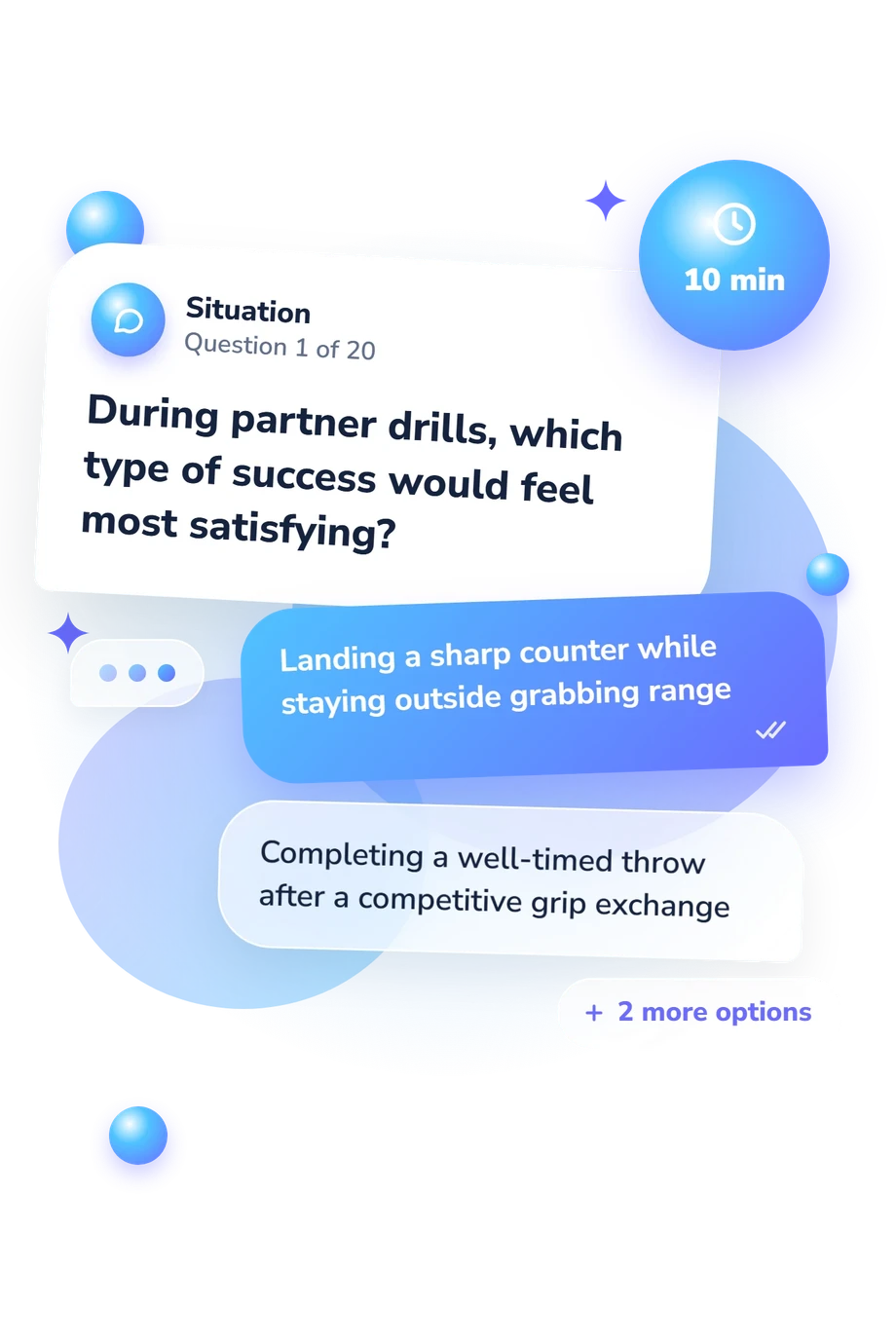
Each item describes a training situation and offers four response choices. The contrasts cover distance striking, ground problem-solving, throws, formal practice, conditioning, and clinch work, so the format captures preferred experiences rather than technical ability.
The five profile scores are compared; the highest outcome is the strongest affinity, while scores within one point indicate a blended result. This quiz makes the practical question of what martial art should I learn easier to examine through training demands rather than labels.
The questionnaire is conceptually consistent with Prasetyo et al. (2024), which treats martial-arts school choice as a combination of valued attributes, but it is not an adaptation of that study. Theeboom and De Knop (1999) provide context for instructional structure; Lopes-Silva and Franchini (2021) provide context for conditioning demands; and Jones, Mackay, and Peters (2006) provide context for participation motivation.
The online scores are comparative preference indicators and have no supplied normative interpretation. Results may shift with current goals, previous experience, gym culture, and interpretation of the choices. Readers wondering what fighting style should I learn can use the quiz to compare classes and training environments.
- Yogi Tri Prasetyo, Maela Madel L. Cahigas, Eugene Patrick, Michael Rodney, Reny Nadlifatin, and Satria Fadil Persada. “Indonesian martial artists’ preferences in martial arts schools: Sustaining business competitiveness through conjoint analysis.” PLOS ONE, 19(4), e0301229, 2024. 10.1371/journal.pone.0301229
- Marc Theeboom and Paul De Knop. “Asian Martial Arts and Approaches of Instruction in Physical Education.” European Journal of Physical Education, 4(2), 146-161, 1999. 10.1080/1740898990040204
- João Paulo Lopes-Silva and Emerson Franchini. “Developing anaerobic power and capacity for combat sports athletes.” Revista de Artes Marciales Asiáticas, 16(1s), 60-85, 2021. 10.18002/rama.v16i1s.7001
- Gareth W. Jones, Ken S. Mackay, and Derek M. Peters. “Participation Motivation in Martial Artists in the West Midlands Region of England.” Journal of Sports Science and Medicine, 5(CSSI), 28-34, 2006.
Updated: