
Disney Movie Quiz
How the Scales are Structured
Who Usually Takes This Test?
See How You Compare
Below is a preview of how scores are typically distributed across each scale.
Example Questions From the Test
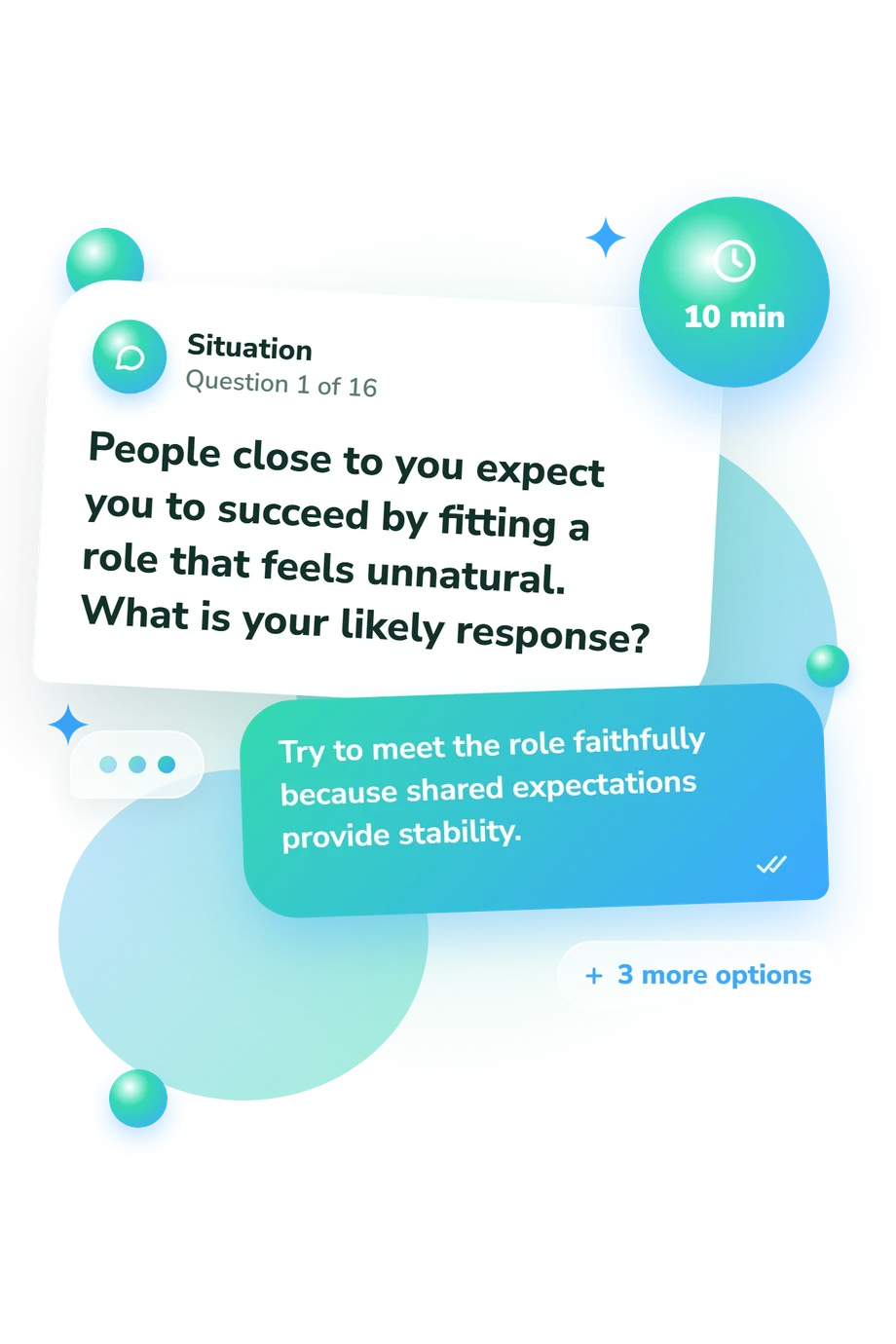
- Try to meet the role faithfully because shared expectations provide stability.
- Adjust my personality to the role while keeping other parts of myself private.
- Discuss which expectations I can honor without losing my own direction.
- Find a courageous, unconventional way to contribute as my actual self.
- Patiently fulfilling a respected role over many years.
- Speaking honestly once supportive allies are already present.
- Accepting a difficult task after careful preparation.
- Acting under pressure despite being underestimated and lacking a clear script.
- Keep using the taught technique so the team remains coordinated.
- Ask the most experienced person to choose the next move.
- Suggest pausing briefly to compare several alternative methods.
- Adapt the available tools into a new tactic and demonstrate it quickly.
Disney Movie Quiz - Description and methodology of the test
Readers who use familiar stories to think about their own values may find this Disney Movie Quiz useful for exploring which character qualities fit their choices. It is aimed at people interested in courage, curiosity, belonging, responsibility, and personal direction, not at measuring film trivia. A quiz about Walt Disney movies gives recurring preferences a memorable framework for reflection.
What This Assessment Explores
Choices cover roles, teamwork, uncertainty, judgment, discovery, setbacks, and belonging. The test, viewed as a Disney character quiz, reads these situations as character affinity rather than film knowledge. The four dimensions are:
- Belle (0-12) reflects curiosity, thoughtful empathy, and resistance to limiting expectations: Different wavelength (0-4), Shared perspective (5-8), or Strong Belle affinity (9-12).
- Moana (0-12) reflects purposeful adventure, community care, and confidence navigating uncertainty: Different current (0-4), Emerging wayfinder (5-8), or Strong Moana affinity (9-12).
- Mulan (0-12) reflects strategic courage, authentic self-definition, and inventive action under pressure: Different approach (0-4), Resourceful streak (5-8), or Strong Mulan affinity (9-12).
- Simba (0-12) reflects belonging, accountability, and courage to return after setbacks: Different path (0-4), Growing into the role (5-8), or Strong Simba affinity (9-12).
Scores within one point can indicate a blended affinity across characters.
Methodology and Evidence Base
Each item describes a social or personal situation and offers four possible reactions. Choose the response closest to your likely behavior. The questionnaire produces four character-affinity scores, but it does not state how many points each response contributes, so the ranges should not be reverse-engineered into a scoring formula. Themes include roles, teamwork, discovery, belonging, setbacks, and responsibility.
Instead of reproducing a published personality scale, this Disney personality quiz uses an interpretive self-report format. Hahn et al. (2025) identify recurring values in Disney films, while Clarke et al. (2024) examine behaviors displayed by Disney protagonists. The questionnaire is conceptually consistent with those studies, not an adaptation of either.
Character connection is also conceptually consistent with Cohen’s (2001) theory of media-character identification and Huang and Fung’s (2024) validated measure of identification with narrative characters. A stronger affinity means more selected responses resemble a character’s qualities; it does not establish a fixed trait.
No population norms, reliability estimates, or independent clinical cutoffs are stated. The result is therefore a structured snapshot that may shift with mood, self-image, familiarity with the stories, or socially desirable responding.
- Hahn, Lindsay, Melinda Aley, Alexandra L. Frank, and Tahleen Lattimer. “What can heroes and villains teach young audiences? A research brief investigating the values emphasized in family-rated Walt Disney films.” Journal of Children and Media 19, no. 1 (2025): 126-137. 10.1080/17482798.2024.2402268
- Clarke, Lucy L., Benjamin Hine, Dawn England, Poppy P. M. S. Flew, Ritaj Alzahri, Stepheni N. Juriansz, and Ma. J. B. C. Garcia. “The gendered behaviors displayed by Disney protagonists.” Frontiers in Sociology 9 (2024): 1338900. 10.3389/fsoc.2024.1338900
- Huang, Kate Y., and Helene H. Fung. “Measuring identification with narrative characters: the development and validation of a new scale.” Current Psychology 43 (2024): 24835-24849. 10.1007/s12144-024-06191-2
- Cohen, Jonathan. “Defining identification: A theoretical look at the identification of audiences with media characters.” Mass Communication and Society 4, no. 3 (2001): 245-264. 10.1207/S15327825MCS0403_01
Updated: