
Romeo and Juliet Act 1 Quiz
How the Scales are Structured
Who Usually Takes This Test?
See How You Compare
Below is a preview of how scores are typically distributed across each scale.
Example Questions From the Test
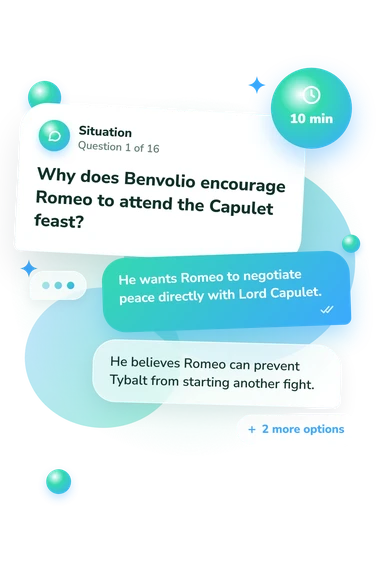
- He wants Romeo to negotiate peace directly with Lord Capulet.
- He believes Romeo can prevent Tybalt from starting another fight.
- He hopes Romeo will compare Rosaline with other women and reconsider his devotion.
- He has discovered that Rosaline secretly intends to marry Romeo there.
- Their disagreement about whether religious vows should control marriage
- Their immediate verbal harmony and a courtship that blends sacred imagery with physical attraction
- Romeo’s plan to abandon romantic love for a religious life
- Juliet’s complete rejection of Romeo’s attempt to speak with her
- Their estates will be transferred to the city.
- Their household servants will be banished.
- They will be required to arrange a marriage between the families.
- They will pay for another disturbance with their lives.
Romeo and Juliet Act 1 Quiz - Description and methodology of the test
For students, teachers, and independent readers deciding whether to revisit Shakespeare’s opening act, this Romeo and Juliet Act 1 Quiz offers a focused check of textual understanding. The result can show whether revision should be broad or more targeted, while an act one literature quiz format keeps the decision anchored in the play rather than general literary ability.
What This Assessment Measures
The assessment treats the opening act as a connected design rather than isolated facts. It asks readers to recognize causes and consequences, infer motives, notice contrasts in family behavior, and explain how private desire becomes entangled with public conflict.
For readers taking a Romeo and Juliet Act One quiz, this means the result reflects understanding of both what happens and how Shakespeare constructs meaning through dialogue, imagery, foreshadowing, and dramatic contrast.
The displayed Romeo and Juliet Act 1 Knowledge scale runs from 0-16 and reads knowledge across these areas:
- Foundation to revisit (0-6) indicates partial recognition of Act 1 details and points to key scenes for review.
- Developing knowledge (7-12) shows command of main events and several literary choices, with details or interpretations to refine.
- Strong knowledge (13-16) reflects a well-developed grasp of plot, characters, themes, imagery, and dramatic structure.
Methodology and Evidence Base
Each item uses four-choice multiple-choice format. The alternatives separate accurate recall from plausible misreadings: a reader may identify why Benvolio brings Romeo to the feast, interpret the lovers’ sonnet, connect the Prologue with later events, or infer what family conduct reveals. This checks textual knowledge alongside basic interpretation.
The displayed scale and its bands report the result; the questionnaire does not specify how individual responses, including unanswered items, contribute. For this assessment, the Act I Romeo and Juliet quiz indicates how much selected Act 1 material the respondent recognized, rather than comparing the reader with a norm group or measuring general intelligence.
The items examine Act 1 of Shakespeare’s Romeo and Juliet. They are conceptually consistent with scholarship by Lees-Jeffries on bodily and lyrical meaning in the lovers’ exchange and by Reynolds and Segal on movement across social boundaries; they are not adaptations of either study. Together, they connect street conflict, the feast, family opposition, courtship, and foreshadowing. Results can shift with memory, attention, and classroom interpretations, so a band is best treated as a prompt to reread relevant scenes.
- Shakespeare, William. Romeo and Juliet. Edited by Jill L. Levenson. The Oxford Shakespeare. Oxford University Press, 2000. ISBN 9780198129370.
- Lees-Jeffries, Hester. "Body Language: Making Love in Lyric in Romeo and Juliet." The Review of English Studies, vol. 74, no. 314, 2023, pp. 237-253. 10.1093/res/hgac097.
- Reynolds, Bryan, and Janna Segal. "Fugitive Explorations in 'Romeo and Juliet': Transversal Travels through R&Jspace." Journal for Early Modern Cultural Studies, vol. 5, no. 2, 2005, pp. 37-70. 10.1353/jem.2005.0016.