
Am I a Boy or Girl Quiz
How the Scales are Structured
Who Usually Takes This Test?
See How You Compare
Below is a preview of how scores are typically distributed across each scale.
Example Questions From the Test
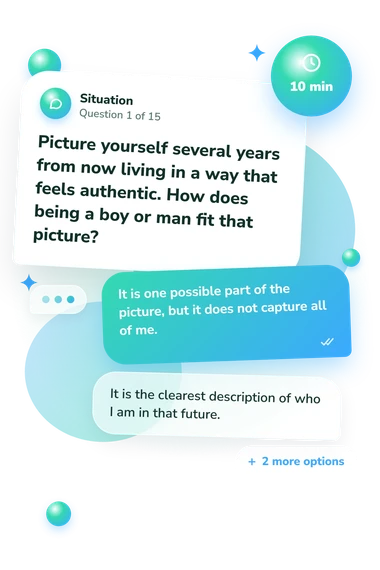
- It is one possible part of the picture, but it does not capture all of me.
- It is the clearest description of who I am in that future.
- It appears more like a role others might expect than my inner identity.
- It feels difficult to place in an authentic picture of my future.
- I would wonder why they chose a description that feels unlike me.
- I would understand the choice socially, though it would not say much about me.
- I would feel partly seen but not fully described.
- I would feel accurately known and recognized.
- One box would represent me accurately.
- One would be close enough, although not perfectly precise.
- I could choose one, but an important part of me would be missing.
- Neither box alone could meaningfully represent my identity.
Am I a Boy or Girl Quiz - Description and methodology of the test
People questioning how gendered words fit their inner experience may use the Am I a Boy or Girl Quiz as a structured starting point. It is designed for anyone who wants to compare boy/man, girl/woman, and broader descriptions without forcing an immediate conclusion. Readers wondering whether they are a girl or woman can use this questionnaire as an am i a girl quiz, considering the full profile rather than one isolated answer.
What This Assessment Explores
Rather than treating gender as a single either-or decision, this questionnaire makes an are you a boy or a girl quiz reflective by examining how descriptions feel in private, socially, and across imagined future situations. The questionnaire treats boy/man and girl/woman language alongside broader possibilities, considering comfort, recognition, incompleteness, flexibility, and whether either binary category feels sufficient.
The displayed dimensions are:
- Beyond-the-Binary Resonance (0-15) shows whether nonbinary, fluid, agender, or self-defined possibilities feel meaningful; its bands are Limited resonance (0-5), Exploring resonance (6-10), and Strong resonance (11-15).
- Boy/Man Identity Resonance (0-15) reflects how accurately boy/man language fits inner identity; its bands are Limited resonance (0-5), Mixed resonance (6-10), and Strong resonance (11-15).
- Girl/Woman Identity Resonance (0-15) reflects how accurately girl/woman language fits inner identity; its bands are Limited resonance (0-5), Mixed resonance (6-10), and Strong resonance (11-15).
Methodology and Scientific Basis
Each item offers four response options, and respondents choose the statement that best matches their reaction, sense of self, or response to the situation described. Questions about whether girl language fits can be considered alongside broader possibilities, so this questionnaire turns the are you a girl quiz format into an exploratory prompt.
Responses produce three resonance scores. Together, they show how strongly each description currently resonates without requiring a single overall identity label. The displayed bands are interpretive categories for current resonance, not population norms; no standardized norms are stated for this online questionnaire.
Conceptually, the questionnaire is consistent with the Gender Self-Report and Genderqueer Identity Scale work, and with National Academies guidance distinguishing sex, gender identity, and self-description. It is not presented as a direct adaptation or validation of either named instrument.
A broader framing may help readers considering whether woman language fits; the result treats the are you a woman quiz question as one part of the profile. Self-report can shift with context, honesty, and self-awareness, so the result is best read as a current reflection.
- Strang, John F., Gregory L. Wallace, Jacob J. Michaelson, et al. (2023). The Gender Self-Report: A Multidimensional Gender Characterization Tool for Gender-Diverse and Cisgender Youth and Adults. American Psychologist, 78(7), 886-900. 10.1037/amp0001117
- McGuire, Jenifer K., Titia F. Beek, Jory M. Catalpa, and Thomas D. Steensma (2019). The Genderqueer Identity (GQI) Scale: Measurement and validation of four distinct subscales with trans and LGBQ clinical and community samples in two countries. International Journal of Transgenderism, 20(2-3), 289-304. 10.1080/15532739.2018.1460735
- National Academies of Sciences, Engineering, and Medicine (2022). Measuring Sex, Gender Identity, and Sexual Orientation. Washington, DC: The National Academies Press. 10.17226/26424
Updated: