
Daemon Quiz
How the Scales are Structured
Who Usually Takes This Test?
See How You Compare
Below is a preview of how scores are typically distributed across each scale.
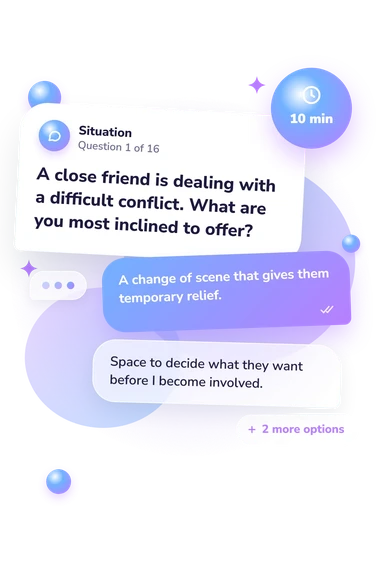
Example Questions From the Test
- Watching the landscape from a quiet, elevated place.
- Following a solitary trail at my own pace.
- Playing, swimming, or relaxing near a river with a few friends.
- Completing a challenging route with a close-knit group.
- Practicing alone through a steady, repeatable routine.
- Following an organized lesson with other learners.
- Researching several methods before choosing one to try.
- Experimenting hands-on and treating mistakes as part of the fun.
- Settling into a warm, quiet spot with plenty of personal space.
- Planning a walk that explores the full shoreline.
- Searching the shallows and banks for interesting natural objects.
- Getting into the water and drawing others into playful activity.
Daemon Quiz - Description and methodology of the test
For readers drawn to symbolic personality tools, the daemon quiz offers a way to reflect on how they build trust, handle uncertainty, and find their place with others. It is intended for anyone who enjoys imaginative self-exploration rather than a fixed label. A what-is-your-daemon-might-be quiz format makes the result approachable while keeping attention on everyday choices and relationships.
What This Assessment Explores
Across scenarios of trust, learning, exploration, conflict, and group problem-solving, the questionnaire explores independence, playfulness, curiosity, and loyalty. The His Dark Materials daemon concept (Pullman, 1995) gives its animal companions a symbolic focus on relationships and action.
The four displayed profiles are:
- Cat Daemon (0-12) reflects autonomy, composure, selective trust, and boundaries; Open Presence (0-4), Feline Resonance (5-8), and Strong Cat Affinity (9-12) show the profile bands.
- Otter Daemon (0-12) reflects playfulness, warmth, tactile engagement, and shared experience; Quiet Current (0-4), Otter Resonance (5-8), and Strong Otter Affinity (9-12) show the profile bands.
- Raven Daemon (0-12) reflects curiosity, pattern recognition, resourcefulness, and fresh perspectives; Grounded Focus (0-4), Corvid Resonance (5-8), and Strong Raven Affinity (9-12) show the profile bands.
- Wolf Daemon (0-12) reflects loyalty, coordination, and trusted companionship; Independent Path (0-4), Pack Resonance (5-8), and Strong Wolf Affinity (9-12) show the profile bands.
Methodology and Evidence Base
Each item presents four situational choices, with each choice aligned to one profile dimension. The result compares the accumulated pattern across profiles; because no published weighting, norm group, or standardized conversion rule is stated, the output functions as a reflective profile rather than a psychometric classification.
The Golden Compass-style daemon profile framing belongs to a fictional-philosophical tradition. Hines examines the concept's ideological symbolism, while Vassilopoulou and Ganeri discuss souls and moral perspective in the same fictional world.
Those works support the interpretive lens, but this questionnaire is conceptually consistent with them, not an adaptation or validation of their literary analysis. It converts recurring fictional associations into accessible self-report choices.
To interpret what is my daemon result meant to show, consider the overall pattern rather than one answer. Current mood, relationships, context, and self-awareness can influence responses, while the bands are catalogue-defined reflective labels rather than established norms or clinical cutoffs. Thoughtful answers make the profile more useful for self-reflection.
- Hines, Maude. "Second Nature: Daemons and Ideology in The Golden Compass." In His Dark Materials Illuminated: Critical Essays on Philip Pullman's Trilogy, edited by Millicent Lenz and Carole Scott, pp. 37-47. Detroit: Wayne State University Press, 2005.
- Pullman, Philip. Northern Lights. London: Scholastic, 1995.
- Vassilopoulou, Panayiota, and Jonardon Ganeri. "The Geography of Shadows: Souls and Cities in P. Pullman's His Dark Materials." Philosophy and Literature, vol. 35, no. 2, 2011, pp. 269-281. 10.1353/phl.2011.0021
Updated: