
Romeo and Juliet Act 2 Quiz
How the Scales are Structured
Who Usually Takes This Test?
See How You Compare
Below is a preview of how scores are typically distributed across each scale.
Example Questions From the Test
- He becomes suspicious that Romeo has secretly joined Tybalt.
- He concludes that Romeo intends to leave Verona permanently.
- He criticizes Romeo for continuing to grieve over Rosaline.
- He welcomes the return of Romeo’s lively, sociable wit.
- They should answer family violence with equal force.
- Their marriage must be celebrated publicly to prevent violence.
- Intense passion pursued without moderation can end destructively.
- Romantic happiness is impossible for members of either household.
- A challenge directed at Romeo
- An invitation asking Benvolio to return to the Capulet house
- A warning that Juliet has discovered Romeo’s identity
- A request for Lord Montague to arrange a public truce
Romeo and Juliet Act 2 Quiz - Description and methodology of the test
Students, teachers, and independent readers who want to check how securely they understand Shakespeare’s second act can use the Romeo and Juliet Act 2 Quiz to connect recall with close reading. A Romeo and Juliet Act Two quiz is especially useful when revision needs to cover events, motives, imagery, and the growing pressure created by the family feud.
What This Assessment Explores
Act 2 turns private attraction into a secret marriage plan while warnings and family hostility make the romance dangerous. The questions connect sequence, language, motive, and consequence rather than testing isolated recall.
To interpret the Act 2 quiz questions for Romeo and Juliet, consider four dimensions:
- Plot development shows whether you follow the balcony meeting, messages, errands, and marriage plan.
- Language and imagery show how the sun, moon, plants, and “violent delights” express beauty and risk.
- Character motivation shows how Juliet, Romeo, Friar Laurence, and the Nurse shape events.
- Conflict and theme show how secrecy, irony, family hatred, and possible reconciliation affect choices.
Results appear as Romeo and Juliet Act 2 Knowledge (0-16): Foundations to revisit (0-6), Developing understanding (7-12), or Strong understanding (13-16). The band reflects connections among Act 2’s events, language, motives, and themes.
Methodology and Evidence Base
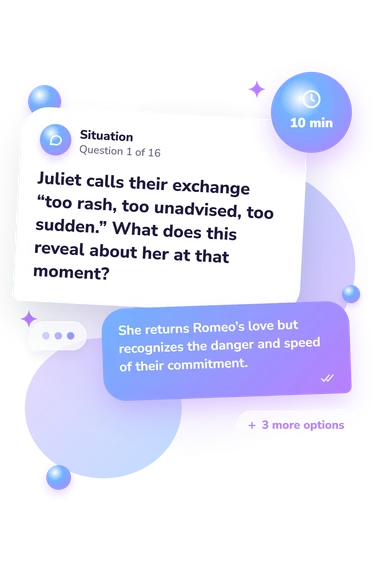
Each item presents a quotation, event, or interpretive situation with four answer choices. The best response requires recognizing what happens and why it matters, so the format joins recall with basic literary interpretation. Quiz answers for Act 2 of Romeo and Juliet can reveal whether an error came from sequence, vocabulary, imagery, or motive.
Scoring is direct: each correct response adds one point, and the total is read against the displayed bands. The score describes performance on this act, not broad Shakespeare expertise.
Honegger (2006) offers the closest conceptual lens for the Orchard Scene’s promises, caution, and negotiation of love. Shakespeare’s text follows the Oxford edition edited by Jill L. Levenson, while Murphy, Culpeper, Gillings, and Pace-Sigge (2020) help distinguish plot comprehension from the difficulty of interpreting Shakespearean language. The questionnaire is conceptually consistent with these works, but it is a text-specific online quiz, not a standardized published instrument.
A second Romeo and Juliet quiz attempt may reflect rereading or classroom discussion. Attention, prior reading, and current familiarity can raise or lower performance, so the result is best used to select passages and themes for another close reading.
- Honegger, Thomas. “Wouldst thou withdraw love’s faithful vow?”: The negotiation of love in the Orchard Scene (Romeo and Juliet Act II). Journal of Historical Pragmatics, 7(1), 2006, 73-88. 10.1075/jhp.7.1.04hon
- Shakespeare, William. Romeo and Juliet. Edited by Jill L. Levenson. The Oxford Shakespeare. Oxford University Press, 2000.
- Murphy, Sean, Jonathan Culpeper, Mathew Gillings, and Michael Pace-Sigge. “What do students find difficult when they read Shakespeare? Problems and solutions.” Language and Literature: International Journal of Stylistics, 29(3), 2020, 302-326. 10.1177/0963947020949441