
Lab Equipment Quiz
How the Scales are Structured
Who Usually Takes This Test?
See How You Compare
Below is a preview of how scores are typically distributed across each scale.
Example Questions From the Test
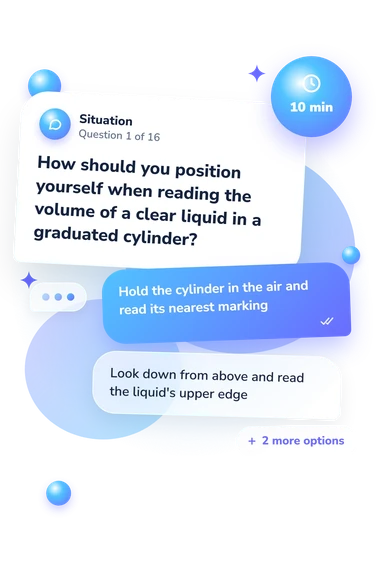
- Hold the cylinder in the air and read its nearest marking
- Look down from above and read the liquid's upper edge
- Place the meniscus at eye level and read its bottom
- Tilt the cylinder until the liquid aligns with a mark
- Crucible tongs
- Beaker tongs
- Test-tube holder
- Utility clamp
- Triple-beam balance
- Top-loading balance readable to 0.01 g
- Analytical balance
- Spring scale
Lab Equipment Quiz - Description and methodology of the test
Designed for learners deciding whether their chemistry knowledge is ready for classwork, the lab equipment quiz focuses on practical choices rather than memorizing names alone. Students reviewing foundational apparatus can use it before a lesson, lab assessment, or new experiment. As a quiz covering chemistry lab equipment, it connects classroom knowledge with the reasoning behind selecting an appropriate tool. The result indicates current performance in identifying and selecting equipment.
What This Assessment Measures
Questions test whether a respondent can match equipment to a procedure involving precision, heating, transfer, filtration, dilution, grinding, or gas collection. The focus suits learners strengthening practical chemistry knowledge before classwork or an assessment.
Lab Equipment Knowledge runs from 0-16: Foundations to Build (0-6), Developing Knowledge (7-12), and Strong Knowledge (13-16). The bands indicate increasing reliability in identifying and selecting common chemistry equipment.
The following themes explain what the result draws on:
- Measurement shows awareness of accuracy, scales, fixed volumes, and mass precision.
- Heating and handling show whether tools are matched to hot vessels and smooth boiling.
- Transfer and separation show recognition of rinsing, filtration, separation of immiscible liquids, and powder-handling tools.
- Setup choices show how apparatus supports titration, gas measurement, and dilution.
Learners taking this lab equipment practice quiz can use missed choices to set concrete review topics rather than treating the result as a vague overall score.
Methodology and Evidence Base
Each item gives a laboratory situation and four answer choices. The respondent selects the apparatus that fits the task, receiving one point for each correct answer; the total therefore counts accurate applications.
Presented as a quiz on science lab equipment, the format joins recognition with application. Items separate tools by precision, capacity, heat tolerance, delivery control, or setup role. This competency emphasis is consistent with Bektas et al. (2011), but the questionnaire is not an adaptation of that study.
Rahayu and Muqtada (2023) relate basic laboratory skills to pictorial assessment, while Giammatteo and Obaya (2018) frame laboratory performance through competencies. Bektas et al. (2011) provides the closest conceptual comparison for the equipment-selection focus; these studies provide educational context, but none establishes reliability, validity, or norms for this questionnaire.
Questions in this chemistry laboratory equipment quiz produce a score that can direct focused review of volume reading, apparatus purpose, or setup selection; stronger performance indicates better command of the sampled tasks. Prior instruction and guessing can affect objective quiz performance, and the score does not demonstrate practical competence.
- Bektas, Oktay, Mustafa Tuysuz, Zubeyde Demet Kirbulut, and Ayla Cetin-Dindar. (2011). Pre-service chemistry teachers' knowledge regarding laboratory equipment and their functions. Procedia - Social and Behavioral Sciences, 15, 510-514. 10.1016/j.sbspro.2011.03.132
- Rahayu, Dea Santika, and Moh. Rikza Muqtada. (2023). Analysis of Basic Laboratory Skills of Science Education Students Using Pictorial-Based Instruments. Journal of Tropical Chemistry Research and Education, 5(2), 60-69. 10.14421/jtcre.2023.52-06
- Giammatteo, Lucila, and Adolfo V. Obaya. (2018). Assessing Chemistry Laboratory Skills Through a Competency-based Approach in High School Chemistry Course. Science Education International, 29(2), 103-109. 10.33828/sei.v29.i2.5
Updated: