
Office Character Quiz
How the Scales are Structured
Who Usually Takes This Test?
See How You Compare
Below is a preview of how scores are typically distributed across each scale.
Example Questions From the Test
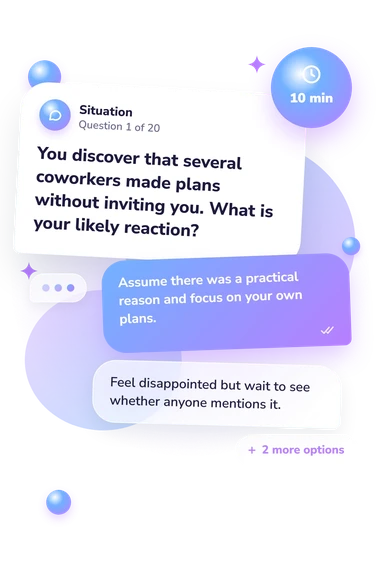
- Assume there was a practical reason and focus on your own plans.
- Feel disappointed but wait to see whether anyone mentions it.
- Ask someone directly whether the omission was intentional.
- Take it personally and make an active effort to become part of the occasion.
- Return to the agenda without drawing more attention to it.
- Laugh at yourself, acknowledge the miss, and move on.
- Try a different joke to recover the room's energy.
- Explain the joke and keep working for the reaction you expected.
- Attend and use the opportunity to get to know everyone better.
- Stop by briefly before continuing with personal plans.
- Decide based on whether close coworkers are going.
- Politely decline because your time outside work belongs to you.
Office Character Quiz - Description and methodology of the test
People who enjoy workplace personality play can use this office character quiz to compare their own habits with familiar sitcom styles. As an office personality quiz, it suits fans of The Office and readers curious about rules, competition, awkwardness, social energy, responsibility, and change. The result identifies a strongest character affinity or a blended profile when the leading scores are close.
What This Assessment Explores
These scenarios cover structure, flexibility, sociability, humor, ambition, routine, conflict, and change. As a quiz about which office character you are, it turns choices into affinities rather than fixed identities. The dimensions are:
- Dwight Schrute Affinity (0-12) reads preparedness, rules, and command: Flexible Operator (0-4), Assistant-to-the-Manager Energy (5-8), Schrute-Level Affinity (9-12).
- Jim Halpert Affinity (0-12) reads wit and improvisation: Earnest Approach (0-4), Knowing Look Energy (5-8), Halpert-Level Affinity (9-12).
- Michael Scott Affinity (0-12) reads enthusiasm and showmanship: Quiet Contrast (0-4), Regional Manager Energy (5-8), World's Best Boss Affinity (9-12).
- Pam Beesly Affinity (0-12) reads empathy and creativity: Outwardly Decisive (0-4), Reception-D Desk Energy (5-8), Beesly-Level Affinity (9-12).
- Stanley Hudson Affinity (0-12) reads boundaries and practicality: Office Participant (0-4), Practical Professional Energy (5-8), Pretzel Day Affinity (9-12).
Your highest is strongest; scores within one point create a blend.
Methodology and Evidence Base
Each item presents a workplace situation with four responses. The choices address exclusion, meetings, routine, policy, competition, conflict, and change. This scenario-based self-report format asks respondents to select what feels most natural rather than perform a controlled task.
Scoring compares response patterns across the five affinities. Because the questionnaire does not state how many points each answer contributes, the displayed totals and bands should be read as descriptive comparisons rather than clinical cutoffs. It is an original character-affinity self-reflection questionnaire, not a standardized psychological scale.
The Office quiz asks who you are at work by linking recognizable comic roles with everyday choices. Ro and Lee (2023) provide the closest conceptual reference for attention to action patterns and social displays. The questionnaire is conceptually consistent with that work, not an adaptation or validated reproduction. Daniels's series supplies the character framework, while Birthisel and Martin (2013) and Roth (2022) support its reading of workplace satire and comic relationships.
For readers asking what office character you are, the result is a flexible snapshot shaped by mood, workplace culture, character familiarity, and self-perception.
- Ro, Eunseok, and Josephine Lee. "Socially Incompetent Character in The Office: Focus on Action Formations and Understanding Displays." The Sociolinguistic Journal of Korea 31(1) (2023): 1-32.
- Daniels, Greg, developer. The Office. NBC, 2005-2013. Based on the BBC series created by Ricky Gervais and Stephen Merchant.
- Birthisel, Jessica, and Jason A. Martin. "That’s What She Said": Gender, Satire, and the American Workplace on the Sitcom The Office. Journal of Communication Inquiry 37(1) (2013): 64-80. 10.1177/0196859912474667
- Roth, Adam R. "Social Network Theory and Comedy: Insights from NBC’s The Office." Socius: Sociological Research for a Dynamic World 8 (2022): 1-3. 10.1177/23780231221141524
Updated: