
General Knowledge Quiz India
How the Scales are Structured
Who Usually Takes This Test?
See How You Compare
Below is a preview of how scores are typically distributed across each scale.
Example Questions From the Test
- Rigveda
- Bhagavad Gita
- Arthashastra
- Mundaka Upanishad
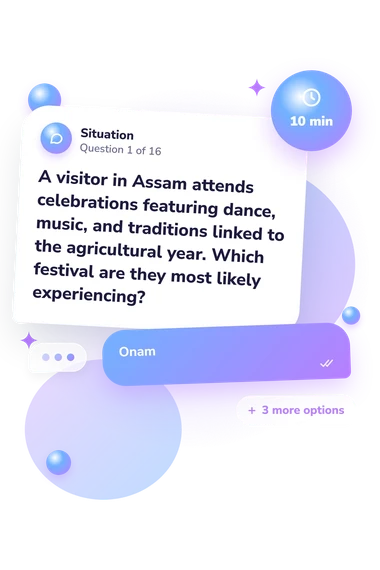
- Assam
- Odisha
- Kerala
- Telangana
- The launch of the Quit India Movement
- India becoming independent from British rule
- The Constituent Assembly adopting the Constitution
- The Constitution of India coming into effect
General Knowledge Quiz India - Description and methodology of the test
People who want to check how well they know India’s major facts can use General Knowledge Quiz India as a focused learning snapshot. This India quiz suits curious learners, students, travelers, and anyone revisiting familiar topics. Its questions provide a practical way to revisit cultural, historical, geographic, civic, and heritage knowledge.
What This Assessment Explores
The assessment samples factual understanding across four thematic areas: culture and heritage, history, geography, and civics. The questionnaire is an Indian quiz that asks readers to recall facts or recognize how they apply in real situations.
The questions cover four thematic areas:
- Culture and heritage cover festivals, arts, literature, music, architecture, and major sites.
- History covers events, leaders, policies, and national milestones.
- Geography covers states, landforms, regions, and monsoon patterns.
- Civics covers institutions, constitutional provisions, and observances.
One overall India General Knowledge score runs from 0-16: Foundation (0-6), Developing (7-12), or Strong (13-16). Foundation suggests a base for review; Developing shows broad knowledge with gaps; Strong reflects well-rounded command of the tested contexts.
This overall band offers a broad indication of performance across the tested contexts, rather than separate results for each theme.
Methodology and Content References
Each item uses four-option multiple choice. Some prompts test recall; others place facts in travel, classroom, or civic situations and ask for the best answer. The format checks recognition and contextual application rather than personality or motivation.
Several prompts span culture, geography, history, civics, and heritage. The questionnaire’s India quiz questions combine factual prompts with short scenarios, so performance can reflect stored information and the ability to apply it.
One displayed result reports overall performance on this selected set of topics. The questionnaire is a general knowledge quiz about India, not a standardized educational grade or norm-based estimate of national knowledge.
Content references include Khullar (2020) for geography, Chandra et al. (1989) for independence-era history, Sen (2011) for constitutional context, and NCERT (2025-26) for art and heritage. These are content references, not evidence of validation or norms; the questionnaire has not been standardized.
Results remain sensitive to prior study, wording, attention, and current context. A strong result shows success on these items, while a lower result can identify topics for review without representing every aspect of knowledge about India.
- D. R. Khullar, India: A Comprehensive Geography, 4th ed., Kalyani Publishers, New Delhi, reprint 2020.
- Bipan Chandra, Mridula Mukherjee, Aditya Mukherjee, K. N. Panikkar, and Sucheta Mahajan, India's Struggle for Independence, 1857-1947, revised ed., Penguin Books, New Delhi, 1989, ISBN 9780140107814.
- Sarbani Sen, The Constitution of India: Popular Sovereignty and Democratic Transformations, Oxford University Press, 2011. 10.1093/acprof:oso/9780198071600.001.0001
- National Council of Educational Research and Training, An Introduction to Indian Art, Part I, NCERT, New Delhi, reprint 2025-26.
Updated: