
Guess the Pokemon Quiz
How the Scales are Structured
Who Usually Takes This Test?
See How You Compare
Below is a preview of how scores are typically distributed across each scale.
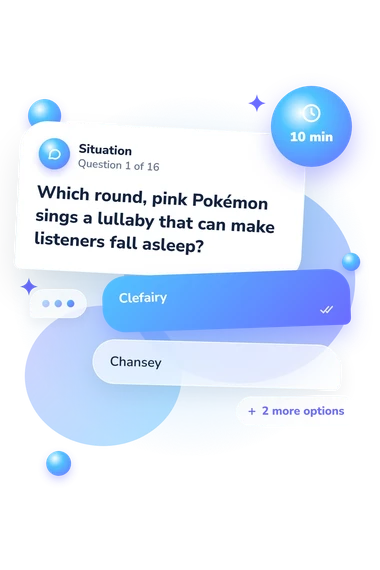
Example Questions From the Test
- Clefairy
- Chansey
- Jigglypuff
- Skitty
- Raichu
- Rapidash
- Sandslash
- Machoke
- Typhlosion
- Dragonite
- Charizard
- Salamence
Guess the Pokemon Quiz - Description and methodology of the test
For readers who enjoy identifying Pokémon from clues rather than memorizing a formal curriculum, Guess the Pokémon Quiz offers a focused way to test recognition. It also works as a Pokémon guessing game for casual fans, returning players, and anyone wondering how well familiar names, forms, types, and evolution lines are connected. The result gives a simple snapshot of recall across several kinds of Pokémon knowledge.
What This Assessment Explores
The questionnaire measures practical recognition rather than speed or competitive performance. Its clues ask readers to identify Pokémon through appearance, type combinations, evolution stages, behavior, powers, and familiar lore. That mix gives fans a Pokémon knowledge test that checks connected recall across identities, types, and evolution lines.
Questions span straightforward and more discriminating prompts. A response may require linking a Pokémon to a stone, level, fossil, transformation, type weakness, or story detail.
Results place performance on the Pokémon Knowledge scale:
- New Trainer, 0-6, shows recognition of major clues with much of the Pokédex still to explore.
- Pokédex Scout, 7-12, shows solid knowledge of identities, evolutions, and types, with tougher clues remaining.
- Pokémon Professor, 13-16, shows accurate recognition across evolution, battle, appearance, and lore.
These labels describe current familiarity, not intelligence or a permanent fandom status.
Methodology and Evidence Base
Each item presents a short scenario or direct clue with four answer choices. The task is recognition: choose the Pokémon that best fits, rather than rate agreement or describe personal experience. Correct identifications are combined into the displayed result. The displayed Pokémon Knowledge result ranges from 0 to 16 correct answers.
The content is conceptually consistent with Cabello et al. (2023), which treats Pokémon knowledge as a testable domain spanning factual and universe-specific details. The 2015 Official National Pokédex supports identity, typing, evolution, and lore references for entries included in that edition. Kilpatrick, Cwiek, and Kawahara (2023) provide relevant context for Pokémon naming and evolution patterns, but their study does not validate this questionnaire. As an online knowledge check, the displayed result reflects performance on its 16 items.
The quiz's Pokémon trivia questions sample entries from multiple generations, but its short format is not a complete survey of every generation or medium. Familiarity with particular games or shows, guessing, recently recalled facts, and item wording can affect the total. Read the band as a current snapshot that can suggest what to revisit, rather than as a formal estimate of overall Pokémon expertise.
- Cabello, Laura, Jiaang Li, and Ilias Chalkidis. “PokemonChat: Auditing ChatGPT for Pokémon Universe Knowledge.” arXiv preprint arXiv:2306.03024, 2023.
- The Pokémon Company International. Pokémon Omega Ruby & Pokémon Alpha Sapphire: The Official National Pokédex. The Pokémon Company International, 2015.
- Kilpatrick, Alexander James, Aleksandra Cwiek, and Shigeto Kawahara. “Random Forests, Sound Symbolism and Pokémon Evolution.” PLOS ONE 18, no. 1 (2023): e0279350. 10.1371/journal.pone.0279350