
Bone Markings Quiz
How the Scales are Structured
Who Usually Takes This Test?
See How You Compare
Below is a preview of how scores are typically distributed across each scale.
Example Questions From the Test
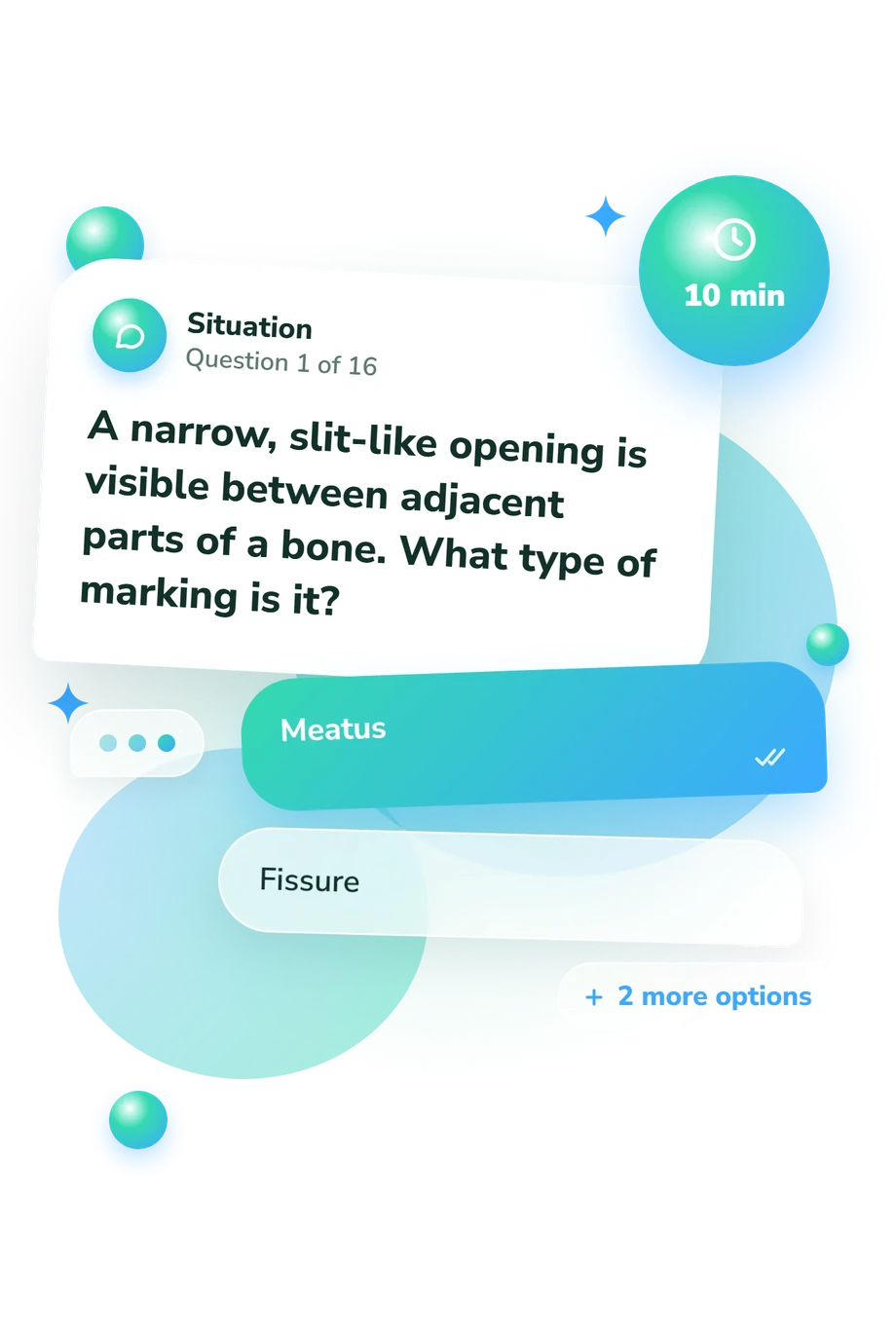
- Meatus
- Fissure
- Sinus
- Crest
- Meatus
- Fossa
- Tubercle
- Condyle
- Condyle
- Sinus
- Fissure
- Tuberosity
Bone Markings Quiz - Description and methodology of the test
Students preparing for anatomy coursework, laboratory practicals, or a refresher can use the bone markings quiz to check whether familiar terms match the structures they describe. This bone markings test uses short anatomical clues and recognition of the matching term, so the result shows an overall level of knowledge and whether foundational, developing, or stronger review may be appropriate.
What This Assessment Explores
Questions ask you to match a structural clue with the anatomical term that best describes it. The focus is vocabulary for shape, location, passage, attachment, and joint-related structure, making the assessment useful for learners identifying landmarks on diagrams, models, scans, or specimens.
The question set covers four anatomical groups:
- Recognizing projections and ridges shows whether you can distinguish shape, size, and likely attachment function.
- Identifying depressions and indentations shows whether you can separate basins, grooves, and notches.
- Naming openings and passageways shows whether you can identify routes through or within bone.
- Matching articular structures shows whether you can compare smooth contact surfaces and rounded expansions.
The quiz on bones and bone markings therefore reflects terminology recognition rather than hands-on specimen skill. Its overall result indicates whether foundational, developing, or stronger review is appropriate.
Methodology and Scientific Basis
In this format, bone markings questions give brief anatomical descriptions and four answer choices. The respondent selects the term that best matches the form, location, passage, attachment, or joint relationship described. This is recognition-based scoring rather than written recall, useful for study beside diagrams, models, or laboratory notes.
The terminology is consistent with Marieb and Keller (2018), OpenStax, and Terminologia Anatomica, while Chmielewski and Domagala (2020) emphasize distinctions among similar labels. These are content references rather than validation studies, so they support the anatomical wording, not claims about the questionnaire's reliability or validity.
Scoring awards one point for each correct response on the Bone Markings Knowledge scale, ranging from 0-16. Results appear as Foundation Building (0-6), Developing Knowledge (7-12), or Strong Knowledge (13-16): Foundation Building calls for review of the main categories; Developing Knowledge reflects recognition of many landmarks with possible confusion between similar terms or specimen applications; Strong Knowledge indicates a reliable command of common terminology and functional clues.
Fixed choices leave results open to guessing, attention, and wording effects, so use this result as a focused educational snapshot rather than evidence of practical skill or complete anatomical competence.
- Marieb, Elaine N., and Suzanne M. Keller. Essentials of Human Anatomy & Physiology, 12th ed. Pearson, 2018. ISBN 9780134395326.
- Betts, J. Gordon, Kelly A. Young, James A. Wise, Eddie Johnson, Brandon Poe, Dean H. Kruse, Oksana Korol, Jody E. Johnson, Mark Womble, and Peter DeSaix. Anatomy and Physiology 2e. OpenStax, 2022. ISBN 978-1-951693-42-8.
- Federative International Programme for Anatomical Terminology. Terminologia Anatomica, 2nd ed. International Federation of Associations of Anatomists, 2019.
- Chmielewski, Piotr P., and Zygmunt A. Domagala. “Terminologia Anatomica and its practical usage: pitfalls and how to avoid them.” Folia Morphologica, vol. 79, no. 2, 2020, pp. 198-204. 10.5603/FM.a2019.0086.
Updated: