
Macbeth Act 1 Quiz
How the Scales are Structured
Who Usually Takes This Test?
See How You Compare
Below is a preview of how scores are typically distributed across each scale.
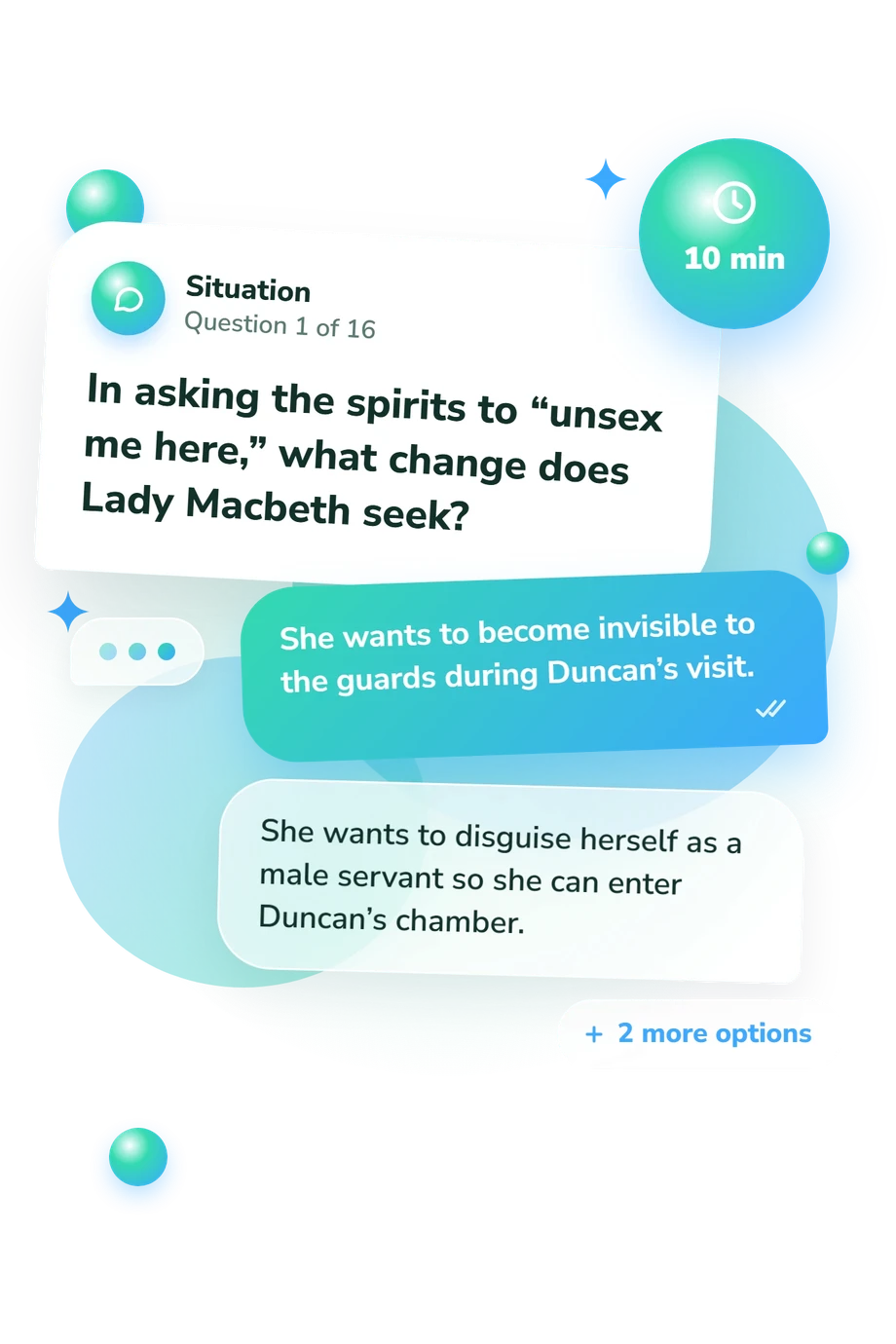
Example Questions From the Test
- She wants to become invisible to the guards during Duncan’s visit.
- She wants to disguise herself as a male servant so she can enter Duncan’s chamber.
- She wants to be stripped of compassion and filled with the resolve she associates with cruelty.
- She wants to abandon Macbeth and claim the Scottish crown independently.
- Banquo is appointed Thane of Cawdor.
- Donalbain is placed in command of the Scottish army.
- Malcolm is named Prince of Cumberland.
- Macduff is declared Duncan’s closest relative.
- Thane of Cawdor, Prince of Cumberland, and future father of kings
- Thane of Fife, savior of Scotland, and future king
- Thane of Glamis, conqueror of Norway, and Duncan’s chosen heir
- Thane of Glamis, Thane of Cawdor, and future king
Macbeth Act 1 Quiz - Description and methodology of the test
Students revising Shakespeare’s opening act can use the Macbeth Act 1 Quiz to check whether they can connect events with motives, quotations, and stagecraft. It suits readers who want a focused comprehension check before class discussion or independent revision. As a Macbeth Act One Quiz, it shows whether recall is secure enough to support interpretation, or whether particular scenes and lines deserve another close look.
What This Assessment Explores
The questionnaire measures knowledge of Act 1 rather than literary ability. Its items ask readers to place scenes in sequence, identify motives behind choices, interpret quotations, and recognize devices such as dramatic irony and imagery. The Macbeth Act I Quiz therefore checks what happens and how Shakespeare makes the audience understand it.
The result is reported on one scale, Macbeth Act 1 Knowledge (0-16), with dimensions:
- Plot and sequence show whether scenes, revelations, and decisions are placed correctly.
- Character motivation shows how Macbeth, Lady Macbeth, Banquo, and Duncan respond to pressure.
- Prophecy and ambition show how supernatural promises interact with political choices.
- Language and stagecraft show whether quotations, images, irony, and soliloquies are understood.
Scores of 0-6 are Foundations to revisit; 7-12 are Developing understanding; and 13-16 are Strong Act 1 knowledge. These labels indicate the revision most likely to help.
Methodology and Evidence Base
Each question uses selected response: four alternatives are presented, and the reader chooses the answer best supported by Act 1. Correct responses form the single displayed result; no separate character or theme subscores are reported. When reviewing Macbeth Act 1 questions, readers should connect each choice with a scene, quotation, motive, or dramatic effect rather than memorize letters.
This is a text-based literary knowledge check, not a published psychological instrument. Its primary reference is Macbeth (2024), with Emma Smith and John Jowett’s edition providing the main wording; A. R. Braunmuller’s 2008 edition supplies a second scholarly text. Heffernan’s 2016 study supports attention to political and historical pressures. The questionnaire is conceptually consistent with these works, but it is not an adaptation or validation of them.
No norm group, reliability estimate, or independent validation is reported, so the bands describe performance on this set rather than population standards. Results may vary with edition choices, classroom emphasis, and the reader’s current attention.
- Shakespeare, William, and Thomas Middleton. Macbeth: The New Oxford Shakespeare. Edited by Emma Smith and John Jowett. Oxford University Press, 2024. ISBN 9780192862426.
- Shakespeare, William. Macbeth. Edited by A. R. Braunmuller. The New Cambridge Shakespeare, 2nd ed. Cambridge University Press, 2008. 10.1017/9780511810381.
- Heffernan, Julián Jiménez. “Beyond this ignorant present”: the poverty of historicism in Macbeth. Palgrave Communications, 2, 16054 (2016). 10.1057/palcomms.2016.54.
Updated: