
Food Safety Quiz
How the Scales are Structured
Who Usually Takes This Test?
See How You Compare
Below is a preview of how scores are typically distributed across each scale.
Example Questions From the Test
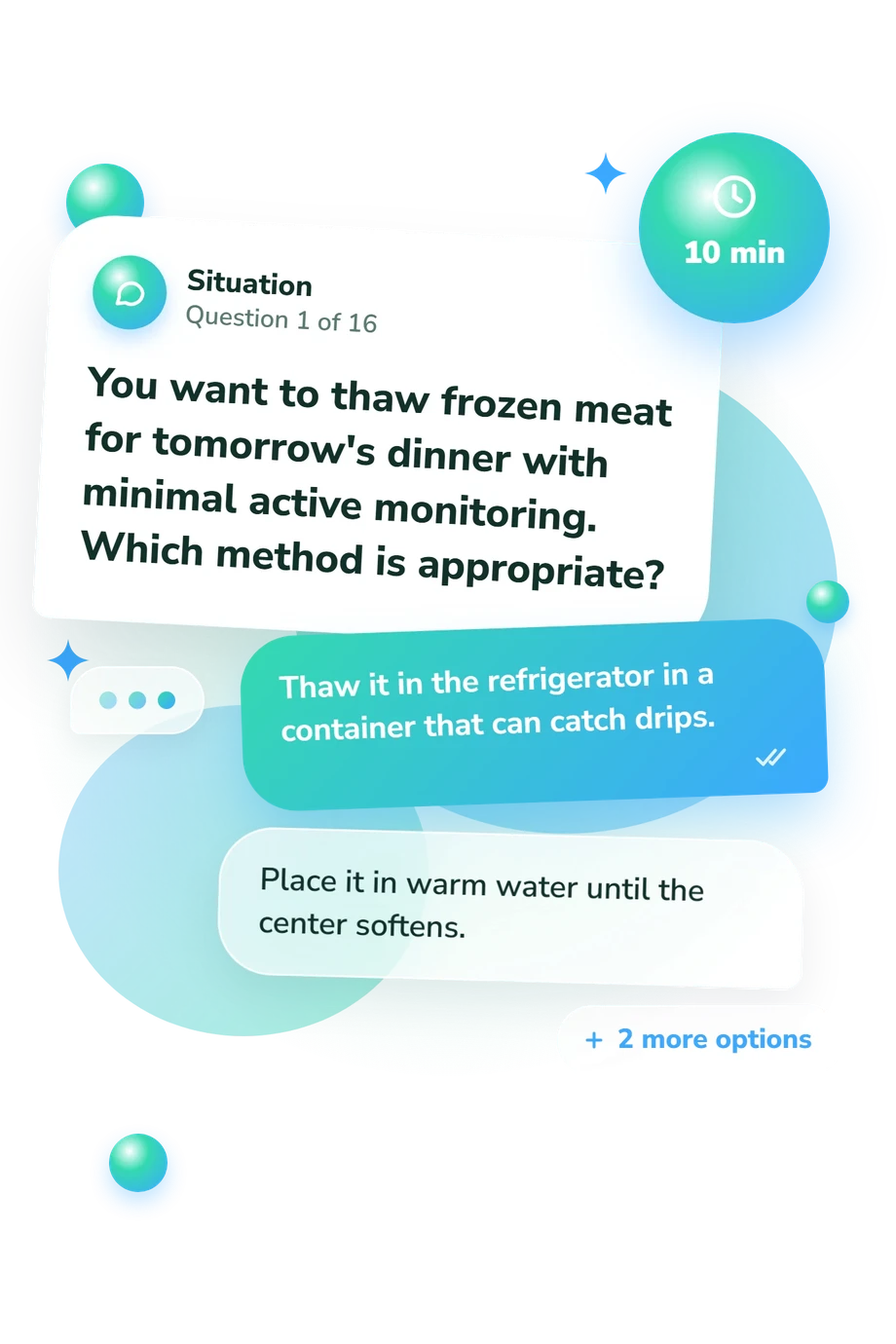
- Thaw it in the refrigerator in a container that can catch drips.
- Place it in warm water until the center softens.
- Microwave it in the evening, then leave it refrigerated until tomorrow.
- Leave it on the kitchen counter overnight.
- Discard the can without opening or tasting its contents.
- Boil the contents before deciding whether to eat them.
- Transfer the contents to another container and refrigerate them.
- Open it outdoors and use the contents if the smell is normal.
- In the oven air directly above the meat.
- Just beneath the surface, where heat reaches the food first.
- Against a bone, because bone gives the clearest reading.
- In the thickest part, away from bone and large pockets of fat.
Food Safety Quiz - Description and methodology of the test
For home cooks, caregivers, and anyone responsible for serving others, this food hygiene quiz examines practical decisions that limit contamination and protect people when safety is uncertain. The food safety quiz helps readers identify which everyday principles they recognize confidently and which deserve review. Its focus is applied judgment in kitchens, not memorizing isolated rules or relying on appearance and smell.
What This Assessment Explores
Across the scenarios, questions in this food-safety quiz cover thawing, chilling, reheating, cooking, handwashing, surface hygiene, raw-food separation, allergen cross-contact, and uncertain storage. It is intended for anyone who prepares or serves food, and the result reflects recognition of safer practices in the situations presented rather than guaranteed behavior in every kitchen.
These items group into four practical areas:
- Hygiene checks whether handwashing and food-contact surface care reduce contamination.
- Separation examines whether raw foods, allergens, and ready-to-eat items remain apart.
- Temperature control shows recognition of safer thawing, chilling, cooking, and reheating.
- Caution reflects decisions made when storage history is uncertain or a guest is more vulnerable.
The displayed scale is Food Safety Knowledge: 0-16. Foundation to build (0-6) signals core safeguards to review; Developing knowledge (7-12) shows many correct principles with gaps; Strong knowledge (13-16) reflects consistent recognition of effective prevention practices.
Methodology and Evidence Base
The prompts describe familiar handling situations and offer several choices. Respondents select the answer that best reflects safe food-handling knowledge or judgment in each kitchen situation, including conclusions, distinctions, guest vulnerability, and practical choices. Answers to the food-safety quiz can point to concrete habits for practice.
The result is reported on the displayed scale, and this online questionnaire has no documented norms or validation; the educational score is not a certification. Its band points to topics for review.
Conceptually, the questionnaire is consistent with the Food Safety Knowledge Instrument (Byrd-Bredbenner et al., 2007), which measures practical consumer food-safety knowledge. It also aligns with Medeiros et al. (2004) on consumer knowledge and attitudes. This is a conceptual relationship, not a claim that the online questionnaire reproduces either instrument. Topics correspond to CDC and FDA guidance on hygiene, separation, temperature control, and uncertain storage.
Food-safety quiz questions and answers are most useful when missed choices become prompts to review a specific habit. Attention, memory, current circumstances, and self-report can influence performance; when safety cannot be established, follow local public-health guidance and choose the cautious option.
- Carol Byrd-Bredbenner, Virginia Wheatley, Donald Schaffner, Christine Bruhn, Lydia Blalock, and Jaclyn Maurer. (2007). Development and Implementation of a Food Safety Knowledge Instrument. Journal of Food Science Education, 6(3), 46-55. 10.1111/j.1541-4329.2007.00029.x
- Lydia C. Medeiros, Virginia N. Hillers, Gang Chen, Verna Bergmann, Patricia A. Kendall, and Mary E. Schroeder. (2004). Design and development of food safety knowledge and attitude scales for consumer food safety education. Journal of the American Dietetic Association, 104(11), 1671-1677. 10.1016/j.jada.2004.08.030
- Centers for Disease Control and Prevention. (2010). Use of a Self-Assessment Questionnaire for Food Safety Education in the Home Kitchen - Los Angeles County, California, 2006-2008. MMWR Morbidity and Mortality Weekly Report, 59(34), 1098-1101.
- U.S. Food and Drug Administration, Office of Women's Health. (2021). Food Safety at Home.
Updated: