
General Knowledge Quiz for Kids
How the Scales are Structured
Who Usually Takes This Test?
See How You Compare
Below is a preview of how scores are typically distributed across each scale.
Example Questions From the Test
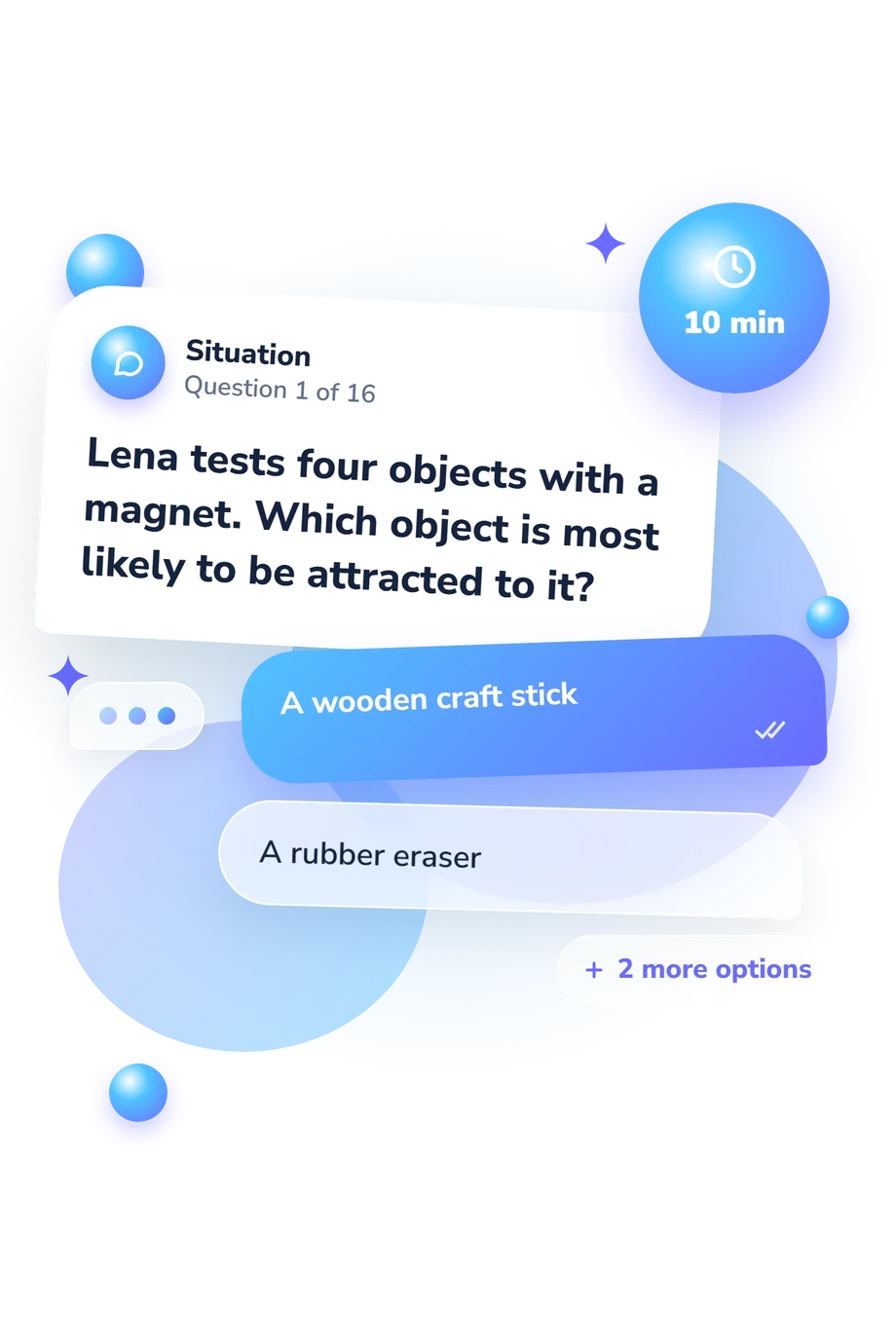
- A wooden craft stick
- A rubber eraser
- A steel paper clip
- A glass marble
- Clouds regularly cover fixed parts of it
- Earth's shadow falls on it every night
- We see different portions of its sunlit half as it orbits Earth
- The Moon changes its actual shape
- The Sun circles Earth once each day
- Earth changes its distance from the Sun
- The Moon pulls the Sun across the sky
- Earth rotates on its axis
General Knowledge Quiz for Kids - Description and methodology of the test
Designed for families, teachers, and children who enjoy learning across subjects, the general knowledge quiz for kids offers a quick snapshot of broad academic knowledge and everyday reasoning. As a kids general knowledge quiz, this assessment can show where a child feels confident and which topics may invite further conversation or practice. It works best as a friendly starting point for curiosity, not as a complete picture of ability.
What This Assessment Explores
This assessment samples science, history, vocabulary, geography, punctuation, mathematics, health, and environmental understanding. Across the general knowledge quiz questions for kids, items ask the child to identify facts, explain familiar processes, or apply simple rules to everyday situations. The result therefore reflects breadth across subjects together with basic reasoning.
The displayed scale, General Knowledge Knowledge (0-16), summarizes performance across the sampled topics. Its bands are:
- Curious Starter (0-6) shows recognition of some key facts and room to build knowledge through exploration.
- Growing Generalist (7-12) reflects a solid base across several topics, with less familiar areas to strengthen.
- Knowledge Champion (13-16) indicates broad, reliable knowledge and strong reasoning across the sampled subjects.
These labels can guide discussion and follow-up learning without treating one result as a complete measure of ability.
Methodology and Evidence Base
In practical terms, this general knowledge test for kids uses multiple-choice items with one best-fitting response. Each prompt offers four choices, so the child identifies a fact, explains a familiar process, or applies a simple rule. Examples include magnetism, lunar phases, renewable energy, fractions, and perimeter. The resulting total is read against the catalogue’s descriptive bands.
Methodologically, the format resembles educational assessment: performance is inferred from selected responses across varied content, not from a single self-rating. Marsh et al. (2012) support viewing retrieval questions as potentially useful for later learning, while Rock and Pollack’s ECLS-K psychometric work highlights the need to connect item performance with careful score interpretation. This questionnaire is conceptually consistent with those sources, not an adaptation of either.
Because this online questionnaire has no stated population norms or independent validation, results may also reflect prior teaching, language, attention, and current context. Use the result to discuss missed topics, reasoning, and next learning interests.
- Elizabeth J. Marsh, Lisa K. Fazio, and Anna E. Goswick. Memorial consequences of testing school-aged children. Memory, 20(8), 899-906, 2012. 10.1080/09658211.2012.708757
- Donald A. Rock and Judith M. Pollack. Early Childhood Longitudinal Study-Kindergarten Class of 1998-99 (ECLS-K), Psychometric Report for Kindergarten Through First Grade. NCES Working Paper No. 2002-05. National Center for Education Statistics, 2002.
Updated: