
Signs Your Mother Hates You Quiz
How the Scales are Structured
Who Usually Takes This Test?
See How You Compare
Below is a preview of how scores are typically distributed across each scale.
Example Questions From the Test
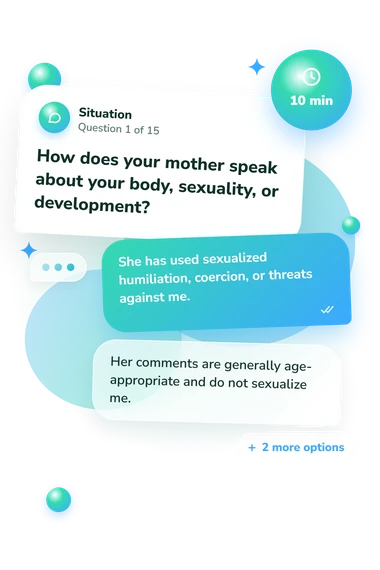
- She has used sexualized humiliation, coercion, or threats against me.
- Her comments are generally age-appropriate and do not sexualize me.
- She sometimes makes personal remarks that feel uncomfortable, then stops when told.
- She repeatedly makes sexualized or invasive comments despite my discomfort.
- She may raise her voice, but keeps physical distance and allows me to leave.
- She slams doors or throws harmless objects away from people.
- She corners me, blocks my path, or uses her body to intimidate me.
- She hits, restrains, chokes, injures, or directly threatens physical harm.
- She initially minimizes the concern but later listens and helps me seek support.
- She threatens or punishes me to keep me from speaking about it.
- She takes me seriously, prioritizes safety, and helps me access appropriate support.
- She repeatedly dismisses, blames, or pressures me to tolerate the behavior.
Signs Your Mother Hates You Quiz - Description and methodology of the test
People facing frightening or boundary-crossing experiences at home may use this questionnaire to organize events and decide what deserves support when they take a does my mom hate me quiz. The Signs Your Mother Hates You Quiz examines behavior rather than claiming to reveal a parent’s private feelings. For someone wondering whether their mom hates them, this questionnaire’s result is useful when it redirects fear toward safety, respect, care, and boundaries.
What This Assessment Explores
These items examine concrete situations rather than inferred motive: control, deprivation, isolation, unsafe supervision, delayed care, physical intimidation, and sexual-boundary violations. For someone taking a why does my mom hate me quiz, the result maps endorsed concerns by domain and identifies the domain needing attention.
The three displayed scales organize that reflection:
- Emotional Control and Unmet Needs (0-15) covers control, threats, deprivation, degradation, and unmet needs; bands are No indicator endorsed (0), Concern to notice (1-2), and Act on the concern (3-15).
- Physical Force and Safety (0-15) covers intimidation, injury, unsafe conditions, and blocked protection or care; bands are No indicator endorsed (0), Concern to notice (1-2), and Act on the concern (3-15).
- Sexual Boundaries (0-15) covers unwanted exposure, ignored refusal, coercion, and sexual contact; bands are No indicator endorsed (0), Concern to notice (1-2), and Act on the concern (3-15).
Methodology and Scientific Basis
Each item presents four situation-based responses, from safer conduct to more concerning behavior. Someone taking a my mom hates me quiz selects the best match, and answers are grouped into three domains. Domain totals are reported, but the questionnaire does not specify how responses contribute to them.
Conceptually, the content is consistent with ICAST-C, which addresses violence, neglect, and safety. It also overlaps with Straus et al. (1998) on psychological aggression and physical force. This questionnaire is not presented as a direct adaptation, normed version, or validation of either instrument. It examines the question behind a why does my mother hate me quiz through observable actions rather than guessed motive.
Displayed bands are unvalidated reflective summaries, not clinical or legal cutoffs, so totals cannot establish hatred, neglect, or abuse. Any red-flag response matters independently; immediate danger or serious injury calls for emergency services. Self-report depends on memory, current context, self-awareness, and boundary understanding. Poverty, disability, crisis, or unavailable care may contribute to neglect-like experiences without erasing impact. The questionnaire helps identify concrete concerns rather than promise a definitive explanation.
- Zolotor, Adam J., Desmond K. Runyan, Michael P. Dunne, Dipty Jain, Helga R. Péturs, Clemencia Ramirez, Elena Volkova, Sibnath Deb, Victoria Lidchi, Tufail Muhammad, and Oksana Isaeva. "ISPCAN Child Abuse Screening Tool Children's Version (ICAST-C): Instrument development and multi-national pilot testing." Child Abuse & Neglect 33, no. 11 (2009): 833-841. DOI 10.1016/j.chiabu.2009.09.004
- Straus, Murray A., Sherry L. Hamby, David Finkelhor, David W. Moore, and Desmond Runyan. "Identification of child maltreatment with the Parent-Child Conflict Tactics Scales: Development and psychometric data for a national sample of American parents." Child Abuse & Neglect 22, no. 4 (1998): 249-270. DOI 10.1016/S0145-2134(97)00174-9
Updated: