
Muscles of the Forearm Quiz
How the Scales are Structured
Who Usually Takes This Test?
See How You Compare
Below is a preview of how scores are typically distributed across each scale.
Example Questions From the Test
- Flexor retinaculum
- Common flexor origin
- Common extensor origin
- Bicipital aponeurosis
- Abductor pollicis longus
- Extensor pollicis brevis
- Extensor pollicis longus
- Flexor pollicis longus
- Pronator quadratus
- Flexor digitorum profundus
- Pronator teres
- Flexor pollicis longus
Muscles of the Forearm Quiz - Description and methodology of the test
Students, trainees, and readers can use this assessment to check how well they connect forearm structures with movement and apply forearm anatomy. The Muscles of the Forearm Quiz focuses on functional anatomy rather than simple name recognition. It suits anyone reviewing the region before study, teaching, or practical work. As a forearm anatomy quiz, it connects structure with movement, while its result can indicate whether broader review may be useful.
What This Assessment Explores
It examines muscle compartments, layers, actions, attachments, nerve supply, and movement. Questions address wrist and finger actions, pronation and supination, elbow position, tendon routes, shared origins, and nerve injuries. As a quiz about forearm muscles, it emphasizes functional understanding rather than memorized labels.
Results appear as Forearm Muscles Knowledge (0-16): Foundation to build (0-6) indicates recognition of some key structures and possible benefit from reviewing compartments, actions, and major attachments; Developing knowledge (7-12) reflects useful understanding with some functional or clinical gaps; Strong knowledge (13-16) reflects consistent connections among locations, actions, attachments, and nerves. This score describes quiz performance, not clinical competence.
These dimensions are:
- Compartments and layers show where muscles sit.
- Actions and movement combinations show how muscles produce motion.
- Attachments and tendon routes show how landmarks explain function.
- Nerve and clinical patterns show how injuries affect movement.
Methodology and Evidence Base
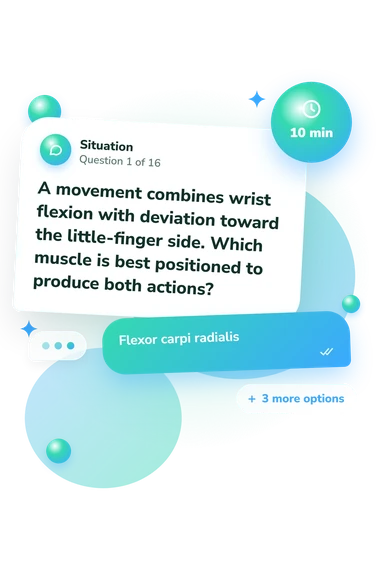
Each item presents a short anatomical or clinical scenario with four answer choices and one best response. The prompts require you to integrate location, action, attachment, and innervation, so success depends on applying relationships rather than recognizing names alone. The scoring display uses the stated result bands, and no additional weighting rule is stated.
Dharamsi et al. (2022) offer relevant educational context: their study is conceptually consistent with linking forearm structures and function but does not validate or author this questionnaire. The quiz is not presented as its adaptation. Dalley and Agur’s clinical anatomy text supplies the conventional framework for compartments, actions, attachments, tendons, and nerves.
In its online format, this forearm muscle quiz is a knowledge and self-reflection tool that reports quiz-specific performance through the displayed bands rather than a broader measure. Scores can be influenced by recent study, wording interpretation, guessing, and familiarity with clinical examples, so they should be read as a snapshot of performance on these questions.
- Dharamsi MS, Bastian DA, Balsiger HA, Cramer JT, Belmares R. Efficacy of Video-Based Forearm Anatomy Model Instruction for a Virtual Education Environment. Journal of Medical Education and Curricular Development. 2022;9:23821205211063287. 10.1177/23821205211063287
- Dalley AF II, Agur AMR. Moore's Clinically Oriented Anatomy. 9th ed. Philadelphia, PA: Wolters Kluwer; 2023.