
Talent Quiz
How the Scales are Structured
Who Usually Takes This Test?
See How You Compare
Below is a preview of how scores are typically distributed across each scale.
Example Questions From the Test
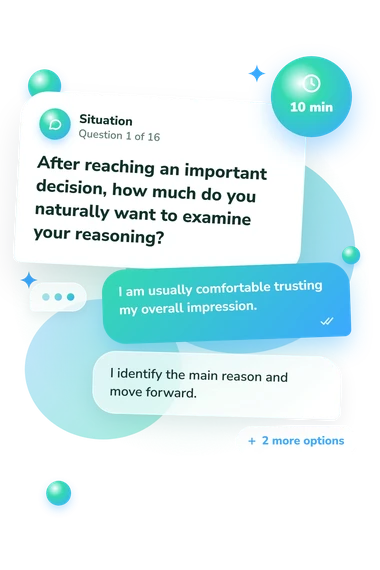
- I am usually comfortable trusting my overall impression.
- I identify the main reason and move forward.
- I check the strongest evidence before committing.
- I test my assumptions and compare credible alternatives.
- Following instructions to make something useful or familiar.
- Customizing an existing idea to suit my taste.
- Making something based on an image or story in my mind.
- Experimenting without knowing what the finished result will be.
- More possibilities for what the event could become.
- One visible task that helps the effort begin.
- A clear definition of the event's essential deliverable.
- A checklist with tasks, timing, materials, and owners.
Talent Quiz - Description and methodology of the test
For readers deciding where to invest energy in study, creative work, practical projects, or social situations, the talent quiz offers a structured way to compare options before acting on a new personal direction. Its self-reflection questionnaire format helps them notice which activities feel more natural, without assigning one permanent label.
What This Assessment Explores
The questions use ordinary situations to show where a person’s attention and effort tend to go. They cover decisions, creative constraints, repairs, deadlines, disagreements, and social cues, helping clarify a person’s natural affinities across different settings.
The four result dimensions are:
- Analytical Problem-Solving (0-12) measures affinity for evidence and patterns: Intuitive Approach (0-4), Situational Analyst (5-8), Natural Investigator (9-12).
- Creative Expression (0-12) measures imagination and experimentation: Familiar Foundations (0-4), Adaptive Creator (5-8), Imaginative Explorer (9-12).
- Practical Execution (0-12) measures organized action and completion: Flexible Contributor (0-4), Capable Implementer (5-8), Hands-On Finisher (9-12).
- Relational Insight (0-12) measures social cues and perspectives: Independent Focus (0-4), Responsive Connector (5-8), People-Sense Strength (9-12).
The highest score marks the strongest affinity; scores within one point indicate a blend.
Methodology and Scientific Basis
Each item presents an everyday scenario with four response options. Choices move from familiar or less involved reactions toward stronger analytical, creative, practical, or relational engagement, but the questionnaire records preference rather than demonstrated skill. No answer is inherently correct.
The result displays four scale scores. The highest score marks the strongest affinity; scores within one point indicate a blend. Descriptive bands clarify the tendency represented by each score.
Analytical, creative, and practical themes are conceptually consistent with Sternberg and Grigorenko (2002), who describe these abilities within successful intelligence. The catalogue’s social-cue dimension is outside that connection. Sternberg et al. (2001) reported distinguishable abilities in three international samples using a different instrument; the study provides no validation for this four-scale questionnaire. Gardner’s framework offers broad context, not instrument-specific evidence. The complete questionnaire has no published validation basis.
Used thoughtfully, the result helps readers compare affinities across learning, work, and relationships, including career and study choices. Self-report is shaped by mood, self-image, and recent experience, so observed behavior and feedback add context.
- Sternberg, Robert J., and Elena L. Grigorenko. "The theory of successful intelligence as a basis for instruction and assessment in higher education." New Directions for Teaching and Learning, no. 89, 2002, pp. 45-53. 10.1002/tl.46
- Sternberg, Robert J. Beyond IQ: A Triarchic Theory of Human Intelligence. Cambridge University Press, 1985.
- Gardner, Howard. Frames of Mind: The Theory of Multiple Intelligences. Basic Books, 1983.
- Sternberg, Robert J., Juan-Luis Castejon, Maria Dolores Prieto, Jarkko Hautamaki, and Elena L. Grigorenko. "Confirmatory Factor Analysis of the Sternberg Triarchic Abilities Test in Three International Samples: An Empirical Test of the Triarchic Theory of Intelligence." European Journal of Psychological Assessment, vol. 17, no. 1, 2001, pp. 1-16. 10.1027//1015-5759.17.1.1