
Flags of North America Quiz
How the Scales are Structured
Who Usually Takes This Test?
See How You Compare
Below is a preview of how scores are typically distributed across each scale.
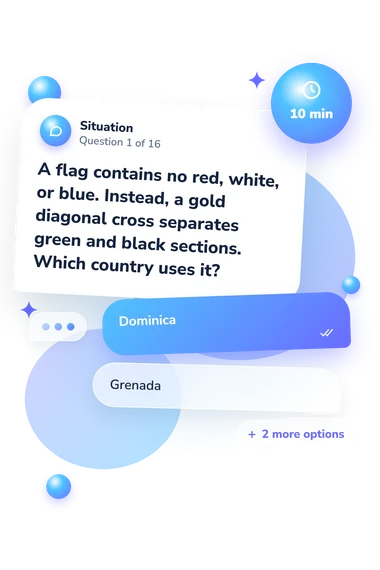
Example Questions From the Test
- Dominica
- Grenada
- Guyana
- Jamaica
- Saint Kitts and Nevis
- Antigua and Barbuda
- Grenada
- Trinidad and Tobago
- 50 stars and 15 stripes
- 13 stars and 50 stripes
- 50 stars and 13 stripes
- 51 stars and 13 stripes
Flags of North America Quiz - Description and methodology of the test
People who want to check their knowledge of national flags can take the Flags of North America Quiz to distinguish neighboring designs rather than rely on a country name alone. As a North America flag quiz, it focuses on colors, geometry, emblems, and symbolic details that make each flag identifiable. Learners, travelers, teachers, and trivia fans may all find it useful.
What This Assessment Explores
The assessment measures recognition of North American national flags through written descriptions of visual clues. Items connect countries with colors, geometric layouts, heraldic devices, stars, plants, animals, and human figures. It suits anyone who wants to distinguish similar designs more confidently.
The questions group into three recognition themes in a quiz about North American flags:
- Color and layout recognition shows how readily you identify bands, crosses, panels, and diagonal divisions.
- Symbols and emblems indicate whether stars, coats of arms, birds, or plants help confirm a country.
- Regional comparison reflects attention to small differences between flags that share broad colors or patterns.
The assessment reports North American Flags Knowledge (0-16), based on correct answers. Because the quiz covers flags of America, results are shown as Foundations (0-6), Developing Knowledge (7-12), or Strong Knowledge (13-16), describing increasing command of national flag features.
Methodology and Evidence Base
Each item gives a written clue describing visual features and four answer choices. You select the country matching the stated colors, symbols, proportions, or arrangement. Performance can still reflect prior exposure, guessing, and concentration.
Scoring uses a direct knowledge-quiz logic: the displayed result is the number of correct answers, so higher totals mean more successful identifications. For a quiz about the flags of the Americas, the score captures performance on the tested visual features rather than a norm-referenced estimate of broader flag knowledge.
Morales-Ramirez (2018) provides a relevant vexillological reference for interpreting visual elements, symbolism, and historical context in flag design. Slater and Znamierowski, along with Barraclough and Crampton, offer comparative descriptions of national flags and heraldic features. These works support the subject matter, but the questionnaire is conceptually consistent with the cited flag references and is not an adaptation of them.
The questionnaire functions as an educational knowledge check, and its bands are descriptive labels for this quiz; prior exposure, attention, and guessing can affect the total.
- Morales-Ramirez, Carlos A. "The Puerto Rican Flag - A Study in Vexillology." Research in Social Sciences and Technology 3(3): 42-67, 2018. 10.46303/ressat.03.03.4.
- Slater, Stephen, and Alfred Znamierowski. The World Encyclopedia of Flags & Heraldry: An International History of Heraldry and Its Contemporary Uses Together with the Definitive Guide to National Flags, Banners, Standards and Ensigns. London: Lorenz, 2007. ISBN 9780754817802.
- Barraclough, E. M. C., and William G. Crampton, eds. Flags of the World. 2nd ed. London: Frederick Warne, 1981. ISBN 9780723227977.