
Travel Quiz
How the Scales are Structured
Who Usually Takes This Test?
See How You Compare
Below is a preview of how scores are typically distributed across each scale.
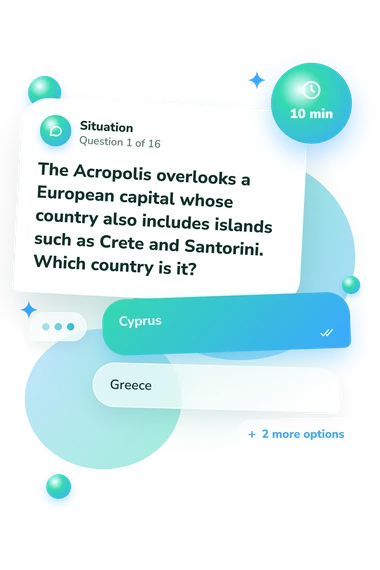
Example Questions From the Test
- Cyprus
- Greece
- Italy
- Croatia
- Belgium
- Switzerland
- France
- Italy
- Sweden
- Iceland
- Finland
- Norway
Travel Quiz - Description and methodology of the test
Anyone who wants to connect famous places with their countries can use this travel quiz to check practical geographic knowledge. It suits curious travelers, students, and people planning future itineraries, turning recognition of landmarks, capitals, routes, and regions into a clear snapshot. This format offers a broad indication of country knowledge before a journey, with country-recognition questions rather than guidance about particular regions.
What This Assessment Measures
Questions focus on country recognition through travel anchors rather than personal preferences. They ask respondents to connect landmarks, capitals, cities, routes, and regional clues with the country they belong to. The questionnaire works as a geography knowledge quiz: each online item tests recognition and recall rather than travel experience, asking which country fits each landmark, capital, route, or regional clue.
The result organizes that knowledge into one scale and three descriptive bands:
- Travel Knowledge (0-16) records the number of country questions answered correctly.
- Starting Explorer (0-6) indicates recognition of some major destinations, with plenty of the world still to discover.
- Growing Globetrotter (7-12) reflects broad travel knowledge with less certainty about some routes or regional clues.
- Worldly Navigator (13-16) indicates accurate identification across a wide range of destinations and geographic contexts.
Methodology and Evidence Base
Each item presents a travel situation followed by four country choices. Landmarks, capitals, routes, cultural geography, and multi-stop itineraries supply the clues, while the respondent selects the country that fits. Destination clues keep the destination knowledge test concrete, without written explanations or personal travel experience.
Scoring counts correct identifications directly. The total reflects performance on country-location questions, not travel frequency or itinerary sophistication. Unfamiliar destinations, inattention, and guessing can affect answers.
The closest conceptual reference is the Tourist Geographic Literacy Scale (Chang et al., 2019). This questionnaire is conceptually consistent with that work, not an adaptation of it. Torrens (2001) connects place-location knowledge with exposure and learning. The 2006 National Geographic study and Turner and Leydon (2012) add context on geographic-literacy testing and online quizzes as learning activities.
Displayed categories are descriptive rather than population norms for this questionnaire. Prior exposure, attention, and guessing can influence performance, so the bands are best read as a learning snapshot. Together, answers offer a snapshot of country knowledge: each response matches a landmark, route, capital, or place to its country.
- Chang, Kang-Tsung, Chung-Ching Huang, and Sheng-Hshiung Tsaur. (2019). "Tourist geographic literacy and its consequences." Tourism Management Perspectives, 29, 131-140. 10.1016/j.tmp.2018.11.005
- Torrens, Paul M. (2001). "Where in the world? Exploring the factors driving place location knowledge among secondary level students in Dublin, Ireland." Journal of Geography, 100(2), 49-60. 10.1080/00221340108978417
- GfK NOP / Roper Public Affairs. (2006). "Final Report: National Geographic-Roper Public Affairs 2006 Geographic Literacy Study." Prepared for the National Geographic Education Foundation, National Geographic Society, May 2006.
- Turner, Sally, and Joseph Leydon. (2012). "Improving Geographic Literacy among First-Year Undergraduate Students: Testing the Effectiveness of Online Quizzes." Journal of Geography, 111(2), 54-66. 10.1080/00221341.2011.583263