
Forklift Quiz
How the Scales are Structured
Who Usually Takes This Test?
See How You Compare
Below is a preview of how scores are typically distributed across each scale.
Example Questions From the Test
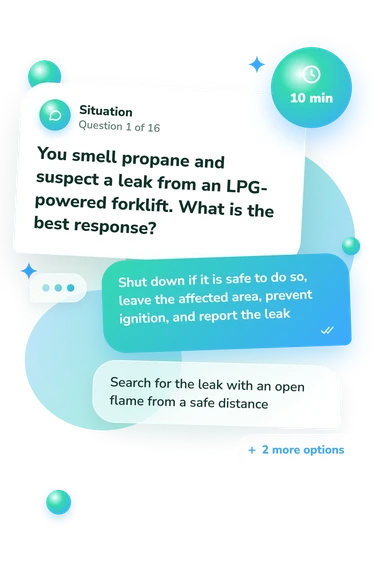
- Shut down if it is safe to do so, leave the affected area, prevent ignition, and report the leak
- Search for the leak with an open flame from a safe distance
- Continue working until the fuel level is low enough to reduce pressure
- Drive the truck outdoors even if the leak is strong
- Accelerate through it to reduce the time spent in the crossing
- Move to the opposite side of the aisle for a wider turning angle
- Raise the forks so they are more visible to other workers
- Slow down, sound the horn, and proceed only when the route is clear
- To calculate how many loads the shift should move
- To identify defects or hazards before the truck is operated
- To replace scheduled maintenance by a qualified technician
- To confirm that the previous operator used the truck efficiently
Forklift Quiz - Description and methodology of the test
For operators, supervisors, and workers who share space with powered industrial trucks, the forklift quiz offers a practical way to examine everyday safety judgment. Scenarios in this forklift safety quiz show how a respondent applies safety principles to hazards, loads, visibility, traffic, inspections, and emergencies. Taken together, they show how the final score reflects broad knowledge across several workplace situations.
What This Assessment Explores
These scenarios examine workplace decisions rather than road-driving knowledge, including leaks, charging, blind corners, pedestrian separation, parking, wet floors, ramps, stability, load centers, attachments, and inspections. Together, these content areas contribute to one overall Forklift Knowledge score, not a profile of separately scored abilities. For someone planning forklift safety training, they provide context rather than separate ratings.
It is reported on a 0-16 scale. The bands are Foundation needed (0-6), Developing knowledge (7-12), and Strong knowledge (13-16). Higher performance reflects stronger safety reasoning within this overall measure, but a score does not authorize truck operation.
The content areas are:
- Hazard recognition shows attention to leaks, charging, and slippery surfaces.
- Load and stability judgment covers capacity, load centers, attachments, ramps, and tip-overs.
- Traffic and operating practice covers visibility, pedestrians, inspections, parking, and platforms.
Methodology and Safety Evidence
Each item presents a workplace situation with four response options. Choosing well requires selecting the response that best applies a safety principle to conditions such as a changed load center, blind crossing, or tip-over. Reviewing forklift safety quiz answers with a trainer can support discussion of why the selected response best applies that principle.
Responses are combined into the displayed total, but the questionnaire does not specify per-answer weighting. This makes the result an overall knowledge indicator rather than a breakdown of individual skills.
The questions are conceptually consistent with OSHA 29 CFR 1910.178 and its stability appendix, plus safety publications by Swartz and by Hughes, Bobick, and Afanuh. These are safety-guidance and incident-prevention sources whose themes align with the scenarios; the questionnaire is not an adaptation or validated version of them. This online questionnaire has no established norms, reliability, or validation.
Because responses are self-reported, memory, attention, and current experience can affect performance. A strong result should still be checked against the truck manual, site rules, and formal evaluation when conditions differ.
- U.S. Department of Labor, Occupational Safety and Health Administration. Powered industrial trucks. 29 C.F.R. § 1910.178.
- U.S. Department of Labor, Occupational Safety and Health Administration. Stability of Powered Industrial Trucks (Non-mandatory Appendix to Paragraph (l) of This Section). Appendix A to 29 C.F.R. § 1910.178.
- Swartz, George. Forklift Safety: A Practical Guide to Preventing Powered Industrial Truck Incidents and Injuries. 2nd ed. Rockville, MD: Government Institutes, 1999.
- Hughes, Sarah E., Thomas G. Bobick, and Susan E. Afanuh. Workplace Solutions: Conducting a Daily Inspection of Powered Industrial Trucks (Forklift, Narrow-Aisle Reach Truck, Walkie Pallet Lift, and Tow Tractor/Tug). Cincinnati, OH: National Institute for Occupational Safety and Health, 2021. 10.26616/NIOSHPUB2022100
Updated: