
American Revolution Quiz
How the Scales are Structured
Who Usually Takes This Test?
See How You Compare
Below is a preview of how scores are typically distributed across each scale.
Example Questions From the Test
- It helped persuade France to enter the war as an American ally
- It forced Parliament to repeal all colonial taxes
- It resulted in the immediate surrender of the British government
- It ended organized fighting in the Southern colonies
- French control of the thirteen former colonies
- The independence of the United States
- American control of Canada
- The restoration of royal governments in the colonies
- George Washington
- Horatio Gates
- Nathanael Greene
- Henry Knox
American Revolution Quiz - Description and methodology of the test
For learners who want to check their grasp of the Revolution’s central story, the American Revolution Quiz offers a focused history review. It suits students, teachers, lifelong learners, and curious adults who can use this Revolutionary War quiz for a lesson, conversation, or independent study. It provides a starting point for revisiting the causes, campaigns, documents, and consequences represented by the quiz’s questions and answers.
What This Assessment Explores
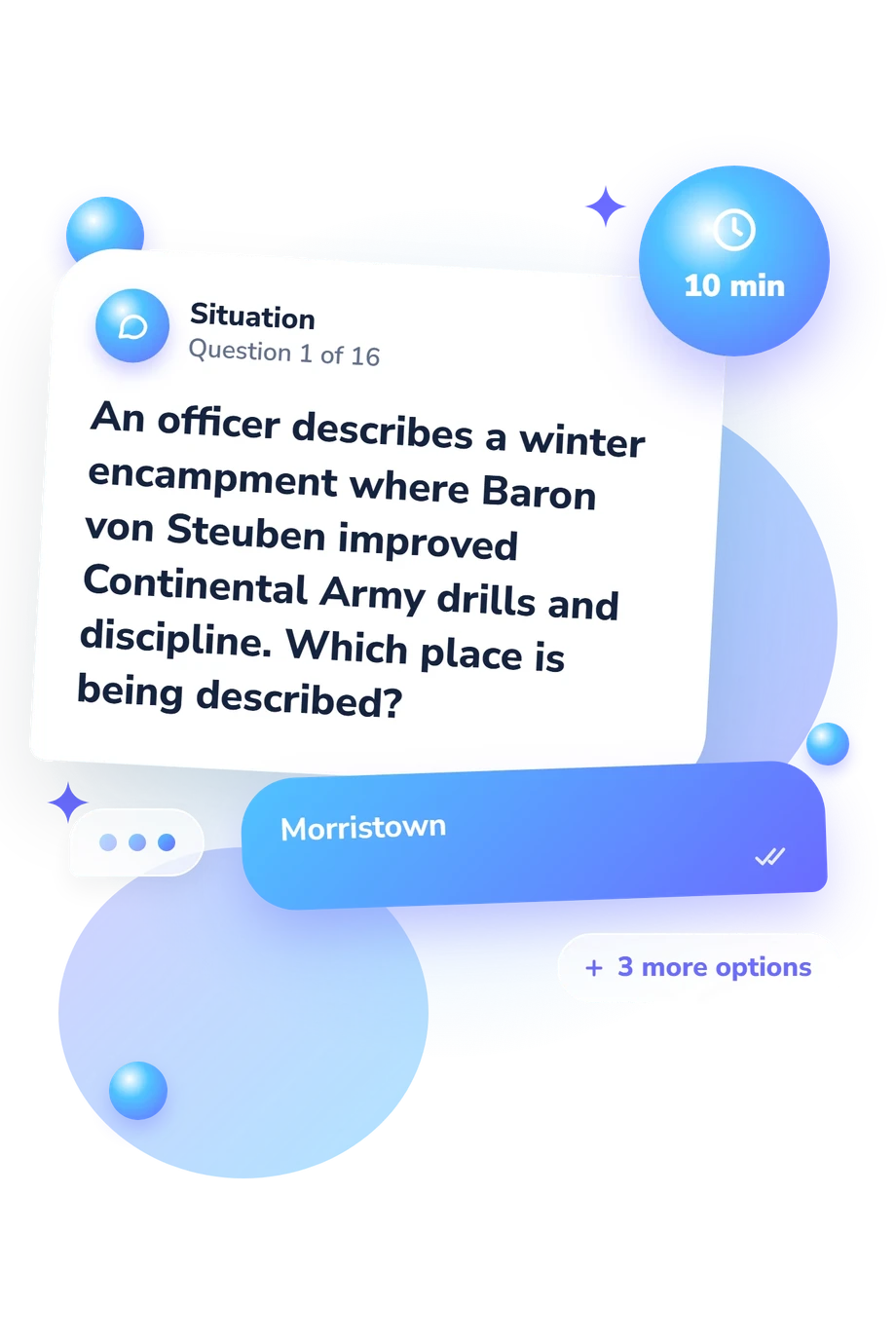
Rather than an essay, the assessment checks recognition of people, policies, battles, documents, alliances, and consequences through four-option questions. It suits learners reviewing the Revolution’s chronology and testing its political and military story.
These four thematic groups show what the result draws on:
- Causes and government explain how imperial measures shaped the conflict.
- People and loyalties identify leaders, Patriots, Loyalists, soldiers, and writers.
- Battles and alliances connect campaigns with strategy and foreign support.
- Documents and outcomes link declarations, treaties, independence, and consequences.
Taken together, the quiz questions about the American Revolution are reflected in one knowledge score. American Revolution Knowledge ranges from 0-16: Foundation to Build (0-6) calls for review of the timeline, causes, and turning points; Developing Command (7-12) shows understanding of many central facts and connections; Strong Command (13-16) indicates a broad, accurate grasp of the Revolution’s political and military history.
Methodology and Evidence Base
Each item uses four-option multiple choice and asks the respondent to select the historically accurate answer. Several questions in this quiz on the Revolutionary War sample the Stamp Act, Boston Tea Party, Saratoga, Yorktown, and Declaration of Independence. Plausible distractors make the result a measure of selected knowledge, not essay-based reasoning.
The result is reported as one overall knowledge score and interpreted through the three descriptive educational bands above, rather than by comparison with a reference population. This profile covers recognition of the Revolution’s chronology, political choices, military campaigns, and founding documents, so choosing answers in this quiz about the American Revolution relies on factual recall rather than broader historical reasoning.
Middlekauff (2005) provides historical context for these events; the questionnaire is conceptually consistent with that work, not derived from it. Reich (2013) supports using multiple-choice performance as a sample of historical knowledge while noting sensitivity to wording and distractor quality. Smith, Breakstone, and Wineburg (2019) distinguish factual recall from broader historical thinking, including sourcing, corroboration, contextualization, and argument.
Guessing, classroom exposure, current attention, and confidence can affect responses. The result indicates general recall but cannot explain why an answer was chosen.
- Middlekauff, Robert. The Glorious Cause: The American Revolution 1763-1789. Revised and expanded edition. Oxford University Press, 2005. 10.1093/oso/9780195162479.001.0001
- Reich, Gabriel A. “Imperfect Models, Imperfect Conclusions: An Exploratory Study of Multiple-Choice Tests and Historical Knowledge.” The Journal of Social Studies Research, vol. 37, no. 1, 2013, pp. 3-16. 10.1016/j.jssr.2012.12.004
- Smith, Mark D., Joel Breakstone, and Sam Wineburg. “History Assessments of Thinking: A Validity Study.” Cognition and Instruction, vol. 37, no. 1, 2019, pp. 118-144. 10.1080/07370008.2018.1499646
Updated: