
Anime Girl Personality Quiz
How the Scales are Structured
Who Usually Takes This Test?
See How You Compare
Below is a preview of how scores are typically distributed across each scale.
Example Questions From the Test
- Quickly analyze what can still be corrected.
- Defend the group if anyone starts assigning blame.
- Use humor and encouragement to restore everyone's energy.
- Reframe the mistake as part of a more creative presentation.
- A practical plan or organized record of current goals.
- A tribute to people and memories that matter to me.
- An imagined character, world, or scene with its own atmosphere.
- Something bold that tests what I can pull off.
- Accept the challenge immediately and focus on surpassing it.
- Observe their technique and prepare before making an attempt.
- Turn the rivalry into a dramatic or funny shared story.
- Enjoy cheering each other on more than settling who is better.
Anime Girl Personality Quiz - Description and methodology of the test
Readers who enjoy playful self-reflection may find the anime girl personality quiz a useful way to compare their instincts across social, creative, strategic, and demanding situations. The invitation to picture yourself as an anime girl makes this What Anime Girl Am I Quiz connect imaginative framing with everyday choices. Comparing the tendencies can show which styles feel natural and where a blended profile may help explain contrasting reactions.
What This Assessment Explores
This anime girl quiz frames five styles playfully. Below, each scale appears with its displayed bands. The highest is strongest affinity; scores within one point indicate a blend.
- Bold Challenger (0-12) measures assertive independence, demanding experiences, and direct confrontation; bands: Measured Path 0-4, Rising Challenger 5-8, Bold Challenger 9-12.
- Dreamweaver (0-12) measures imaginative exploration, emotional symbolism, and turning experience into stories; bands: Concrete Focus 0-4, Creative Undercurrent 5-8, Dreamweaver 9-12.
- Quiet Strategist (0-12) measures observation, deliberate planning, and acting after patterns clarify; bands: Improvised Approach 0-4, Situational Planner 5-8, Quiet Strategist 9-12.
- Radiant Spark (0-12) measures expressive social energy, visible enthusiasm, and lifting the atmosphere; bands: Background Glow 0-4, Selective Spark 5-8, Radiant Presence 9-12.
- Steady Guardian (0-12) measures loyalty, dependable care, and strengthening valued bonds; bands: Independent Current 0-4, Trusted Support 5-8, Steady Guardian 9-12.
Methodology and Scientific Basis
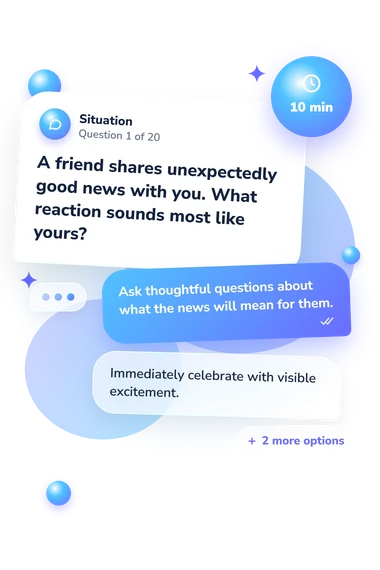
Each prompt offers four forced-choice responses to a social, creative, strategic, or demanding situation. The closest option creates a profile across five dimensions.
Scoring converts responses into five results with lower, middle, and higher bands. Since point contributions are unstated, read the output as a relative pattern rather than reverse-engineering options. The strongest result leads interpretation; near-ties should be read together by comparing the situations behind them.
Conceptually, the questionnaire overlaps with the Big Five Aspect Scales from DeYoung and colleagues, and Goldberg provides broader Big Five context. This is conceptual, not a direct adaptation or standardized administration. Wang, Luo, and Liu's forced-choice scoring offers relevant context but does not validate these custom scales.
The result offers a playful answer to who you might be as an anime girl, making this a quiz about you as an anime girl that links the profile with a fictional character style. Results can shift with mood, recent experiences, and self-perception; the displayed bands are categories for this questionnaire, not clinical cutoffs.
- DeYoung, Colin G., Lena C. Quilty, and Jordan B. Peterson. "Between Facets and Domains: 10 Aspects of the Big Five." Journal of Personality and Social Psychology 93, no. 5 (2007): 880-896. 10.1037/0022-3514.93.5.880
- Goldberg, Lewis R. "An Alternative ‘Description of Personality’: The Big-Five Factor Structure." Journal of Personality and Social Psychology 59, no. 6 (1990): 1216-1229. 10.1037/0022-3514.59.6.1216
- Wang, Shan, Fang Luo, and Hongyun Liu. "The Conventional and the IRT-based Scoring Methods of Forced-Choice Personality Tests." Advances in Psychological Science 22, no. 3 (2014): 549-557. 10.3724/SP.J.1042.2014.00549
Updated: