
10 Amendments Quiz
How the Scales are Structured
Who Usually Takes This Test?
See How You Compare
Below is a preview of how scores are typically distributed across each scale.
Example Questions From the Test
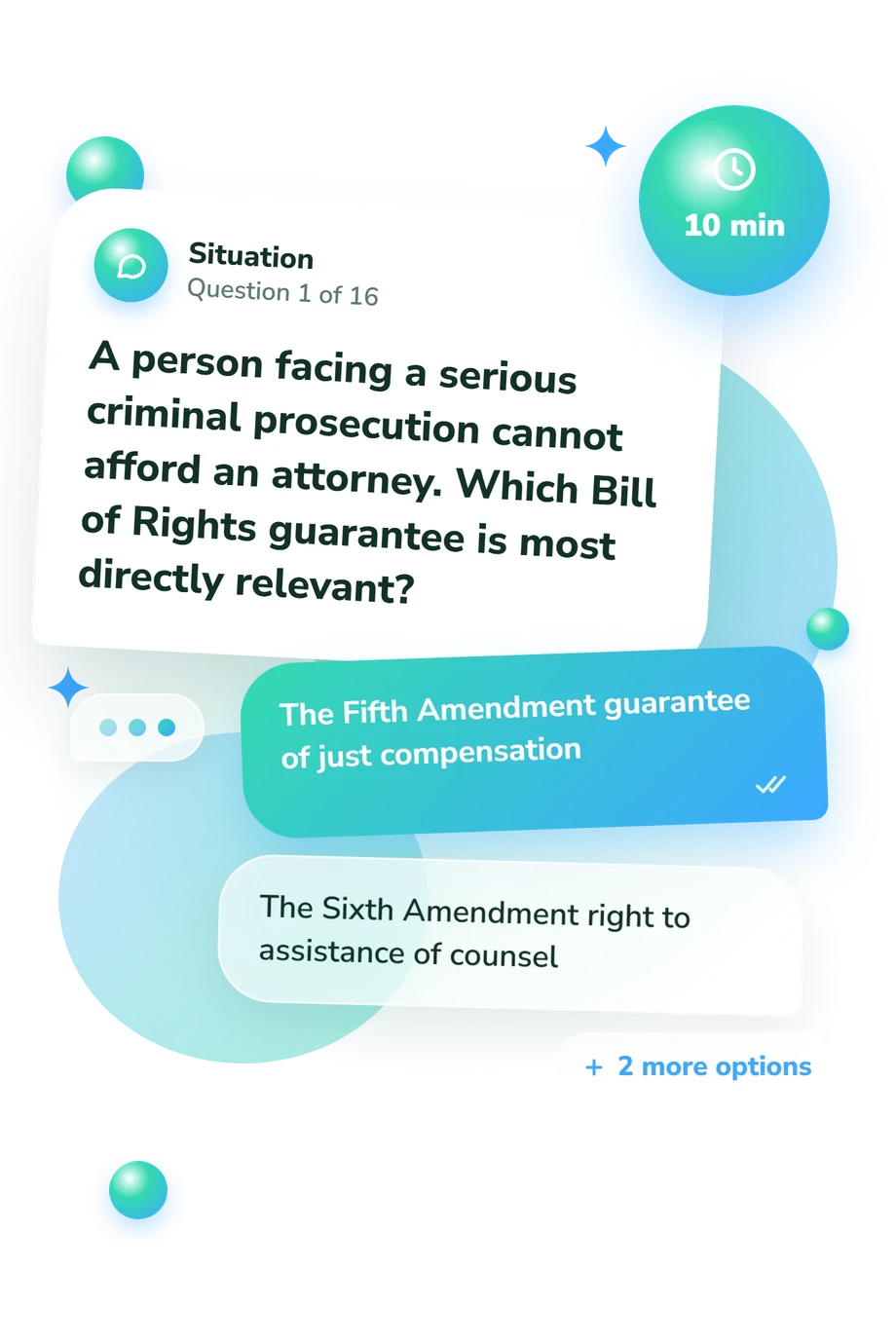
- The Fifth Amendment guarantee of just compensation
- The Sixth Amendment right to assistance of counsel
- The Seventh Amendment guarantee of a civil jury
- The Ninth Amendment recognition of unenumerated rights
- Proof beyond a reasonable doubt
- A prior civil judgment against the suspect
- Probable cause supported by oath or affirmation
- A unanimous vote by a grand jury
- The Second Amendment
- The Third Amendment
- The First Amendment
- The Ninth Amendment
10 Amendments Quiz - Description and methodology of the test
People seeking a practical introduction to constitutional rights can use this 10 amendments quiz to connect everyday legal situations with protections in the Bill of Rights. It suits students, civics learners, and adults who want to test amendment knowledge. The format emphasizes recognizing which amendment addresses a right or procedure. The exercise functions as a Bill of Rights quiz, offering a focused snapshot of current knowledge and suggesting topics for review.
What This Assessment Measures
This questionnaire measures recognition of protections in Amendments 1 through 10, not political views or general legal expertise. Its scenarios connect constitutional language with speech, religion, searches, criminal procedure, juries, punishment, property, and reserved powers.
The main themes are:
- Expression and religion identify speech, press, establishment, and free exercise protections.
- Search and procedure cover warrants, probable cause, counsel, confrontation, speedy trial, and self-incrimination.
- Trial, property, and punishment connect jury rights, takings, bail, excessive penalties, and reserved powers to the correct amendment.
Used as a first ten amendments quiz, these themes support structured civics review. The result is reported as 10 Amendments Knowledge, scored from 0-16: Foundation (0-6) means core concepts need review; Developing (7-12) shows solid working knowledge with distinctions to sharpen; Strong (13-16) indicates accurate command that applies to practical situations.
Methodology and Evidence Base
Each prompt presents a constitutional question or short legal scenario with four answer choices. Selecting the protection that fits most directly tests distinctions among related guarantees, rather than personal attitudes or open-ended self-report. The format is a knowledge check of recognition and application.
The multiple-choice design lets the ten amendments quiz assess whether the respondent can connect a fact pattern with the relevant amendment. Scoring reflects performance across keyed answers and is reported through the single knowledge scale; its bands show increasing command.
Its constitutional reference point is the Bill of Rights, ratified in 1791 and preserved by the National Archives and Records Administration. The questionnaire is conceptually consistent with the civic-knowledge approach examined by Coggins et al. (2020), but it is not a reprint or validated adaptation of that study. That research offers context, not norms for this online version.
No separate weighting, norms, reliability estimate, or standardization procedure is stated. Prior study, legal wording, attention, and current context may affect performance, so the result is an educational snapshot, not a complete measure of constitutional understanding.
- Coggins III, Porter Eldridge, Janet A. Heuer, and Michael A. Anderson. "A Crisis in Civic Conscience in the United States? Knowledge and Understanding of the U.S. Bill of Rights among a Group of Undergraduate Students Citizens of the United States." World Journal of Social Science, vol. 7, no. 1, 2020, pp. 12-24. 10.5430/wjss.v7n1p12
- National Archives and Records Administration. "Bill of Rights (1791)." National Archives, 1791.
Updated: