
Pokemon Type Matchup Quiz
How the Scales are Structured
Who Usually Takes This Test?
See How You Compare
Below is a preview of how scores are typically distributed across each scale.
Example Questions From the Test
- 4× damage
- 2× damage
- ½× damage
- 1× damage
- No damage because Ground is immune to Grass
- Half damage because Water resists Grass
- Quadruple damage because both types are weak to Grass
- Double damage because only Water is weak to Grass
- 2× damage
- 4× damage
- 1× damage
- ½× damage
Pokemon Type Matchup Quiz - Description and methodology of the test
Players who want to understand why an attack is super effective, resisted, or blocked can use the Pokemon Type Matchup Quiz to test practical reading of the modern main-series chart. It suits learners, casual battlers, and returning fans who want a clear snapshot of current knowledge rather than a judgment about overall battle skill. Turning familiar Pokémon matchups into focused practice makes this Pokémon matchup quiz useful for chart reasoning.
What This Assessment Measures
The questions examine attacking and defending type relationships, especially how dual typings combine. They ask you to identify weaknesses, resistances, immunities, neutral effects, and multipliers such as 2× and 4×. The result reflects modern main-series chart knowledge, excluding abilities, items, Terastallization, and other special effects.
Players learning the chart can use this pokemon type chart quiz to spot whether errors come from basic relationships or combined interactions. The result is organized into one knowledge scale and three descriptive bands:
- The Pokémon Type Matchup Knowledge scale (0-16) counts correct chart judgments.
- Type Chart Starter (0-6) shows recognition of some core relationships, with possible confusion about resistances or immunities.
- Developing Battler (7-12) shows many correct matchups but room to strengthen dual-type multiplier knowledge.
- Matchup Expert (13-16) shows strong command of single-type interactions, immunities, and combined weaknesses.
Methodology and Scientific Basis
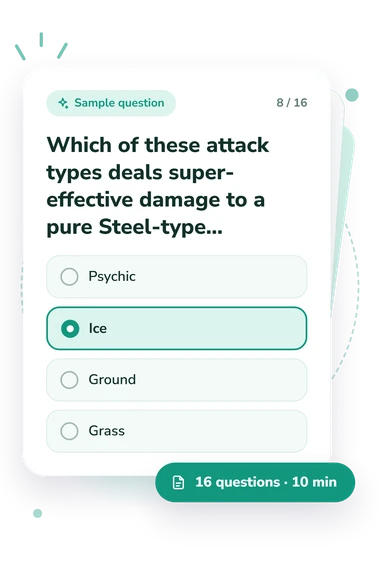
Each item presents a battle situation with four answer choices. You select one chart judgment: whether dual weaknesses produce 4× damage, an immunity produces 0×, or opposing effects produce another multiplier. The displayed score counts correct responses; its bands describe performance on these questions, not a population ranking.
That format also makes this a pokemon type effectiveness quiz: each judgment can be checked against the chart rather than broader battle strategy. The reference point is Stratton’s 2013 official guide, which documents the chart rules rather than a validated instrument. The official 2021 battle guide and 2013 game provide rule examples. The score is a raw correct-answer result with descriptive bands, so it shows accurate application of the type chart in this format rather than broader battle expertise.
Interpretation is strongest when you review matchups behind errors. A lower band may reflect unfamiliarity with dual types or immunity rules; a higher band indicates accurate recall in this format. Attention, reading mistakes, and prior game experience can affect results, which do not capture timing, team context, abilities, items, or excluded mechanics.
- Pokémon Company International and Stephen Stratton. Pokémon X & Pokémon Y: The Official Kalos Region Guidebook: The Official Pokémon Strategy Guide. Bellevue, WA: The Pokémon Company International, 2013. ISBN 978-0-8041-6199-2.
- Su Bin Ahn and Man-Je Kim. Identifying Key Strategic Factors from VGC Battle Log Data: A Statistical Approach. Smart Media Journal 14, no. 10 (2025): 54-62. 10.30693/SMJ.2025.14.10.54.
- The Pokémon Company International. Pokémon Brilliant Diamond and Pokémon Shining Pearl Trainers Guide: Pokémon Battling. The Pokémon Company International, 2021.
- Game Freak. Pokémon X and Pokémon Y. Nintendo 3DS video game. Nintendo, The Pokémon Company, and Creatures, Inc., 2013.